A Cockatoo Works out That It Is Standing on Its Own Problem

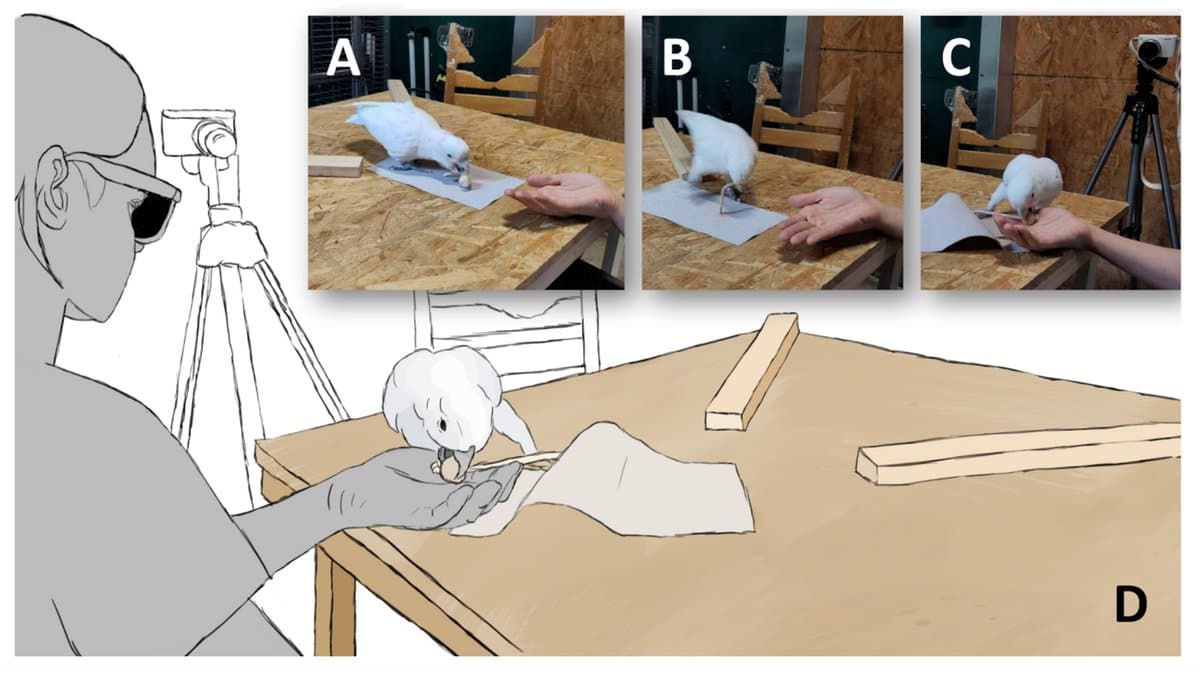
The bird picks up the ball, the way it has been taught to, and turns to hand it over to the person at the edge of the table. The cord pulls tight. The ball does not move, because the far end of the cord is fastened to the mat under the bird's feet, and the bird is standing on the mat. A second or two later the cockatoo steps off, and finishes the handover from beside it.
That sequence is the whole of an experiment published Sept. 17 in Scientific Reports by Paula Hundegger and colleagues at the Messerli Research Institute of the University of Veterinary Medicine Vienna. Fifteen Goffin's cockatoos took part, all of them living at the Goffin Lab in Goldegg, Lower Austria. The task is called the body-as-obstacle test, and no bird had ever been given it before.
For half a century the standard way to ask an animal what it knows about itself has been a mirror. Put a mark where the animal can see it only in its reflection, and watch whether it touches its own body. The test is powerful, but it is also narrow, because it works through the eyes. Parrots have generally failed it, Goffin's cockatoos included.
"Probably all animals have to represent themselves in one way or another," said Antonio J. Osuna-Mascaró, one of the study's authors, in a statement issued in German by the university. As the primatologist Frans de Waal argued, he noted, a monkey has to know whether a branch will take its weight before it lands on it. The mirror captures one dimension of that self-knowledge, how an animal looks, out of a range that also takes in smell, size, position and weight.
The body-as-obstacle task goes at the same question through action rather than vision. It was devised for human toddlers, who begin solving problems of this shape in their second year, around the age at which mirror self-recognition appears. Since then it has been given to Asian elephants, to dogs, and to chimpanzees and gorillas. Rachel Dale, the third author on the cockatoo paper, co-wrote the 2017 elephant study.
The cockatoos already knew how to pass an object on command, so the experiment could be built on a routine they were comfortable with. In the test condition a small wooden ball was tied by a cord to the mat the bird stood on. Pulling the ball moved the mat, and the bird's own weight held the mat in place. The only way through was to step aside. Across three sessions the birds did exactly that in 97.8% of test trials. When the ball was loose and could simply be picked up and handed over, they stepped off in 0.7%.
The second control is where the design earns its keep. The cord was anchored to the table through a concealed hole, so the ball resisted a pull just as it did in the test, but stepping off the mat relieved nothing. The birds left the mat in 39.1% of those trials, well above the loose-ball rate and well below the test rate. Hundegger and colleagues are careful with that middle figure. The condition was unsolvable by design, so it asked a bird to abandon an attempt rather than complete one, and that difference in difficulty probably lifted the rate. Reading the control also meant deciding when a bird had given up, from behaviors defined in advance but still open to interpretation.
Whatever the birds were doing, they were not building it up over time. The statistics were run on the first session alone, precisely to check that, and the three conditions still came apart cleanly. Adding session to the model made no difference. "The solution often unfolded in a very clear sequence," Hundegger said in the university statement. "A cockatoo picked up the ball, felt the resistance, stepped off the mat and completed the handover. We saw this pattern in the very first session."
One obvious alternative had to be closed off first. A cockatoo might step off a mat simply because the mat is moving underneath it. So before the experiment each bird was set a different job, dropping a glass marble into a cup, while the experimenter pulled the mat out from under its feet. The birds stayed standing in 179 of 180 of those trials. The pre-test did not reproduce the exact pull and force of the real task, so the direction of the pull cannot be ruled out entirely. That the birds treated the two attached conditions so differently makes it unlikely to be the whole story.
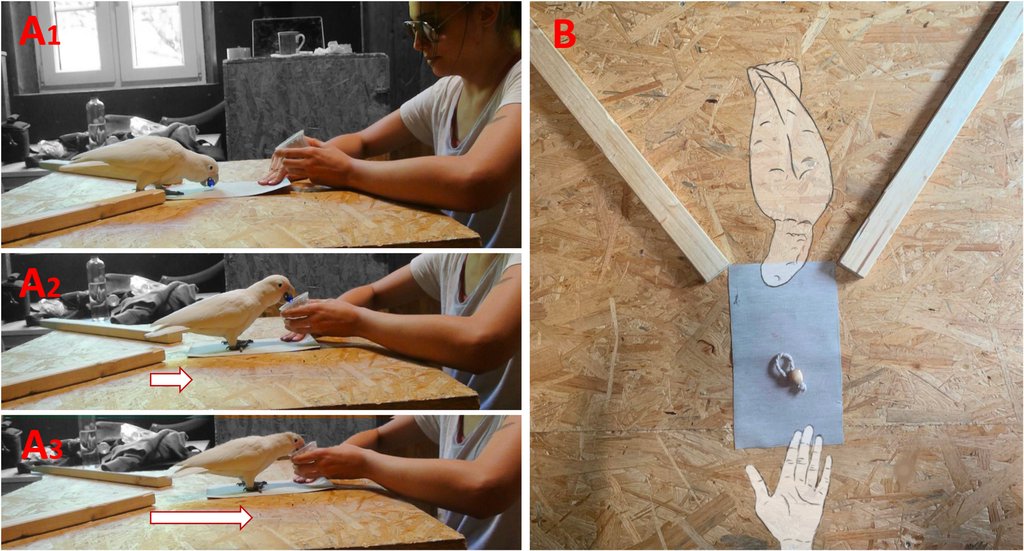
What the study establishes is narrower than a headline about self-aware parrots, and the authors say so themselves. Stepping off the mat is not the mirror test passed by another route, and it is no evidence of a human-like, reflective sense of self. It says that the birds distinguished a problem their own body was causing from one it was not. The finding rests on 15 birds at a single lab, all of them veterans of earlier cognition experiments in the same rooms.
There is a wild counterpart, and the paper points to it: sulfur-crested cockatoos in Sydney, filmed opening household bins by stepping off the lid and onto the rim, moving their own weight out of the way. How the birds learned to do that is not known.
"We are learning how self-representation can be studied in very different kinds of minds," Osuna-Mascaró said. "The emerging picture is modular: different species draw on the forms of self-knowledge that matter most for their way of moving and acting." Rather than treating self-awareness as a single threshold an animal either crosses or does not, the question becomes what information animals use about themselves, in what circumstances and to what end. A bird stepping off its own mat is one small answer.
Sources
- Scientific ReportsPeer-reviewed
- idw-online.de