Every Cell Agrees on How to Switch a Gene on. Almost Nothing Agrees on How to Switch One Off

Pick any two eukaryotes far enough apart and the differences are almost comic. A human being and Acanthamoeba castellanii, a soil amoeba that spends its life eating bacteria in damp earth, last shared an ancestor somewhere around two billion years ago. They do not share a body plan, a cell count, a life cycle, or a way of feeding. What they do share, it turns out, is a punctuation system.
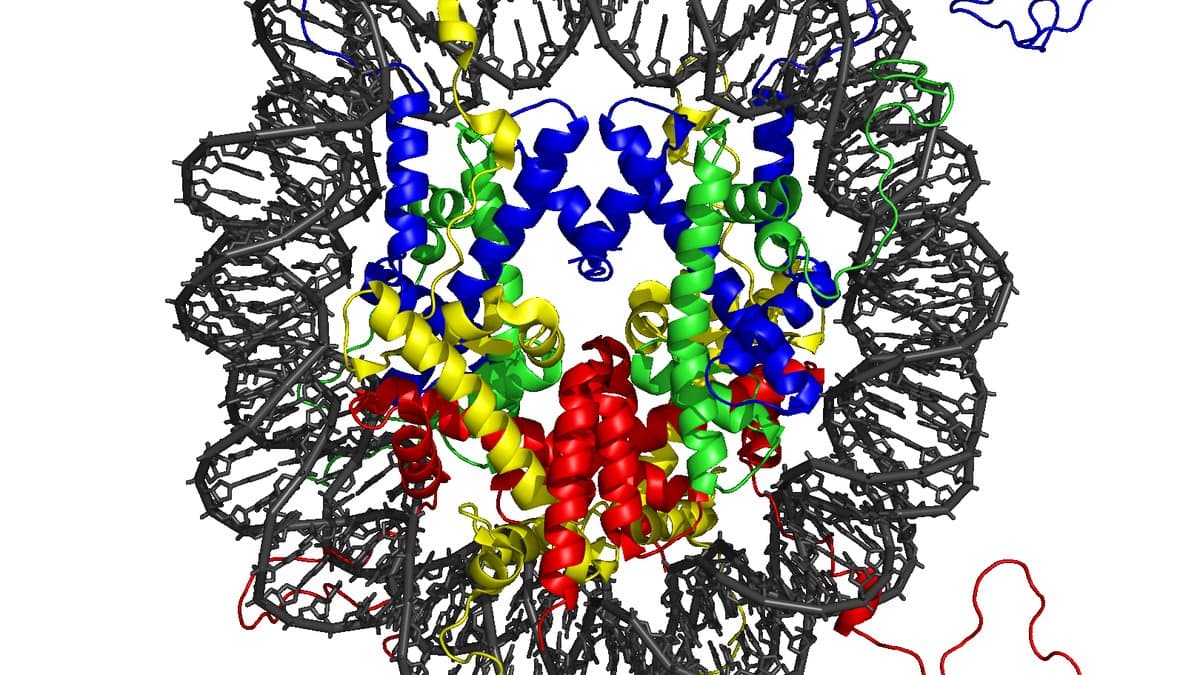
Both of them mark an active gene the same way. Wrap DNA around the histone proteins that package it, then tag those histones with a methyl or an acetyl group in a particular pattern, and you have written read this one in a script that has not been meaningfully revised since before animals existed. The amoeba writes it the same way. So does a sea anemone, a moss, a yeast and a ciliate.
The instruction for do not read this one is where the agreement collapses.
That asymmetry is the finding of "Diversity and evolution of chromatin regulatory states across eukaryotes", which nine researchers led by Cristina Navarrete, with senior author Arnau Sebé-Pedrós of ICREA and the Centre for Genomic Regulation in Barcelona, published in Nature Genetics on August 3. The peer-reviewed version is what is new. The result itself has been sitting in the open on bioRxiv since March 2025, under the identical title, for about 16 months before a journal put its name to it.
The species nobody had profiled
Chromatin biology has a sampling problem, and it is the same one that afflicts most of genomics. The techniques were built on a handful of laboratory organisms, refined on them, and then largely stayed there. Fruit flies, mice, Arabidopsis, budding yeast, human cell lines. Whole branches of the eukaryotic tree have never had their histone modifications mapped at all, not because they are uninteresting but because the assays demand more starting material than a culture of some obscure protist is willing to give you.
Navarrete and colleagues got around that with a method they call iChIP2, a combinatorial indexing approach that profiles several histone modifications at once and works from very little input. That let them run 12 species, chosen for phylogenetic spread rather than convenience: two amoebozoans, including A. castellanii and the slime mould Dictyostelium discoideum; the freshwater amoeba Naegleria gruberi; the marine predator Bigelowiella natans; the alga Guillardia theta; the ciliate Tetrahymena thermophila; two fungi; an ichthyosporean; two plants; and the sea anemone Nematostella vectensis.
Several of those lineages — discobans, rhizarians, cryptomonads, ichthyosporeans — had never been examined this way before. "It's the power of looking at non-model organisms to see how evolution has brought about many differing solutions," co-author Sean Montgomery said in the CRG announcement.
One grammar for yes, many for no
At active promoters and across the bodies of genes being transcribed, the states the team found were, in the paper's own word, highly conserved. The same euchromatin signature turns up in species separated by the whole depth of eukaryotic history. "The cell's instructions for activating genes are essentially the same in a human, a sea anemone and a soil amoeba," Sebé-Pedrós said.
Silenced regions were another matter. Across the 12 species the team found diverse configurations of repressive heterochromatin, built from different combinations of marks: H3K9me3 in some lineages, H3K27me3 in others, various methylations of H3K79 in others still, and mixtures. Silencing is done, but there is no shared way of doing it.
The two-billion-year figure comes from the age of LECA, the last eukaryotic common ancestor, the cell from which everything with a nucleus descends. It is the source's own number, not a calculation performed here, and it is what makes the conservation striking: the activation code has survived essentially untouched across a span that produced fungi, plants, ciliates and us.
The authors' explanation, and its limits
Why would one half of the system freeze and the other half churn?
The explanation the authors offer is conflict. Repressive chromatin does not only shut down the cell's own genes; a great deal of it is aimed at transposable elements, the parasitic stretches of DNA that copy themselves around a genome and make up roughly half of ours. Those elements evolve fast, and anything evolving fast to escape suppression forces the suppression to change with it. Activation, under this reading, has no adversary and so has no reason to move. Silencing has one, permanently, and so it never settles.
That is an interpretation, and it should be read as one. The paper demonstrates that repressive states are diverse and that they sit on transposable elements. It does not run an experiment that tests whether the diversity was caused by the conflict. The authors describe it as a genomic arms race; the data are consistent with that, and consistency is not proof.
Two other things are worth holding onto. The result is 16 months old in the open literature, and no independent group has yet published its own version of it: the coverage so far traces back to a single announcement from CRG. And the direction of the finding is not a surprise to specialists, which is a point in its favour rather than against it. That active promoters look alike everywhere and heterochromatin systems differ sharply between lineages was already the impression from scattered prior work. What the survey adds is breadth, and evidence from organisms nobody had asked.
The practical consequence is a warning about extrapolation. A rule about gene repression learned in a mouse may hold in a mouse, and in nothing else. The rule about activation is likelier to travel.
Sources
- Nature GeneticsPeer-reviewed