A Texas Fossil Suggests Insects Waded Ashore Rather Than Leaped

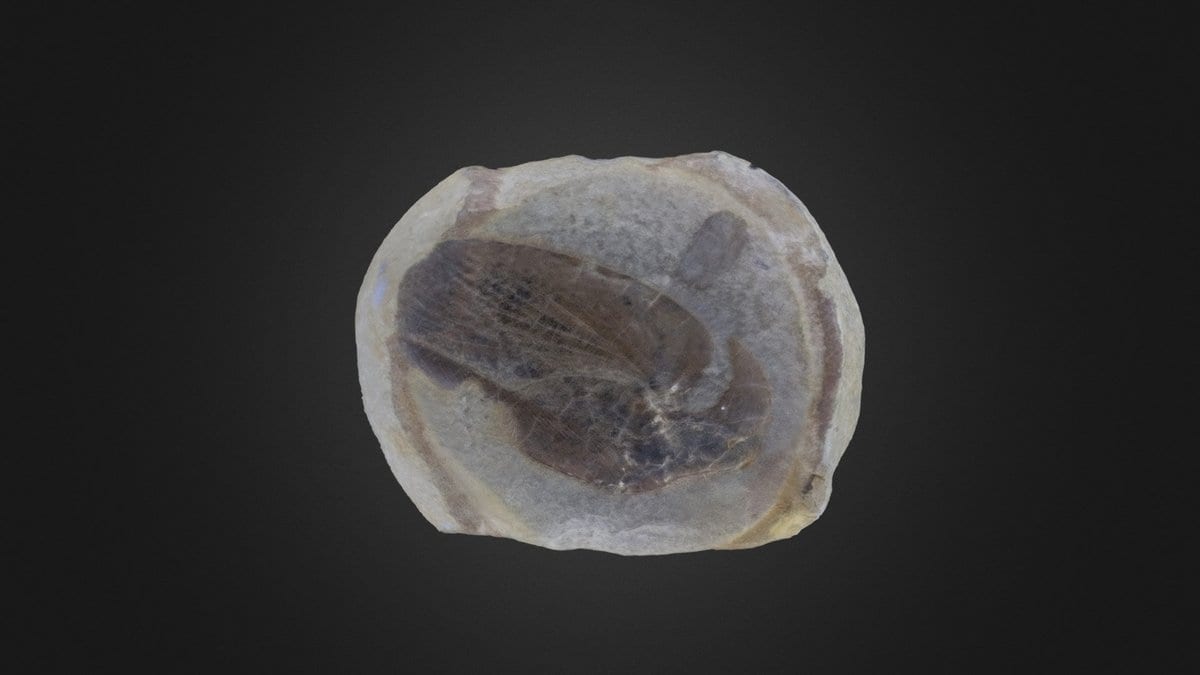
Erik Tihelka was leafing through a secondhand Russian paleontology textbook when a line drawing stopped him: a small, many-legged animal from a shale bed in West Texas, labeled a crustacean. He tracked down the original papers, and the identification still did not sit right. So he went to the San Diego Natural History Museum, where the specimen itself, collected in 1985 north of Big Bend National Park, had been lying in a drawer. At first glance, he told Science News, it looked like little more than a black smudge.
Polarized light filters cut the glare off the rock and sharpened the contrast, and the smudge resolved into anatomy: a thorax in three parts, a long abdomen, whiplike antennae, a stiff tube for laying eggs, a long central tail flanked by shorter ones, and three pairs of walking legs. Those are insect features. Then there were the others: short, segmented legs running the length of the belly, the rear ones flattened into grooved paddles. Nothing alive today wears that combination.
The animal is now Chosha praecursor, described on August 26 in Nature by Tihelka, a doctoral researcher at the University of Cambridge, Chenyang Cai of the Nanjing Institute of Geology and Palaeontology, and colleagues. It came out of the Tesnus Formation in western Texas and dates to roughly 324 million years ago. The name joins the Navajo word for insect, ch'osh, with the Latin praecursor, predecessor, after a creation story in which a first world was peopled by insectlike beings. Tihelka put the total at 24 legs in an interview with Science News; the institute's release describes the specimens as adult females about 32 millimeters long.
Just outside the group that holds every insect alive today
That mix, insect equipment plus limbs no insect keeps, is why the authors stop short of simply calling it an insect. Their phylogenetic analysis recovers Chosha as a hexapod and strongly favors placing it as an early-diverging insect. Those are two different strengths of claim. The analysis could not rule out more than one position low in the insect tree; what it could rule out was the older reading, that the animal sits among the crustaceans.
The distinction the paper leans on is between a crown group and a stem group. The crown group of insects is the group that contains every insect alive today, plus their common ancestor. A stem group is everything that branched off before that ancestor and left no living descendants: related, sharing a great deal of anatomy, and outside. Chosha and its kin, in Science News's plain rendering, all sat just outside the group containing every insect alive today, with crustaceans a distant branch away. That is not a hedge. It is a position on a tree, and it is exactly where a transitional form should sit.
What the word "uncontested" is defending against
Alongside Chosha, the team revised three other puzzling fossils: Leverhulmia, from the Early Devonian of Scotland, and two undescribed Carboniferous specimens from the Mazon Creek beds of Illinois. All four, they argue, belong to one early insect stem clade. The claim they make for that group is worded with care, and the wording is the substance: together, these stem-group fossils represent the earliest uncontested insects. Plural, collective, stem-group: not a superlative for Chosha alone.
That caution has a history, and the paper's own reference list keeps it. Rhyniella, from the Rhynie chert and long treated as the earliest known insect, was reassessed in Nature in 1981. Devonohexapodus bocksbergensis, described in 2003 as a marine hexapod from the Devonian, was later synonymized out of existence. Strudiella devonica, announced in Nature in 2012 as a complete Devonian insect, drew a formal challenge the following year, and another, arguing it was more likely a myriapod. Each was, in its moment, the oldest insect.
William Shear, a retired paleobiologist at Hampden-Sydney College in Virginia, is a good witness to that history: he wrote the Nature commentary that greeted Strudiella, under the title "An insect to fill the gap." On Chosha he is warmer. "It opens a lot of doors to the study of insect evolution," he told Science News.
Molecular clocks put the divergence of hexapods from their marine crustacean relatives far back, near the Cambrian–Ordovician; undisputed hexapod body fossils appear in the Rhynie chert about 405 million years ago, and unambiguous insect fossils do not become abundant until the Late Carboniferous. The Chinese Academy of Sciences release announcing the work calls the interval an 80-million-year gap, which is the field's standard framing of it. The paper names the "notorious hexapod gap" without attaching a number, and it is just as careful about what the four fossils do to it: they partly reconcile the incongruence between molecular clock estimates and the fossil record.
How 24 legs became six
Modern hexapods walk on six legs, all of them on the thorax, and the abdomen carries almost nothing. Paleozoic stem insects, the authors note, commonly kept segmented abdominal limbs, and Chosha is a snapshot from the middle of that reduction. The reduction looks less like losing a capacity than like reining one in. The paper cites work by Barbora Konopova and Michael Akam showing that in a living springtail, Orchesella cincta, the Hox genes Ultrabithorax and abdominal-A specify three different kinds of abdominal appendage. The machinery for putting appendages on an abdomen is still present in a hexapod today. What changed across the Paleozoic was what that machinery was permitted to build.
Where Chosha lived is the softer of the two claims, and the paper says as much. The abdominal appendages are described as gill-like, a statement about their shape rather than a demonstration that the animal breathed through them, and they suggest a semiaquatic mode of life in at least some stem-insects. The rock is part of the argument: the institute's release places the host strata in near-shore, shallow-water delta and coastal settings. What the paddles were for stays open. Science News floated two options, that they helped the animals swim or scuttle through muddy shallows, and left it there.
Other lineages had already been caught mid-crossing
Other Paleozoic gaps have narrowed the same way, and the paper's opening citations say so. A study of aquatic stem-group myriapods closed a gap between molecular divergence dates and the terrestrial fossil record for millipedes and centipedes. Another from the same year reported air breathing in an exceptionally preserved sea scorpion 340 million years old. In both, the missing chapter turned out to be occupied by animals that were neither fully marine nor fully terrestrial, and that had been hard to recognize as either. Insects were the conspicuous holdout.
The character matrix and the analysis files are deposited openly at Zenodo, so the placement can be re-run and argued with rather than taken on faith. Given the record of oldest-insect claims, that is the more useful outcome. The route to it is repeatable, too, and cheap. No new dig produced Chosha. A drawer, a secondhand textbook, and a pair of polarizing filters did.