Wild Capuchins Pick the Stone Someone Else Already Used, Even When It Is the Worse Tool

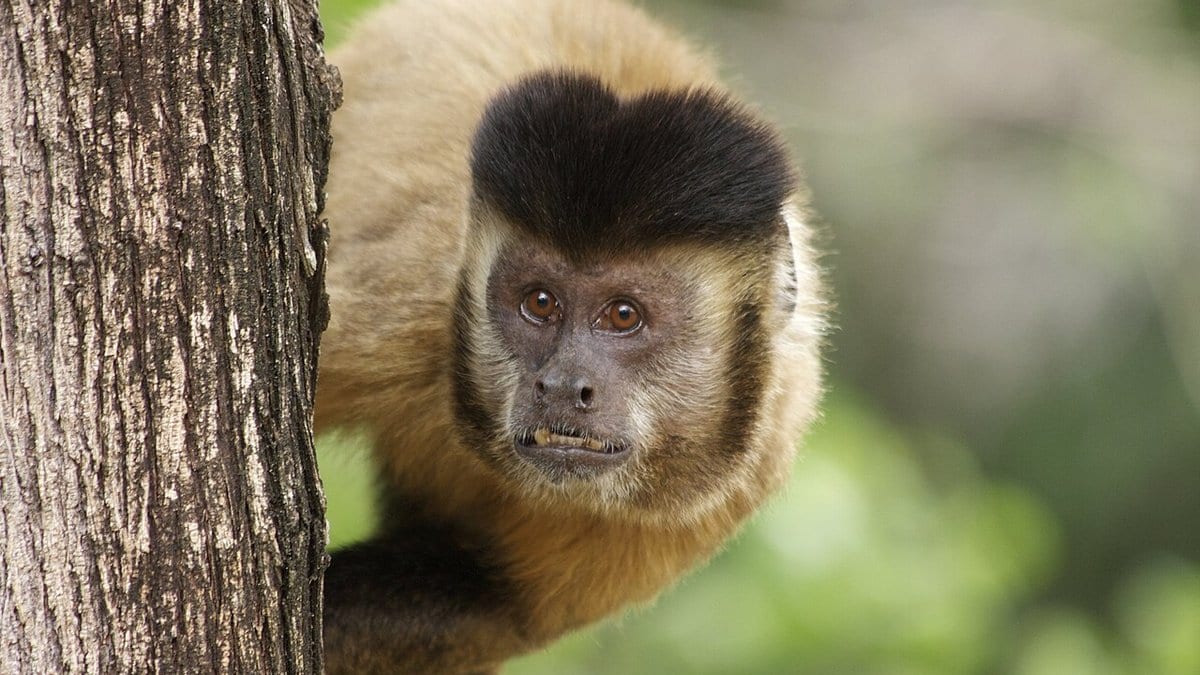
In the Brazilian savanna a capuchin monkey climbs onto a flat block of stone with a palm nut in one hand. It sets the nut down, picks up a second stone, raises it above its head with both arms, and brings it down. The nut usually survives the first blow. Sometimes it takes a dozen. Everything in that sequence depends on the two rocks being right, and the monkeys know it: this is a species that walks past perfectly ordinary stones to fetch the one it wants.
What nobody could easily separate was where that knowledge comes from. A capuchin might judge a rock by hefting it, or it might be following the choices of the monkeys around it, and in the wild the two arrive tangled together. An experiment published in Proceedings of the Royal Society B on Aug. 5 pulls them apart. Johanna Henke-von der Malsburg, Lydia Luncz and colleagues at the Max Planck Institute for Evolutionary Anthropology in Leipzig, working with Tiago Falótico and Henrique Rufo of the Neotropical Primates Research Group and the University of São Paulo, ran a set of choice tasks with two wild populations of bearded capuchins, Sapajus libidinosus.
The first task offered stones that had never been used, made of materials differing in hardness. Both populations sorted them the way a toolmaker would: harder stones became hammers, softer ones became anvils. That result is not new in itself, and it was not meant to be. This part of the experiment is a control, confirming the animals can read a stone's physical properties before the interesting condition arrives.
That baseline goes back a while. Elisabetta Visalberghi's group reported in 2009 that wild bearded capuchins select effective stone tools, and a later study found the animals judging hammerstones by mass and factoring in how far they would have to carry them, favouring rocks over a kilogram for the toughest palm nuts. The new experiment needed that foundation to be solid, because the whole design turns on what happens when something overrides it.
Henke-von der Malsburg described it in the institute's announcement, translated from the German: what surprised the team was "how consistently the monkeys distinguished between the different types of stone on the basis of hardness alone."
The other two tasks introduced history. In one, the monkeys chose between a completely fresh cracking site and one strewn with worn stones and broken shells. In the other they chose directly between an unused stone and a used one. The pattern reversed. Given a stone that showed signs of previous use, both populations preferred it regardless of what it was made of, and the material judgment they had applied so consistently a moment earlier stopped governing the choice.
The paper's reading is that tool selection here is shaped by indirect social cues, and the word doing the work is indirect. No monkey had to watch another monkey crack a nut. The information sat in the object, in the pits and scratches that percussion leaves behind, and it was available to any animal that came along afterwards. Luncz called it a striking example of how social information can override an individual's own assessment of physical properties.
There is a plainer explanation and the paper does not close it off. A stone that has been battered and survived is, by that fact, a stone that works. Percussive damage is evidence about the rock as much as about the monkey who used it, so choosing the scarred one may be shrewd materials testing rather than a social signal. Distinguishing the two would take a stone that carries convincing marks without ever having done any work, and that is not one of the three tasks described here. The abstract's phrasing, that the monkeys preferred used stones "regardless of material properties", is careful. The institute's announcement goes further and says they took stones that were mechanically inferior. Those are not quite the same claim, and the first is the one the published abstract supports.
One thing a reader cannot check is scale. Neither the paper's abstract nor the institute's announcement gives the number of monkeys involved, the number of groups, or how many trials each population ran. Two independent populations behaving the same way is the design's real strength, and it is genuinely harder to explain away than a single troop's habit. Without the counts, though, there is no way to judge how much statistical weight that agreement carries.
The reason a primatologist's stone-choice experiment reaches beyond primatology is what it implies about reading the deep past. Archaeologists working at early hominin sites confront scatters of battered cobbles and have to decide what the scatter records. The Max Planck team's suggestion is that the marked stones themselves may have drawn hominins back to particular places, so that, as their announcement puts it, the archaeological landscape functioned as a kind of external memory.
The practical consequence is easy to state. If a used tool attracts the next user simply by looking used, then a cluster of worn stones at a two-million-year-old site is not by itself proof that anyone taught anyone anything. It might record a skill being handed down. It might record a rock that kept catching the eye. The capuchins of the Brazilian savanna have just made that a question an archaeologist has to answer.