The Brain Makes Thousands of Proteins the Reference Catalog Never Listed

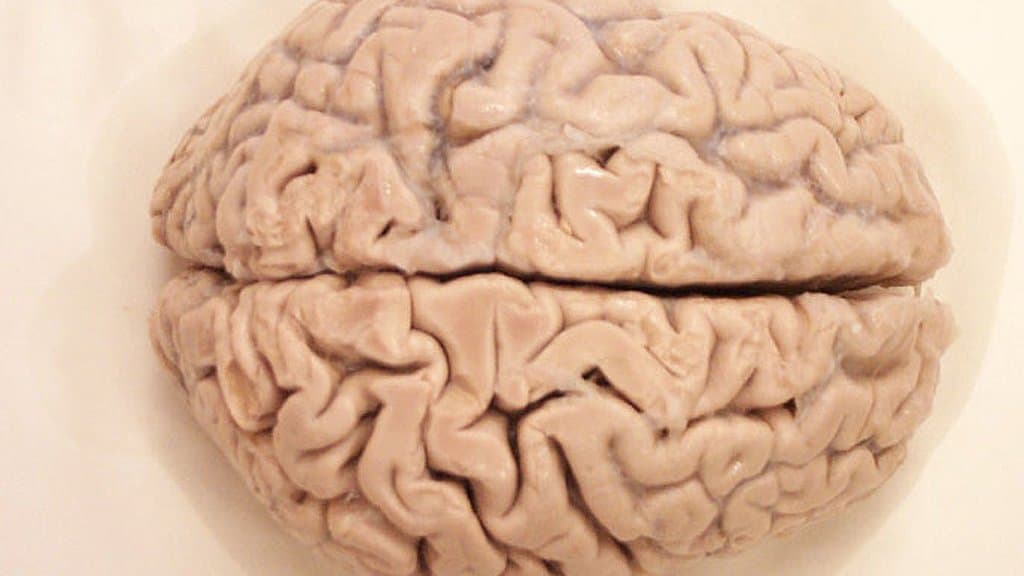
Search aged human frontal cortex for the protein the MKKS gene is known for, and the mass spectrometers come back empty. Not one fragment of the large protein that gives the gene its name and its link to a rare developmental disorder. What the machines found instead, more than a thousand times over, was a different protein read from the same stretch of DNA: a stub 63 amino acids long, logged in the unreviewed tier of the human protein catalog, where entries sit waiting for someone to confirm them.
That locus is one entry in an atlas of the human frontal cortex published on September 14, 2026, in Nature Aging by Brendan Miller, Alan Saghatelian and colleagues at the Salk Institute for Biological Studies. Its subject is microproteins: proteins of about 150 amino acids or fewer, small enough that the reference map of human proteins has never had much room for them.
The reason is mostly technical. Mass spectrometry, the standard way of taking inventory of the proteins in a piece of tissue, chops them into pieces and weighs the pieces. A short protein yields few pieces, sometimes only one usable one, and a few is close to invisible. The genes are awkward as well: many of these short reading frames sit inside, above or below the reading frame of a larger protein on the same transcript, so ordinary RNA sequencing counts both together and reports a single gene.
Miller's team worked through mass spectrometry measurements of 610 frontal cortex samples from the Religious Orders Study and the Memory and Aging Project, two long-running cohorts of older adults who agreed to donate their brains. That search logged 4,321 microproteins. Of those, 3,217 are missing from the reviewed section of UniProtKB, the curated tier of the standard protein catalog. The team then put 3,001 of them through PROSIT, a deep-learning model that predicts what a fragment pattern should look like, and compared prediction against measurements: 1,067 matched strongly.
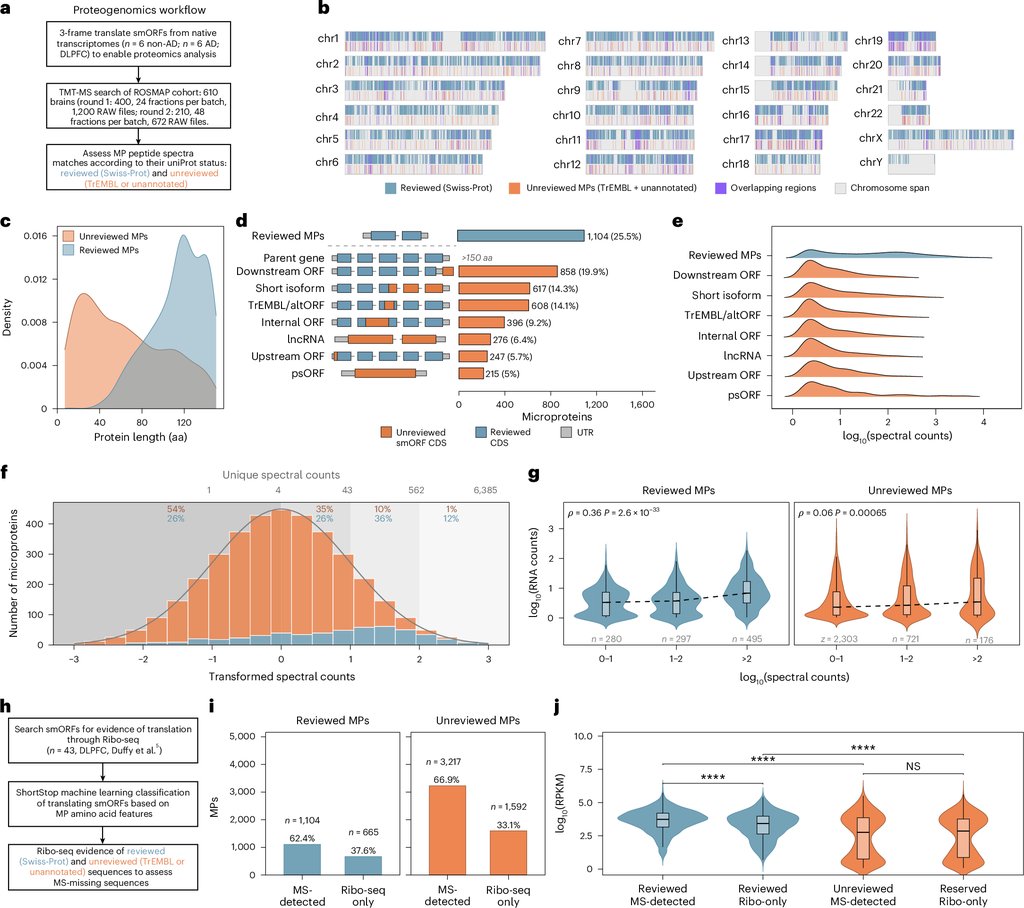
That last figure is the headline number, and it comes with an asterisk the authors put there themselves. Of those detections, 814 rest on a single observed peptide, below the two-peptide rule conventional proteomics uses to call a protein present. The paper argues the rule was never built for molecules this short, since most microproteins cannot physically yield two unique fragments, and backs the single-peptide calls with ribosome profiling, which reads the stretches of RNA the cell's protein-building machinery is actually sitting on. The position is defensible and openly stated. It also means the number counts confident detections, not proteins anyone has characterized.
The Alzheimer's half of the work is narrower than the atlas. On 480 samples sorted by autopsy into three groups (no Alzheimer's damage, damage without symptoms, damage with dementia), the team compared the first group against the last. Under its strict model, 22 unreviewed microproteins clear the usual statistical cutoff; under a looser model, judged at a more permissive one, 258 do. The differences are small, and they run in both directions: some entries sit higher in Alzheimer's samples and some lower.
MKKS is where the atlas stops being a list. The small protein, which the team calls micro-MKKS63, sits about 4% lower in donors who had dementia than in donors with no Alzheimer's damage, a real difference and a modest one; transcripts carrying the gene's main reading frame do not move at all. Genes whose expression tracks the small protein skew heavily toward mitochondrial biology, the cell's energy supply, and that is what sent the team to the bench.
Using CRISPR, they cut the small reading frame out of HMC3 cells, an immortalized line of human microglia. Microglia are the brain's resident immune cells; the edit left the larger reading frame intact. Two independently generated knockout lines both burned less oxygen than controls: baseline consumption, the share of it used to make ATP, and the maximum the cells could reach all fell. Spare capacity, a fourth measure, dropped significantly in only one of the two lines. The measurement is of a cultured cell line, not of brain tissue.
Two other entries got a lighter test. Microproteins encoded at two actin pseudogenes each reduced the amount of filamentous actin in a cell, but the team produced that effect by supplying extra protein rather than removing the native one, which is weaker evidence. The authors say why they took that route: pseudogene sites often resist CRISPR editing, so what the protein ordinarily does is unresolved. For the rest of the atlas, there is no function claim at all. An entry records that a molecule exists, and where.
That is the point of a resource paper. The atlas is browsable, the analysis code is on GitHub and the raw mass spectrometry data are deposited in a public repository, so another lab can pull a sequence and go test it. Three of the authors, Miller, Eduardo Vieira de Souza and Saghatelian, have filed a patent related to ShortStop, the machine-learning classifier the study used to sort translated reading frames, and Saghatelian is a cofounder and shareholder of Exo Therapeutics; the paper declares both.
"We might be actually missing a whole layer of biology by overlooking these microproteins," Bahareh Ajami, a neuroimmunologist at Cedars-Sinai Medical Center who was not involved in the study, told Nature's news team.
Sources
- Nature AgingPeer-reviewed
- nature.com
- salk.edu
- huggingface.co