A Gene in Human Neurons Never Stopped Jumping

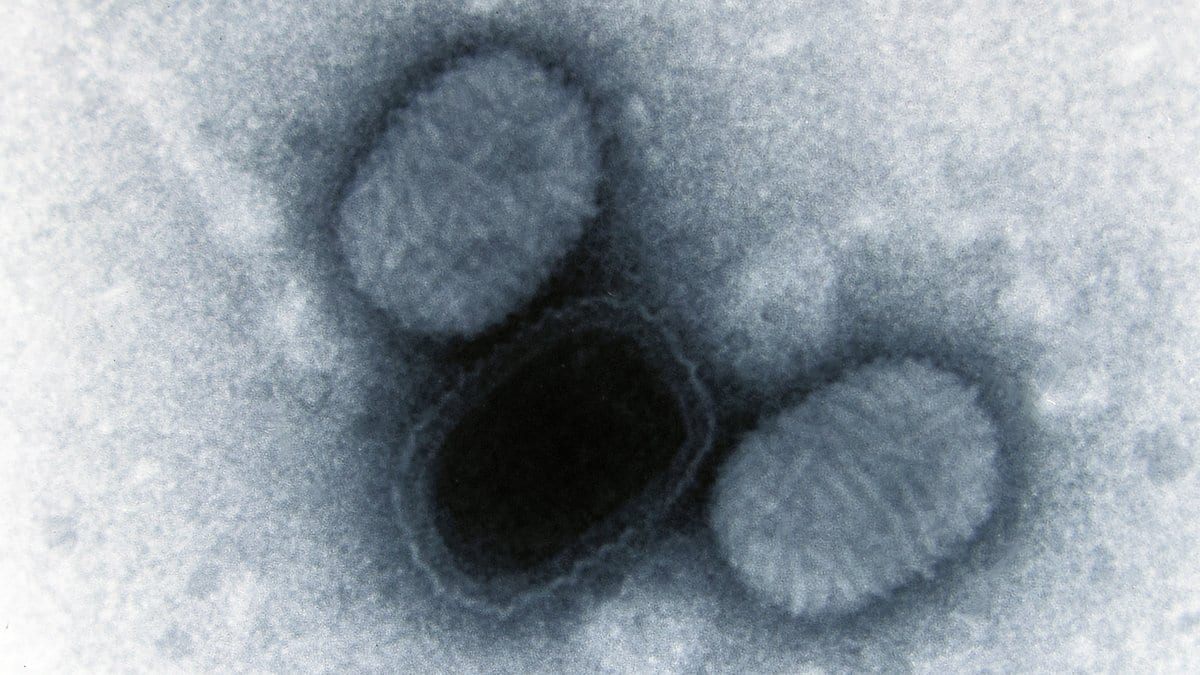
In 2010, in a lab at the University of Texas at Arlington, a postdoctoral researcher named Cheng Sun was combing viral genomes for stretches of human DNA, and found some. Two copies of a human gene were sitting inside molluscum contagiosum virus, a poxvirus that causes small, largely harmless warts and infects nobody but us. Sun and the two other scientists whose lab it was, Cedric Feschotte and Ellen Pritham, understood that the find mattered. They did not write it up, and the project sat for 16 years.
Feschotte, who has since moved to Cornell, ran into Sun at a conference, where Sun mentioned that he and his graduate student Pu Gao had revived it. "I can't believe we never got scooped on this," Feschotte said, in Cornell's account of the study. The paper that came of it, published Sept. 24, 2026, in Science, is not really about a stowaway in a virus. It is about the gene: BC200, a short RNA that codes for no protein, is made in quantity by human nerve cells and, the paper reports, has never stopped moving.
BC200 began as a transposon, a piece of DNA whose business is getting itself copied into new places. Its ancestor was an Alu element, one of the short repeated sequences scattered through primate genomes; a 1993 paper characterized the gene as the product of a single one of them. Then, roughly 40 million years ago, in a common ancestor of the anthropoid primates, meaning the monkeys and apes, it was co-opted into cellular work. Cornell's account fills in what that work is thought to be: transposons make up about half of human DNA and almost all of it is inert, with only a small number still mobile. Evidence suggests BC200 helps regulate translation in neurons, the step at which a cell reads a gene's transcript and builds a protein, and its physiological role is poorly understood.
Normally that is where a transposon's story ends. "Genes that come from transposable elements and that are repurposed for cellular functions are typically no longer transposable," Feschotte said. "BC200 was itself created from a mobile element but has retained its mobility and yet it is also clearly serving a cellular function. Somehow evolution hasn't been able to untangle these two things."
BC200 kept both. Pu Gao, Sun's graduate student at Capital Normal University in Beijing, is the paper's first author; Sun, Pritham and Feschotte are credited as equal contributors. Across the anthropoid genomes the four compared, the gene behaved as what they call a master source: one active copy that went on spawning hundreds of lineage-specific insertions through anthropoid evolution, each set appearing in a single lineage after it had split from the rest. The copying is not BC200's own doing. The authors attribute it to LINE-1, or L1, an element still active in people: its enzymes copy another sequence's RNA back into DNA and drop the copy somewhere new. BC200 also turns up at low levels in sperm and eggs, Cornell's release notes, which is what lets a new insertion be inherited. Some insertions are recent enough to vary from person to person. The authors report sites that differ across the human population, including ones carried by a single individual, which points to transposition that has not stopped.
The copies in the virus are the most arresting part of the paper and the thinnest part of its evidence: two insertions in a single virus genome, with the route inferred from the sequences rather than caught happening. The authors say the transfer was likely L1-mediated as well, and they date it no more precisely than modern human history. Molluscum contagiosum virus infects only humans, and skin cells are the only cells known to be infected, so the team suspects the jump happened in skin. A figure comes from Cornell's announcement of the study, which bounds a period rather than dating an event: it puts the two jumps within roughly the last 100,000 years, since the era of Homo sapiens.
Transposable elements escaping into viruses is not itself new. In the late 1980s, researchers working with cultured moth cells watched a transposon move into a baculovirus, which infects insects. "This was to my knowledge the first clear example of a transposon escaping its host genome to hop onto a virus," Feschotte said, "which led to the idea that perhaps if viruses can cross species boundaries, then you may have a mechanism for the spread of these elements across species." In 2007, a group in Japan found a transposable element lodged in a rodent poxvirus, one that had come from a snake. "I think [at the time] it was the first and only case of a clearly vertebrate transposable element escaping into a virus in the wild," Feschotte said.
What is new here is the passenger. Cornell's announcement states that no one until now has observed a human gene that is both mobile and required for bodily functions; that superlative belongs to the university and to Feschotte, not to the paper, which claims something narrower and odder. BC200, the authors argue, blurs the line between a gene and a transposon, holding down a job in the nervous system while still moving.
The open questions are the ones the collaboration wants answered next. Feschotte said he and colleagues would like to know whether the virus is putting BC200 to use on its own account, manipulating the cells it infects, and whether the gene is still jumping in cancer cells and causing mutations there. BC200 is abnormally expressed in some tumors and overexpressed in the brains of people with Alzheimer's disease, which in the release's own wording raises a possibility rather than showing anything. The two copies in the poxvirus looked for years like a curiosity about a virus. They were a clue about us.
Sources
- SciencePeer-reviewed
- news.cornell.edu