The Oldest Animal Fossils May Not Mark the Oldest Animals

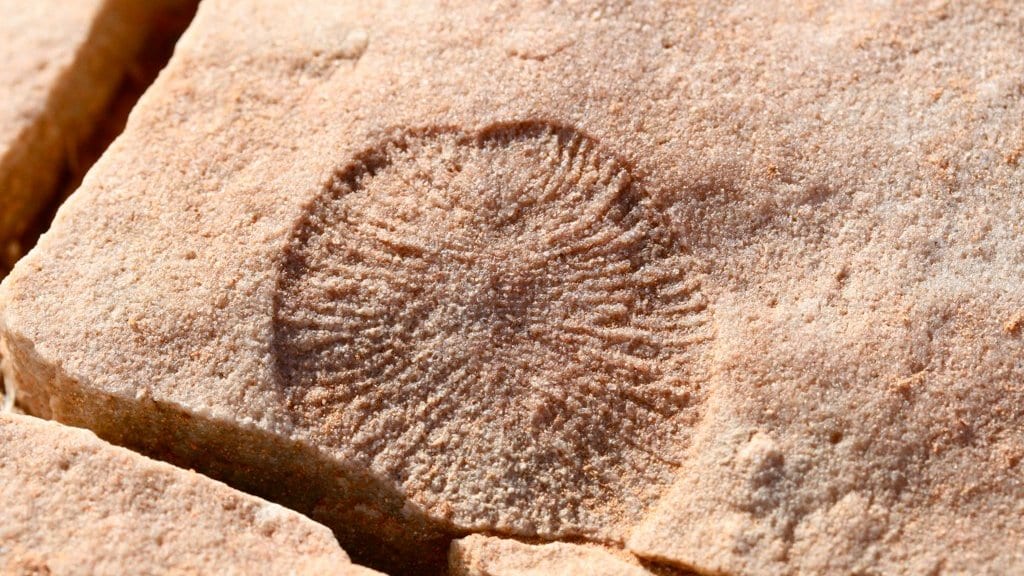
Two slabs of rock, one from southern China and one from southern Mongolia, look much the same under a microscope. Both are crowded with the preserved shapes of tiny organisms. In neither can anyone point to something and say with confidence: that was an animal. What separates them is age. The Chinese rocks sit close to the window in which animals are thought to have appeared. The Mongolian rocks were laid down long after animals were certainly swimming and burrowing, so their emptiness proves nothing about whether animals existed.
That pairing is the core of a paper published Oct. 2, 2026, in Science Advances. The authors are Orin M. Lole Durbin of the University of Oxford and Virginia Tech, Ross P. Anderson of Oxford's Museum of Natural History, and three colleagues at ETH Zurich, Yale and UC Berkeley. Their subject is not a new fossil. It is a number that constrains every attempt to date the origin of animals from the genes of living ones.
The problem the paper opens with is an old one. The authors put the oldest accepted animal body fossils at about 574 million years, and note that fossil molecules in much older rocks have been read as traces of sponges living before 635 million years ago. If that reading holds, animals were in the oceans a very long time before anything recognizable turns up in stone. But the reading is disputed. Ilya Bobrovskiy, Jochen J. Brocks and colleagues argued in Nature Ecology & Evolution in 2020 that the key compound is not unique to sponges, and probably formed when fat-like molecules from green algae were altered inside the sediment.
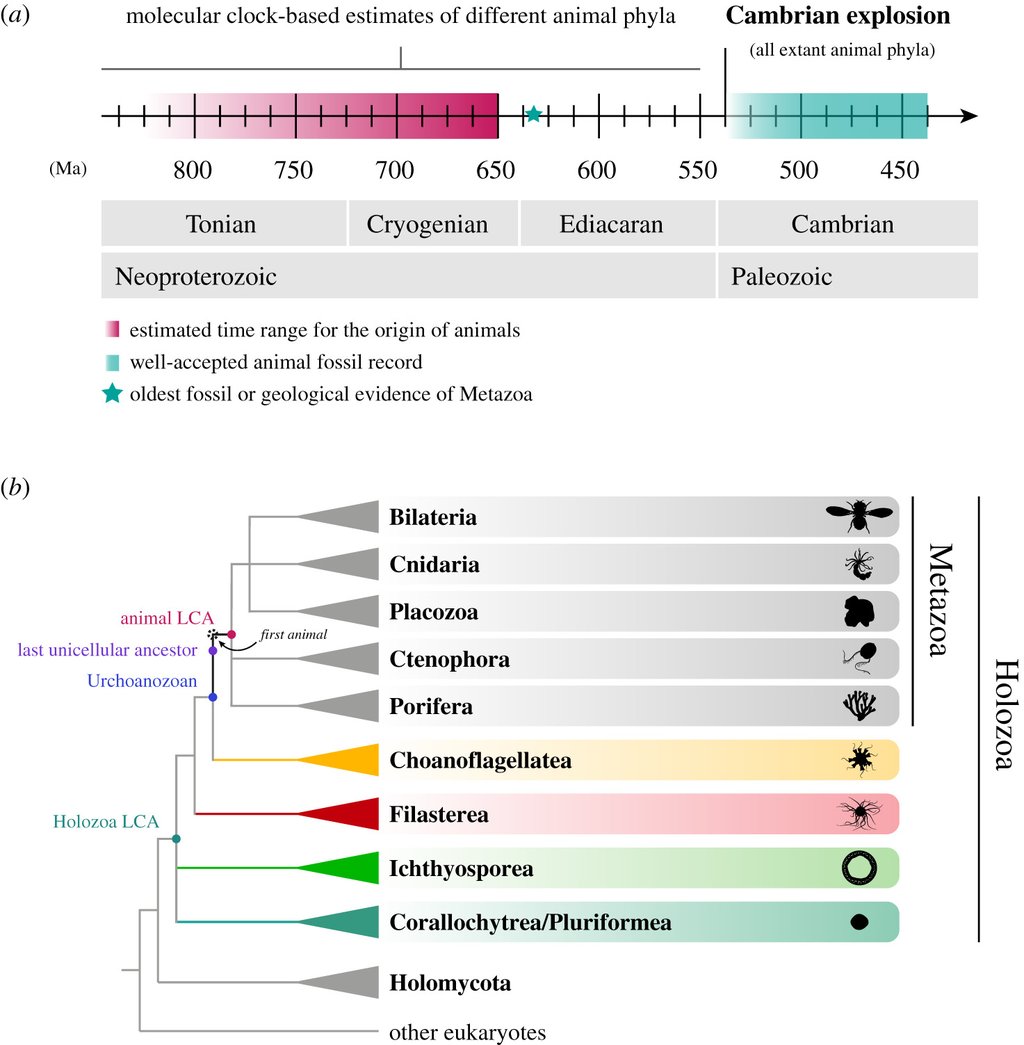
A molecular clock turns genetic differences between living species into dates. Count how far two genomes have drifted apart, assume a rate, and the method returns a time of divergence. The rate is the weak point, so clocks are pinned to the fossil record at both ends. A minimum age comes from the oldest fossil that definitely belongs to a group. A maximum age is an upper limit on how early that group could have appeared. The maximum is the awkward one. It has to be argued from an absence, which means from rock where a group is not found but might have been preserved if it were there.
Lole Durbin and colleagues argue that the accuracy and precision of such clocks hinge on the maximum ages they are given. To test one, they went to the Weng'an Biota of southern China, an Ediacaran deposit from the period just before the Cambrian, which preserves microscopic life in fine detail and has been used to set an upper limit on when animals began. Nothing in it is a definite animal. The inference usually drawn from that silence is that animals had not yet appeared, or were too rare to catch.
Then comes the Kheseen Biota of Mongolia. By the authors' account the two deposits are closely matched in how they are preserved and in what they contain, and neither holds a definite animal. The difference is that Kheseen was laid down between roughly 550 and 526 million years ago, when animals were undoubtedly present. A deposit of that kind can miss animals entirely while animals are swimming overhead, which means the same silence at Weng'an carries much less weight than it has been given.
The authors then propose a different class of anchor: several pre-Ediacaran deposits whose conditions favored preservation and which already hold both the bodies and the fossil molecules of non-animal life. Those are the criteria that make an absence meaningful. The authors report that their analyses support an origin for animals between roughly 800 and 700 million years ago, which the paper places in the late Tonian to mid-Cryogenian. Their title describes that as reviving pre-Ediacaran estimates rather than establishing a new one.
The field has not settled this. Emily Carlisle and Philip C. J. Donoghue of the University of Bristol and colleagues published an analysis in Science Advances in 2024 that runs the argument the other way. From their own revised fossil calibrations, they estimate that animals originated in the early Ediacaran, a result they describe as being in much closer accord with the fossil record. That paper also notes that clock studies have invariably estimated a Cryogenian or Tonian origin, which is the estimate the new work defends. It sits in the new paper's own reference list. Both groups agree on one thing: the fossil record cannot be taken literally. They disagree about which direction it misleads.
What hangs on the answer is not a date so much as a missing chapter. If animals began that early, a long early stretch of their history left no bodies anyone has found, and the open question becomes why. If the Bristol estimate is closer, the fossils are telling the story more or less straight. The new paper does not close that gap. It argues that one of the stones propping up the clock was never load-bearing.