Nature's Catapult: The Spider That Turns an Ant's Own Bite Into a 1,300 M/s² Launch

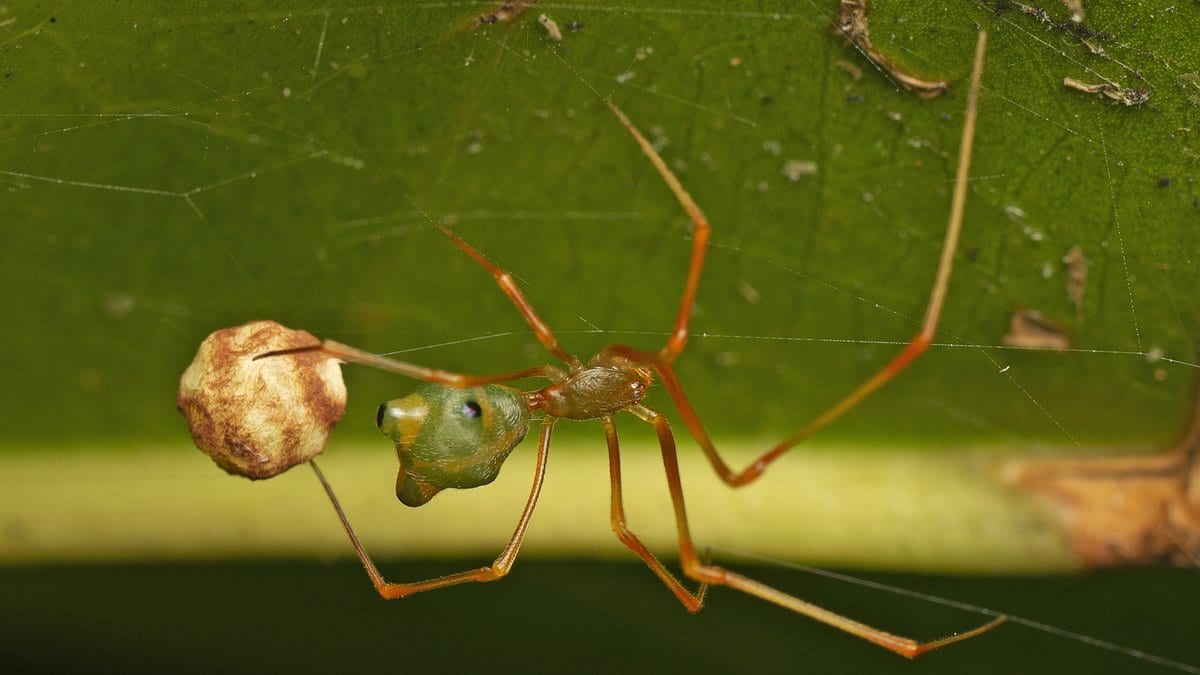
Green tree ants are not the kind of prey most spiders go looking for. They swarm, they bite, they spray formic acid, and they coordinate. A spider that tried to wrestle one into a web would, more often than not, end up the meal. So a small Australian spider has stopped wrestling altogether. It has built a machine.
Working in the rainforests near Cooktown, in northern Queensland, a team led by Professor Ajay Narendra and postgraduate student Pranav Joshi of Macquarie University spent ten days and nights filming a spider in the genus Propostira, a species so new it has not yet been formally named. What they recorded, published on 26 June in Current Biology, reads less like ordinary predation than like a sprung trap in an action movie.
A cone built to fail on cue
Near the ground, the spider spends as long as four hours assembling a vertical cone from somewhere between 15 and 60 strands of silk, drawn taut and bundled together, then wrapped with a finer layer of thread. The whole structure is held under tension and anchored at its base. It is, in effect, a loaded spring waiting for a release.
The release is the clever part. The spider does not pull the trigger; the ant does. When a green tree ant (Oecophylla smaragdina) climbs onto the cone and bites, the same reflexive aggression that makes the ant so formidable, it severs the cone from its anchor. The stored tension snaps free all at once, and the ant is hurled upward, more than 30 centimetres, straight into the spider's main web, where it tangles and is captured. The animal's instinct to attack becomes the very thing that launches it to its death.
Using high-speed and infrared cameras, the researchers clocked the launch at accelerations exceeding 1,300 metres per second squared. To picture that, imagine a structure built entirely of spider silk delivering, in an instant, a punch that flings a struggling ant the length of a forearm. The team also turned to scanning electron microscopy to examine the silk itself and understand how so much energy can be packed into so slight a frame.
The most powerful silk spring known
What sets this apart is not just that the spider uses a spring; plenty of organisms do. Trap-jaw ants snap their mandibles shut, mantis shrimp throw a punch so fast they create tiny bubbles that collapse with enough energy to produce extreme heat, and other spiders, like the slingshot-building Theridiosoma, fling their whole web at passing insects. Stored elastic energy is one of evolution's favourite tricks for beating the speed limits of muscle.
The standout here is power density: how much energy the snare releases per unit of material, and how fast. The researchers report that this silk cone delivers a greater instantaneous power density than any other specialised silk-based biological catapult described so far. The qualifier matters and is the authors' own: this is a claim about silk-based springs specifically, not about every catapult in nature. Within that category, though, the device is exceptional. The spider has solved an engineering problem (how to store a large amount of energy in a flimsy, biodegradable material and unload it in a fraction of a second) with nothing but thread.
A predator with one item on the menu
Just as striking as the mechanism is the spider's near-total dedication to a single quarry. This is not a generalist that occasionally lands an ant. It appears to feed almost exclusively on green tree ants, building a device tuned to defeat that one species' specific behaviour. Professor Greg Anderson, a spider taxonomist who first spotted the animal, described the strategy as "the ultimate specialization": catching one ant species, one ant at a time.
That degree of specialisation is a gamble. Tie your survival to a single prey species and you rise and fall with it; if the ants move on or crash, so do you. But it also lets evolution sharpen the tool to a fine point. Every feature of the cone (its tension, its trigger threshold, its placement near the ground where the ants forage) can be tuned to one target rather than compromised across many. The result is a snare that works because it expects exactly the prey it gets.
A spring built outside the body
For biologists who study how living things move fast, the find is a fresh and unusually pure data point. Most biological springs are built into the body: a tendon, a cuticle, a latch of chitin. This one is external, made entirely of secreted silk and rebuilt from scratch for each hunt, which makes it a kind of natural experiment in how far a soft, spun material can be pushed as an energy store.
For engineers and materials scientists, the appeal is just as direct. Spider silk already draws interest for its strength-to-weight ratio; a silk structure that doubles as a high-power-density spring hints at design principles for soft, lightweight actuators and other devices that need to store energy and release it in a burst.
The work has been peer-reviewed and is published in Current Biology, and the species still awaits a formal scientific name. For now it carries an apt nickname: the ballista spider, after the ancient siege engine that hurled bolts with a wound-up spring. The comparison is more than decorative. In a patch of Queensland rainforest, a spider barely large enough to notice has independently arrived at one of humanity's oldest weapons and, by letting the ant trip its own trap, improved on the design.