A Volcano's Own Lid, Measured After It Was Blown Off

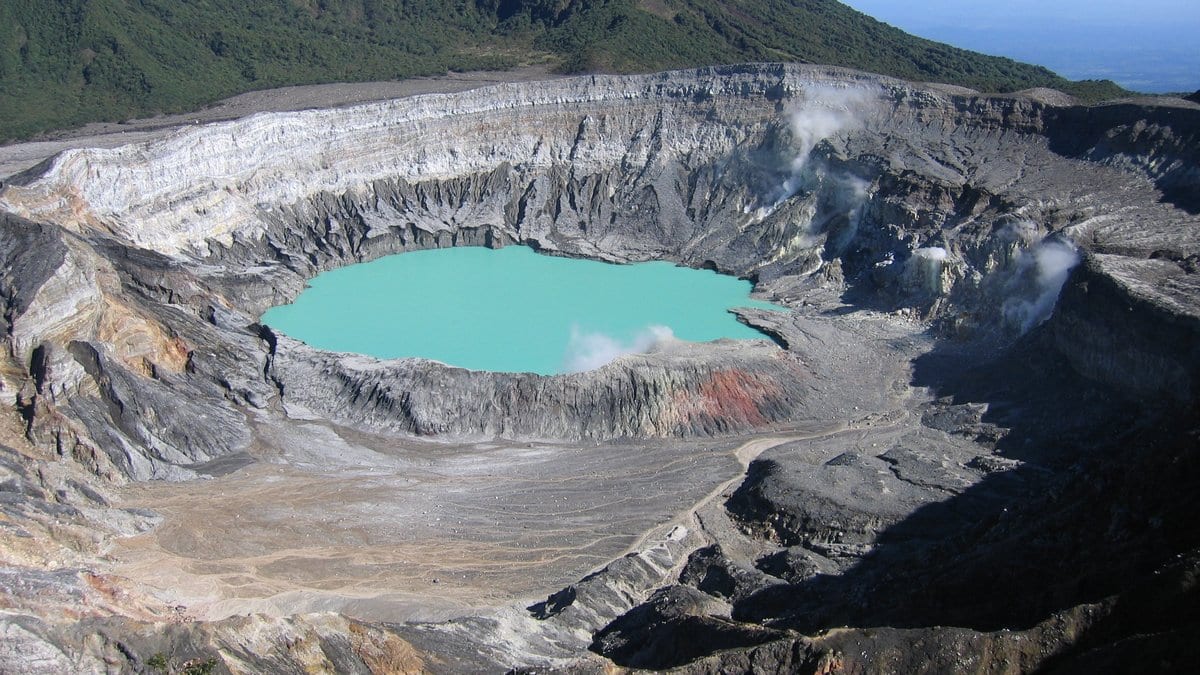
Some volcanoes announce themselves with lava. Others just cough, and rock rains down around the crater. In Costa Rica, recent activity at three of them has thrown out pieces of the very thing that was holding them shut. A team of 12, led by Michael J. Heap of the Université de Strasbourg and the CNRS, took those blocks into the laboratory and measured what the lid of a volcano is actually made of. Their results appeared Oct. 31, 2026, in JGR: Solid Earth.
The idea the team was testing is called hydrothermal sealing. Above a shallow pocket of hot groundwater, minerals crystallize out of the fluid and fill the cracks in the rock, cementing it into something close to watertight. Pressure builds underneath, and eventually the lid breaks. The paper opens by calling sealing a mechanism "thought to be responsible for challenging-to-forecast phreatic and phreatomagmatic eruptions": the first word means steam-driven, the second the kind of blast where magma meets water. Thought to be, not shown to be. The study measures the lid and models it; it does not claim to have caught it causing an eruption.
What makes the Costa Rican material unusual is that the volcanoes handed it over themselves. The team worked on "blocks of hydrothermal seal that were explosively expelled as ballistics during recent activity at Turrialba, Poás, and Rincón de la Vieja (Costa Rica)." That is rock that had been part of the seal until an explosion threw it out of the crater. It is not pretty stuff. The seals are altered lava and rubble whose angular fragments have been cemented back together by minerals the hot water left behind.
The measurements make the lid sound like a poor piece of rock, and in almost every way it is. The seal-forming materials are highly porous, typically more than 0.2, so a fifth or more of their volume is empty space. They are weak in tension, typically under 4 MPa, which is to say it does not take much pulling to crack them. Where they are remarkable is in letting nothing through: permeability as low as 10⁻¹⁸ m², which is close to watertight.
Those are aggregate figures across the seal material rather than a value belonging to any one volcano. From them come equations that estimate permeability and tensile strength for a seal whose porosity is known, which is a thing another group can pick up and use.
A similar picture appears well outside Costa Rica. The authors set seals from five volcanoes side by side, among them Whakaari in New Zealand and Tokachidake in Japan, and report mineral and physical likenesses. That, they write, "speaks to the commonality of the process of hydrothermal sealing," and to "the importance of alunite group minerals as a cementing material." Similar is the word, and common, not universal: nothing here says every volcano builds a lid, or that the ones that do build it out of identical rock.
The laboratory numbers then went into a model of fluid being injected into a shallow volcanic system, one that tracks pressure and stress together. The overpressures it produces are often within the range of the tensile strengths measured on the real blocks, which is to say the lid is weak enough for pressures such a system can plausibly build. And the direction of the risk is legible even where its size is not: "the likelihood of an eruption increases if fluid injection rate increases, permeability decreases, and/or tensile strength decreases." No probability, no threshold and no timescale attaches to it.
The line a monitoring agency will read twice comes last. "The modeling predicts small-magnitude changes to vertical displacement, but suggests that tiltmeters close to the conduit could detect shallow hydrothermal sealing and pressurization," the authors report. A tiltmeter measures how far the ground leans. Close to the conduit means near the pipe that feeds the vent, not spread out across the flank. And what the instrument could catch is the sealing and the pressure behind it, not an eruption: there is no forecast in this work, no lead time and no warning system.
That distinction is the difference between a research result and a civil-protection tool. Blasts of this kind are the ones that catch people out. GeoNet's bulletin for Dec. 9, 2019, records an eruption at Whakaari in New Zealand and the tragedy that came with it. Two of the authors, Geoffroy Avard and J. Maarten de Moor, work at OVSICORI, the observatory that watches the Costa Rican volcanoes in the study. The paper's own closing note is that understanding sealing, and forecasting eruptions, will take monitoring signals read alongside laboratory and modeling work. It is the peer-reviewed version of record, open under a CC-BY license, so a reader who wants the equations can go and get them.
Sources
- Journal of Geophysical Research: Solid EarthPeer-reviewed