A Lab-Made Glue Held the Chromosomes of Aging Mouse Eggs Together
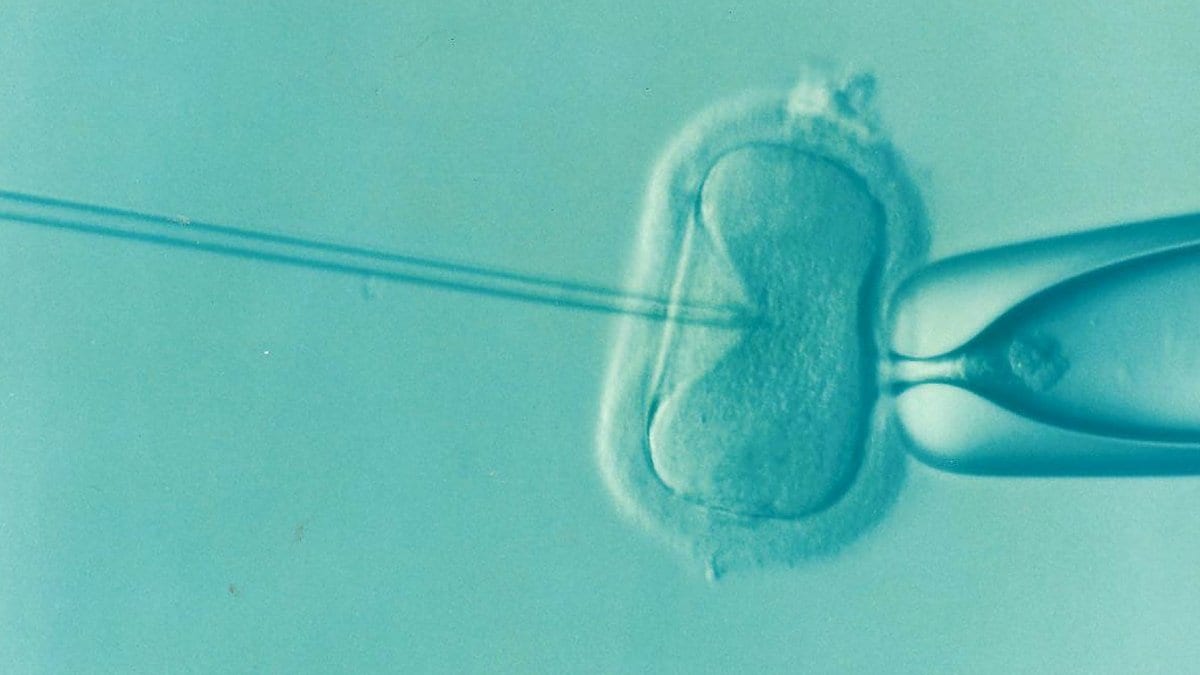
Researchers at the Max Planck Institute for Multidisciplinary Sciences in Göttingen, Germany, built an artificial glue that held the two halves of a chromosome together in aged mouse eggs, where the natural glue has worn away. Their paper appeared Nov. 26, 2026, in Science.
Female fertility declines rapidly from about the age of 35. Cohesin, a protein complex, holds a chromosome's two identical halves together until an egg is fertilized, and it drains out as the egg ages without being replaced. The halves then come apart too early, leaving an egg with too many or too few chromosomes. Nothing could make up for that loss until now, the institute says.
Alexandre Webster, Melina Schuh and colleagues report in Science that their replacement, TALhesin, is a pair of programmable DNA-binding proteins, aimed at the DNA where cohesin does its holding, and chemically locked together. By the institute's own count, the share of aged mouse eggs with no prematurely separated halves rose from 46.7 to 74.1 percent, against 74.7 percent in young mice.
A glue that never lets go has its own problem — the halves must part when the egg divides. So the team wrote into TALhesin a cut site of the kind separase, an enzyme already in the egg, uses on cohesin. In treated eggs pushed into that division, it cut the artificial glue on schedule.
The group then re-aimed it at a target sequence on human chromosomes. In donated unfertilized eggs, it bound where intended without visibly disturbing the first division, and the cut site worked there too. The authors call that a proof of principle, not a method. The eggs came from fertility clinics in Göttingen, Cambridgeshire, England, and Berlin.
Later studies will test whether TALhesin lowers the error rate in eggs from older women, the institute says. "Our long-term goal is to develop the system further so that it can be used safely in fertility treatment, although further research and safety testing will be needed before clinical use," said Melina Schuh, a biochemist and director at the institute, in the Max Planck Society's announcement.
Sources
- SciencePeer-reviewed
- www.eurekalert.org

Medical Disclaimer: This content is provided for general informational and educational purposes only. It is not medical advice and should not be used as a substitute for professional medical advice, diagnosis, or treatment. Always consult a qualified healthcare professional regarding any medical condition, concern, symptom, or treatment decision.