A Milky Way Arm That May Not Be an Arm at All

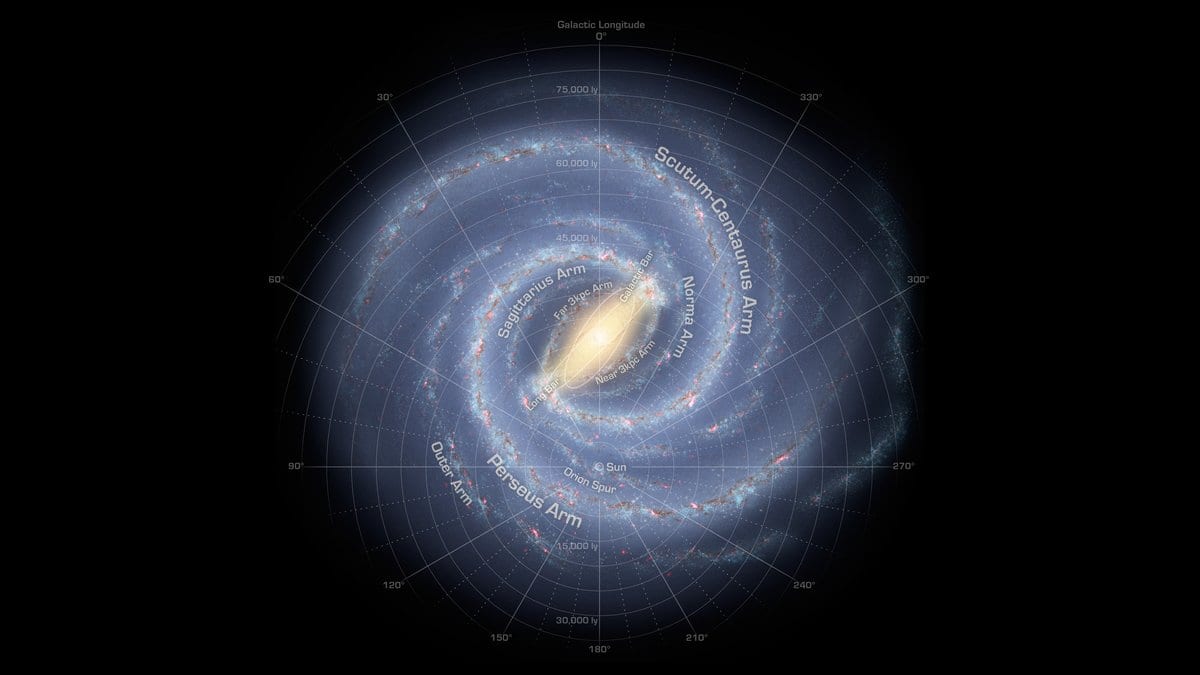
Every picture of the Milky Way seen from outside is a drawing. We have never had that view and never will. The map, with its four great spiral arms sweeping out from a central bar of stars, is assembled from inside the disk, looking out through the dust and gas it is trying to chart. Most of it holds up. One stretch of it may not be an arm at all.
The claim comes from a paper published Nov. 20 in Nature Astronomy. Hillary Davis and Joss Bland-Hawthorn, of the Sydney Institute for Astronomy at the University of Sydney, worked on it with three colleagues in Australia and Sweden. They argue that the young stars long placed in the Norma arm are not in a spiral arm at all, but strung along a shock front on the leading edge of the Galaxy's central bar: the lane of compressed gas and dust a bar drags around with it.
No new observations went into this. The stars in question are marked by masers: pockets of gas beside newborn massive stars that shine like natural radio lasers. Their distances were measured by radio parallax and published in 2019 by Reid and colleagues, using data from the BeSSeL Survey and Japan's VERA project. That catalog is where the Norma arm's inner stretch comes from. The new work runs simulations of galaxies and asks what else that curve of dots could represent. The data being reinterpreted is also the study's only observational input.
A bar is not a solid object. It is a crowd of stars on elongated orbits, and gas caught up in it cannot pass through cleanly. Along the bar's leading edges, the orbits crowd together, causing gas to pile up and shock. The result is a dense lane of gas and dust that funnels material toward the center. In other barred galaxies, those lanes are visible as dark streaks running off each end of the bar; the James Webb Space Telescope's view of NGC 1433 shows a pair of them. The simulations grow the same structures.
The match the team reports shows up in two pictures at once. Seen from above, in the simulation, the shock front curves the way the Norma masers curve. Seen the way we are forced to see the Galaxy, as position across the sky plotted against speed along the line of sight, the same points land on the same feature: a sharp step in the velocity envelope that appears in the models wherever the line of sight grazes a bar's dust lane. In the real sky, that step sits well outside the bar's traditional territory, in a zone long read as a spiral arm.
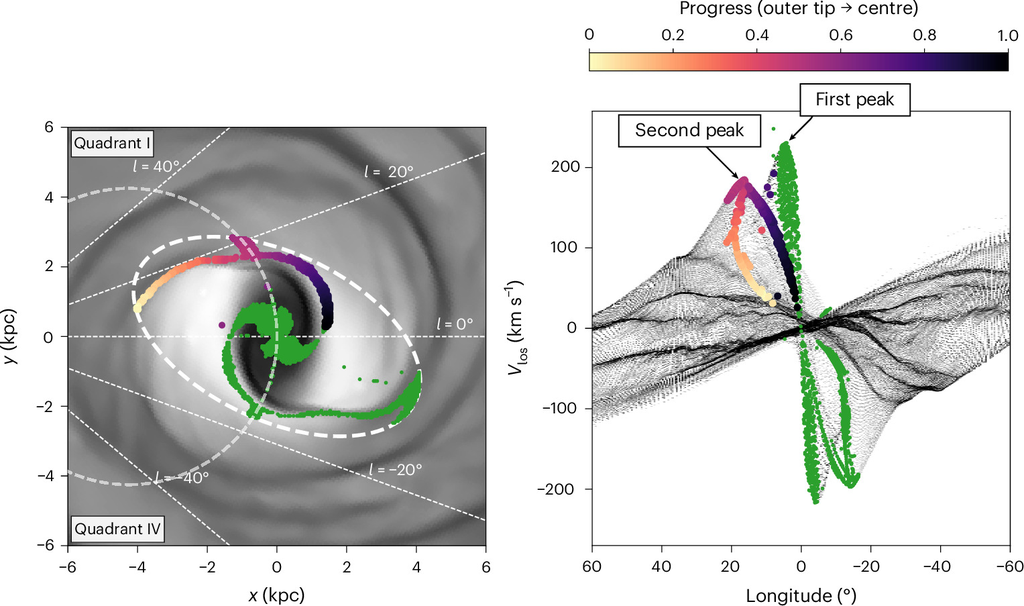
The age of the masers turns this from a filing question into a physical one. A maser of this kind marks a star-forming region less than a million years old, too young to have drifted far from the gas that made it. If the masers are on the dust lane, the dust lane is making stars. The authors write: "This implies that the bar dust lane is star-forming, shedding new light on our understanding of star formation processes in the Milky Way."
Along most nearby bars, star formation is suppressed. The gas is there in quantity, but the bar's pull drags it inward before it can collapse, and the shocks and shear that build the lane stir up turbulence that keeps clouds from forming stars. Davis and colleagues are careful about how far that goes. They write that the suppression is not universal and name four nearby barred galaxies whose dust lanes do make stars. A star-forming lane in our own bar would put the Milky Way in a minority, not on its own.
Lining the simulated shock front up with the maser positions also fixes the bar's size, and that is where the result needs reading carefully. The authors state plainly that they assumed the Norma masers approximately trace the innermost orbit that gives a bar its shape, then measured that orbit on a scaled simulation snapshot by eye. On that assumption, the bar's semimajor axis comes out at 4.3 ± 0.2 kiloparsecs, about 14,000 light-years from the center to one end, with a half-width of 2.3 kiloparsecs and the long axis tilted 20 degrees from the line between the Sun and the Galactic center. If the masers are not on the shock front, those numbers go with the interpretation.
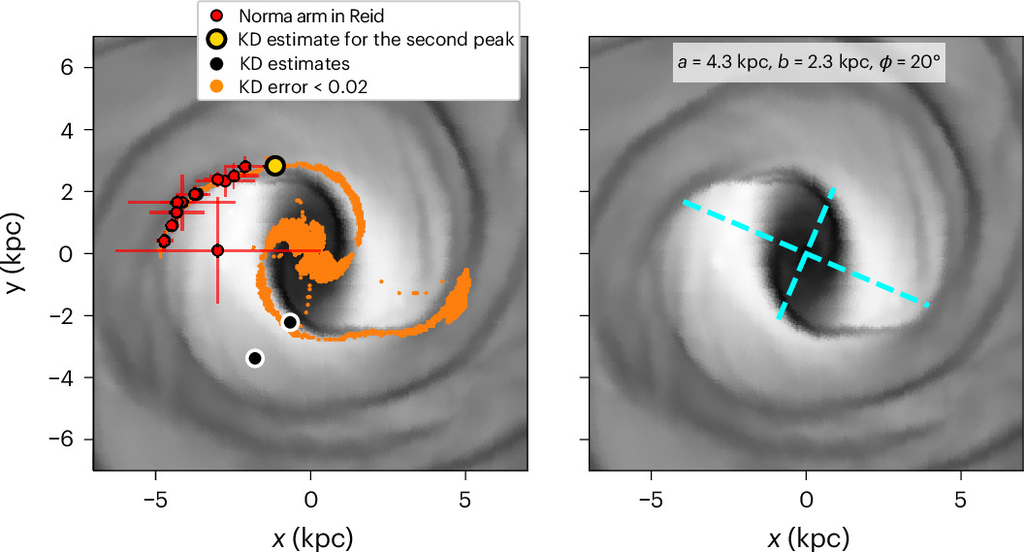
The same fit places an upper limit on how fast the bar turns: no more than about 40 kilometers per second per kiloparsec from the center. That is an upper limit, not a measurement. Astronomers have argued for decades over whether the Milky Way has a long bar turning at roughly that rate or a shorter one, about 3.5 kiloparsecs in half-length, that turns faster. These numbers favor the long-bar picture. The paper's closing sentence reads: "This raises questions about the Milky Way's spiral structure and suggests that the Galactic bar is long, slow and star-forming." Here, "slow" is one camp's label in a debate about the Milky Way, not a ranking against other galaxies' bars, which are classified by a different measure that the authors note is not always a good guide to how fast a bar turns.
Rereading an apparent arm as bar structure is not new in itself. The paper's own reference list points to a 2025 study by Kumar and colleagues arguing that the Milky Way's expanding 3-kiloparsec arms are neither expanding nor spiral arms, but gas on orbits driven by the bar. What is new here is the proposed reinterpretation of Norma and the claim that the lane is forming stars.
The team repeated the exercise on a second, unrelated simulated galaxy and found the same signature. This tests the method, not the Milky Way. The code and the saved arrays behind every main figure are publicly available, so another group can apply the same method elsewhere. The signature itself is portable: find the sharp second peak in a longitude-velocity diagram, and you have the longitude where the line of sight crosses a bar's dust lane. The Milky Way is the one galaxy astronomers cannot step outside to photograph, and the argument over its shape is still being settled from the inside.