Astronomers Weigh a Black Hole in the Early Universe by Watching Gas Swirl Around It
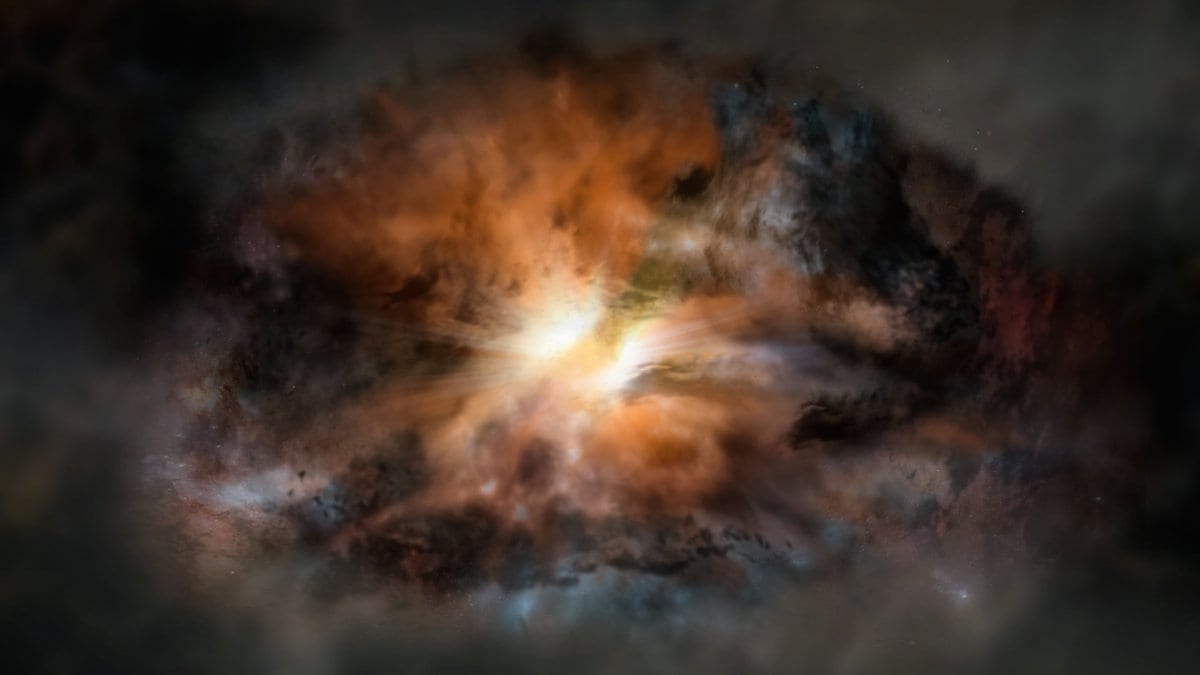
Astronomers using the Atacama Large Millimeter/submillimeter Array (ALMA), an international observatory in northern Chile, have weighed a black hole in the early universe from the motion of the gas closest to it. Mai Liao of the National Astronomical Observatories of the Chinese Academy of Sciences and colleagues put its mass at about 6 billion times that of the Sun, in a paper published Nov. 20, 2026, in Science Advances.
The black hole sits at the center of W2246-0526, a dust-shrouded galaxy whose blazing core marks it as a quasar. The observatory said masses in quasars this distant are usually estimated indirectly, from the width of lines in their light and the core's brightness. Reading a mass off moving gas instead tests whether relationships calibrated on nearby galaxies hold this far back in time. The authors report it as the first mass obtained that way above redshift 2, a measure of cosmic distance.
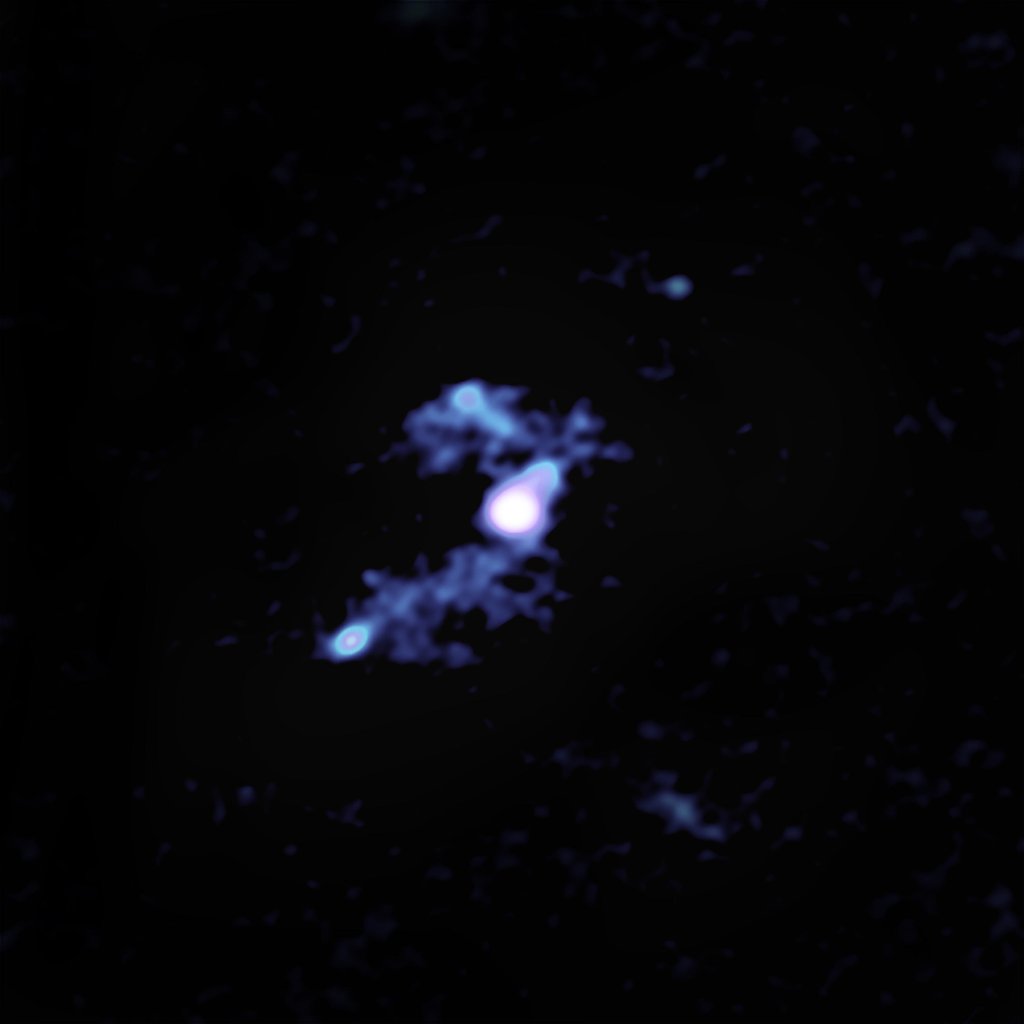
W2246-0526 lies at redshift 4.6: its light left when the universe was about 1.3 billion years old, according to the observatory's release. Tracking emission from ionized carbon and carbon monoxide, the team resolved the black hole's sphere of influence, the region where its gravity outweighs the galaxy's. Once gas streaming outward was accounted for, the spread of gas speeds rose steeply toward the center. That is the pattern a single compact mass makes, the paper reports.
At that distance ALMA can pick out details about 700 light-years across, according to the observatory. "By resolving the gas motions close to the center, we can see the black hole's gravity imprinted on its surroundings," said Liao, who is also affiliated with Universidad Diego Portales in Chile.
The release recounts earlier ALMA attempts on bright, unobscured quasars that found no clear gravitational signature, and offers one explanation — intense X-rays from a galaxy's center ionize the carbon further and weaken its emission close in. The authors suggest the thick dust around W2246-0526 shields nearby gas from some of that radiation, letting the tracers survive closer in, which would make heavily obscured quasars promising targets for more such measurements.
Sources
- www.almaobservatory.org
- Science AdvancesPeer-reviewed