Eighteen Years of Venus Orbiter Data Disagree With Two Standard Climate Models
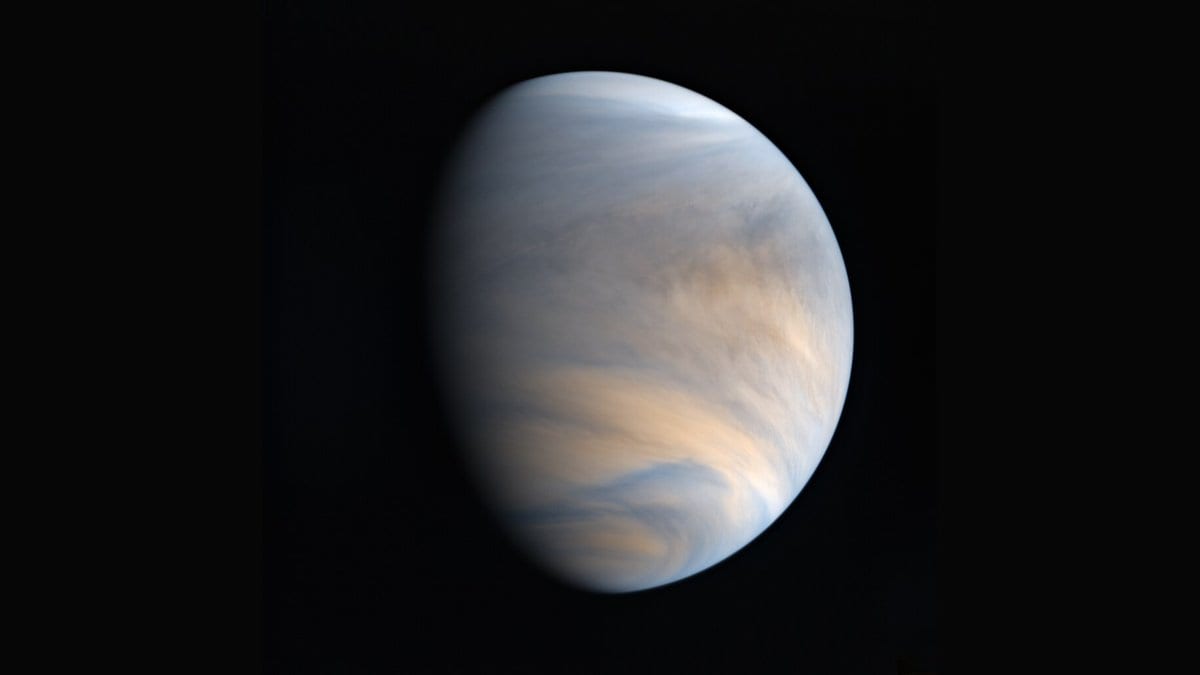
Two reference models of Venus's atmosphere disagree with 18 years of spacecraft temperature measurements by more than 10 K, or 10 degrees Celsius, according to a paper posted to the arXiv preprint server on Aug. 27 by Soumyaneal Banerjee and seven co-authors. The authors' note on the posting says the paper has been accepted for publication in the journal Icarus.
The team compared temperature profiles retrieved from radio-occultation measurements taken by the European Space Agency's Venus Express and Japan's Akatsuki orbiter, as a spacecraft's radio signal passes through the atmosphere on its way to Earth. The measurements span 2006 to 2024 and cover the middle atmosphere between 45 and 80 km, the paper states.
Set against Venus-GRAM and the Venus Climate Database, two model descriptions of average conditions on the planet, the retrieved profiles show what the authors call "systematic deviations exceeding 10 K," most pronounced at high latitudes in both hemispheres. The comparison measures the models against the observations; it is not a report of the atmosphere itself changing.
The long record also shows what the authors describe as a possible decadal-scale variability in temperature at low-to-mid latitudes, which becomes less coherent at higher altitudes. A statistical analysis of the temperature anomalies indicates that the variability at low-to-mid and polar latitudes is not readily explained by uneven sampling across latitudes, while trends at mid-to-high latitudes are affected by sparse and uneven occultation coverage.
The team also re-ran the Venus Climate Database with modified cloud albedo inputs, changing how much sunlight the clouds reflect. Adjusting that forcing partially reconciles the differences below 60 km, but above the cloud top at lower latitudes the divergence from the observations increases significantly, leaving no general reconciliation between the model and the measurements.
Banerjee and colleagues write that the results highlight the need for updated empirical climatologies incorporating recent radio-occultation measurements, and for improved physical parameterizations in Venus general circulation models, meaning the simplified formulas such models use for processes they cannot resolve directly.
Sources
- arXivPreprint