Skip to content
See the World Through ScienceA project of ALLATRA
Source: PreprintarXiv1 source

Some Planets May Be Warmer at Night Than During the Day
Space

Republish this story

Our work is licensed under Creative Commons BY-NC 4.0. You may republish this piece for free — with credit to ALLATRA Media and a link to the original, unedited beyond length trims, and not for commercial use.

Read the full license

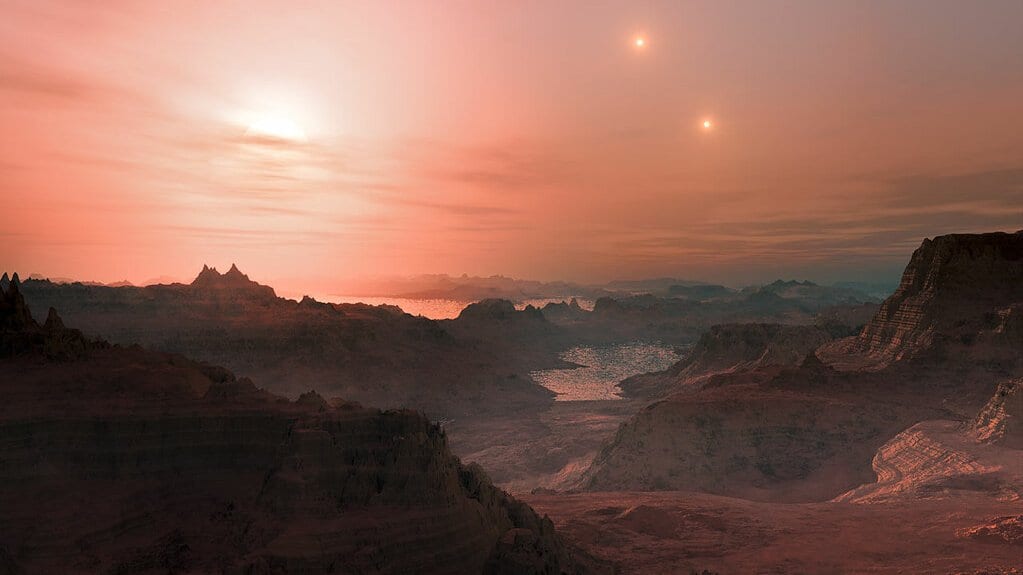
An artist's concept of a reddish rocky landscape with water pooled in the valleys, under a hazy pink sky holding a low bright sun and two smaller bright stars.
Three stars hang over a rocky landscape, two of them distant enough to show only as points (artist's concept). A sky with more than one star is one of the settings where the light reaching a planet rises and falls."Artist’s impression of sunset on the super-Earth world Gliese 667 Cc" by European Southern Observatory, via flickr, CC-BY-2.0

Deepayan Banik and colleagues report that a planet keeping one face permanently toward its star can end up with a night side warmer than its day side, if the starlight it receives rises and falls as it orbits. Their paper was posted Sept. 29, 2026, to the arXiv preprint server and submitted to Monthly Notices of the Royal Astronomical Society; it has not yet been peer-reviewed.

Planets on stretched orbits, planets circling two stars and planets on polar orbits around unevenly bright stars all receive starlight that rises and falls. The authors say that case had not been studied in general dynamical terms before, and they present the preprint as the first such study. They also say where to look: among planets already observed, they count 11 whose brightness over an orbit should vary by at least 10% because of the changing starlight, with HAT-P-2b the largest of them.

Their model is a single shallow layer of atmosphere, pushed toward a temperature pattern that itself changes with time. In it the atmosphere behaves like a forced damped oscillator, the physics of a swing pushed rhythmically against friction, and the paper derives expressions for the average response, its size and how far it lags behind the starlight. Held to steady starlight, the model reproduces the fixed hot spot already expected on a tidally locked planet.
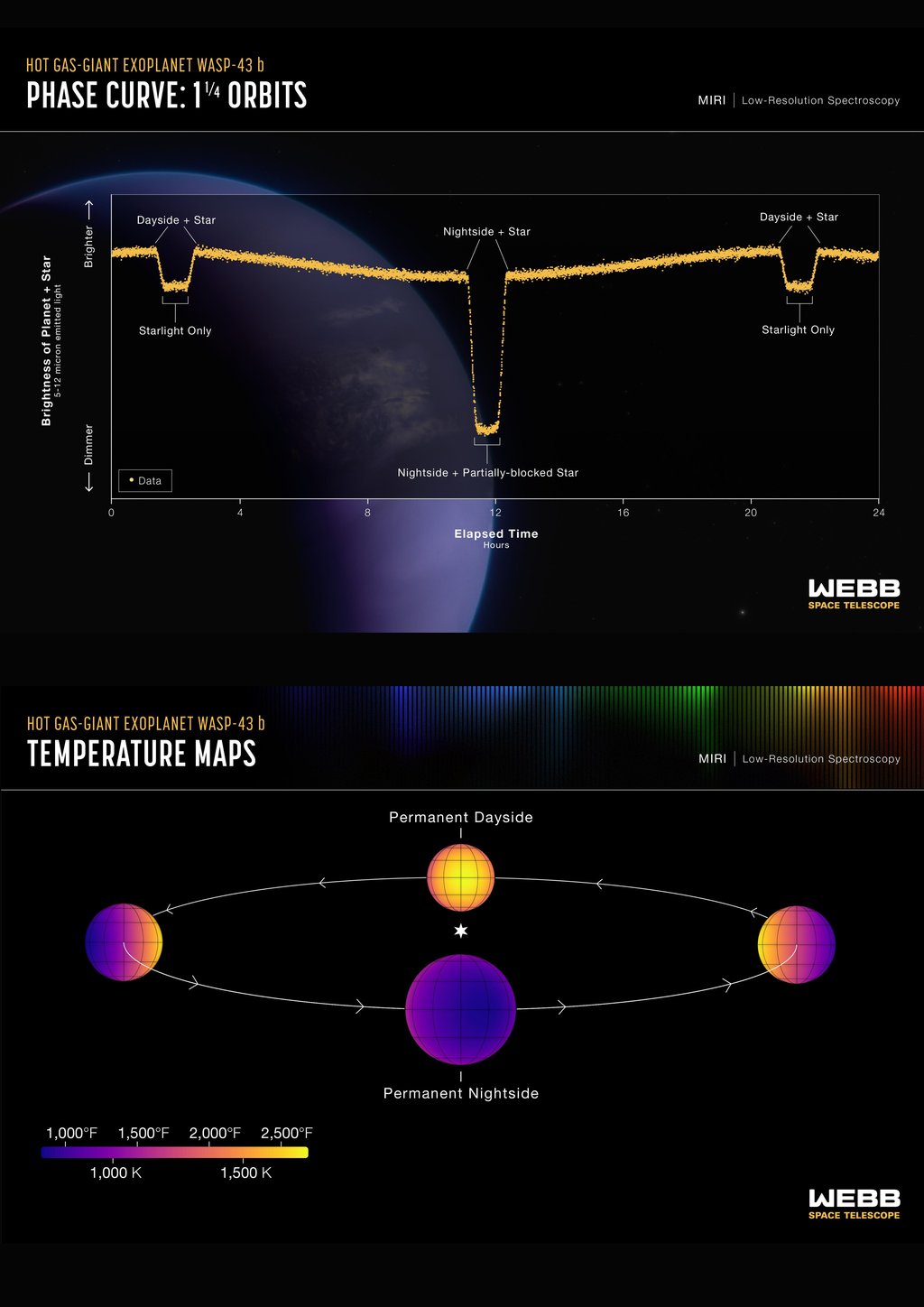
A two panel infographic. The upper panel plots a planet's brightness across one orbit, dipping sharply at two points. The lower panel shows four colored globes around an orbit, labeled permanent dayside and permanent nightside, beside a temperature scale.
Measured for a different world: brightness through one orbit, and charts of where the heat sits (illustrative). The preprint predicts conditions under which the warm spot would shift onto the unlit face. "Hot gas giant exoplanet WASP-43 b (MIRI phase curve and temperature map) (WASP43b-2)" by NASA, ESA, CSA, R. Crawford (STScI), T. Bell (BAERI), J. Barstow (The Open University), M. Roman (University of Leicester), via wikimedia, CC-BY-4.0

The effect peaks at resonance, when the rhythm of the changing starlight matches the time atmospheric waves need to cross the planet and friction is weak. The response then forms a single standing wave across the planet, the hot spot swings right around to the point facing directly away from the star, and simulated brightness curves invert in shape as the night side warms. Nothing here was observed: the results come from analytic theory and from simulations, linear and nonlinear.

Whether the hot spot leads or trails the point directly beneath the star depends on how fast the planet spins.

Sources

Spot an error?

Spot an error?

Report an error

Spotted a mistake on this page? Tell us what's wrong and our editors will take a look.

What kind of problem?

Only if you'd like us to be able to follow up. We won't use it for anything else.

We correct mistakes openly. Select any text to flag it. Fixes are logged under our Corrections Policy.

Report an error

Reporting on

Some Planets May Be Warmer at Night Than During the Day

What kind of problem?

Only if you'd like us to be able to follow up. We won't use it for anything else.

We read every report. Corrections are logged publicly.