The Ice Around Beta Pictoris Was Never Warmed, a Webb Spectrum Shows
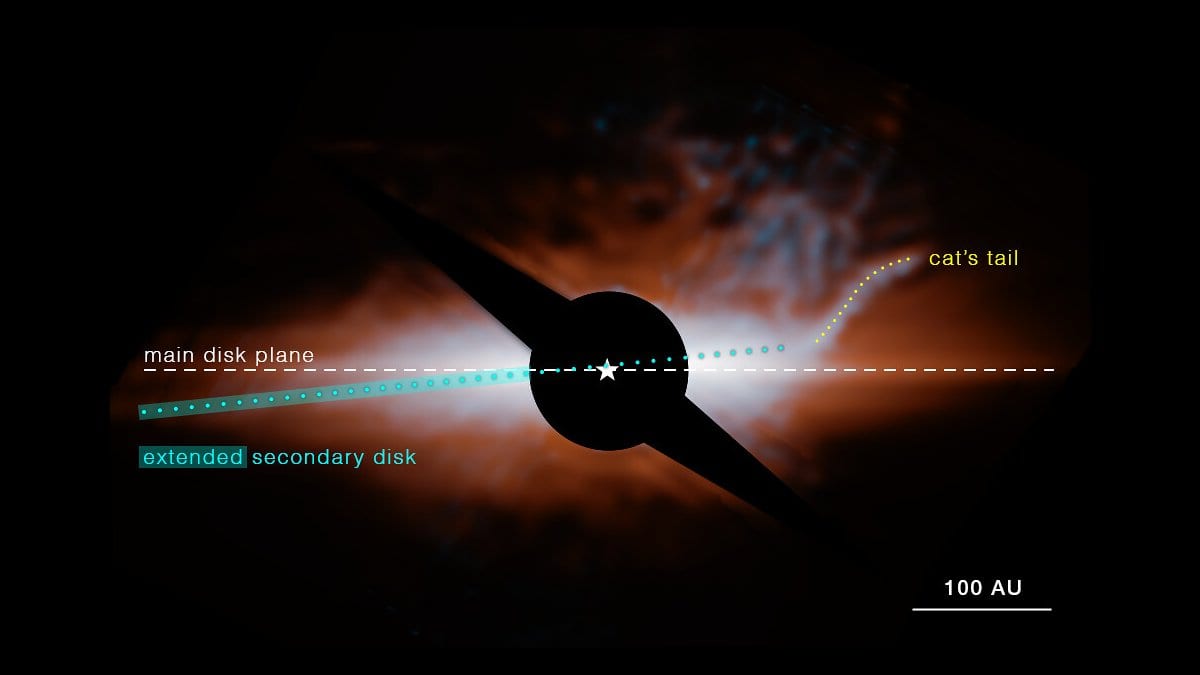
Water ice in the ring of dust around the star Beta Pictoris has stayed almost entirely disordered rather than freezing into crystals, and carbon dioxide ice is mixed through it at about one part in ten, Sarah Betti of the Space Telescope Science Institute and colleagues report in the journal Science.
Ice whose molecules sit in no fixed order, called amorphous ice, is a record of how cold the grains have stayed: ice that had warmed up would have rearranged itself into crystals. The authors read the Beta Pictoris ices as having formed in cold conditions, likely in interstellar space rather than around the star itself.
The paper puts the water ice at under 7% crystallinity, measured from a near-infrared spectrum taken with the James Webb Space Telescope. The carbon dioxide ice shows up both in its ordinary form, built on carbon-12, and in a heavier one built on carbon-13, and both are mixed in with the water ice rather than sitting apart from it in separate grains.
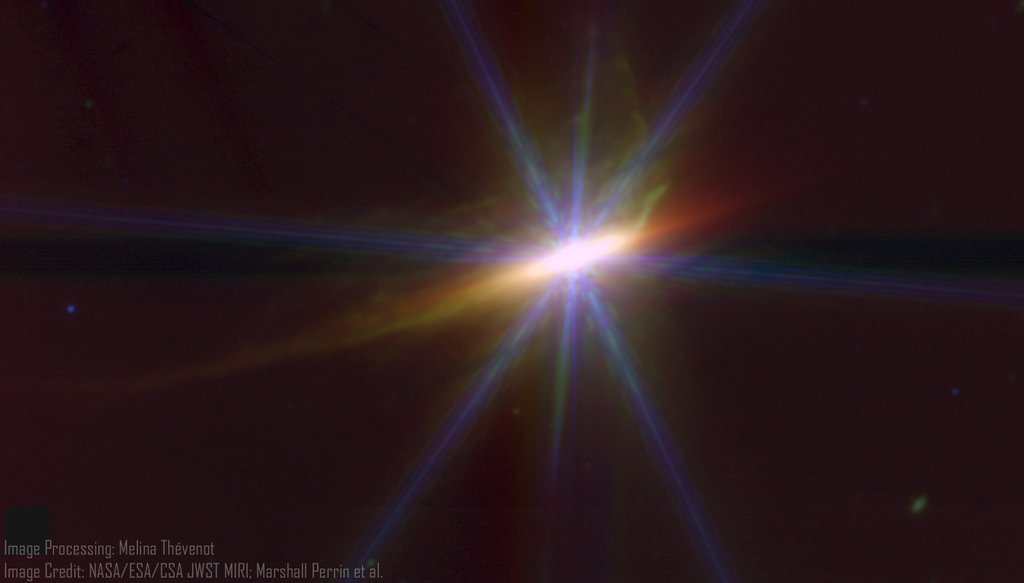
The disk is dusty, planet formation is occurring within it, and its outer reaches lie far enough from the star for molecules there to freeze solid. The authors also argue that frequent collisions inside the disk are needed to explain how evenly the icy grains are spread through it.
The study appeared in Science on Nov. 12, 2026. Its authors work at institutions including the Space Telescope Science Institute, Johns Hopkins University, Clemson University and NASA's Goddard Space Flight Center.
Sources
- SciencePeer-reviewed