JWST's First Look at TRAPPIST-1 F Rules out a Hydrogen-Rich Atmosphere
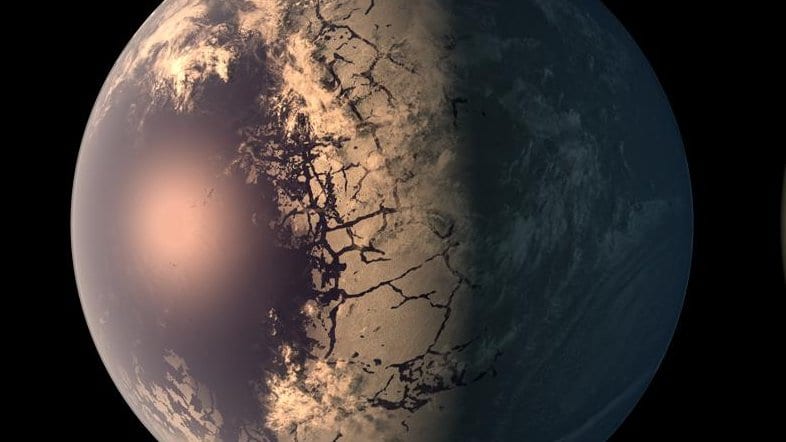
The first JWST transit spectra of TRAPPIST-1 f rule out hydrogen- and helium-dominated atmospheres with surface pressures higher than about 20 millibars, at 95% confidence, a team led by Olivia Lim and René Doyon reports. That is an upper limit rather than a detection: the measurement bounds what the planet's atmosphere cannot be, and does not establish whether it has one.
The paper, posted Aug. 17 on arXiv and accepted for publication in The Astronomical Journal, is based on five transits of the planet observed with NIRISS SOSS, a JWST mode that spreads the star's infrared light into a spectrum as the planet passes in front of it. TRAPPIST-1 f is the habitable-zone planet of the system, meaning its orbit sits at a distance where liquid water could in principle persist on a surface. The 20-millibar limit comes from the visits least affected by stellar flares, the authors write.
At least one flare occurred in each of the five visits, according to the paper. Even so, and unlike observations of the closer-in TRAPPIST-1 planets, the team found no evidence that the spectra were contaminated by unocculted bright and dark regions on the star, an effect known as the transit light source effect. The authors state that this non-detection does not guarantee the absence of such contamination in future observations of the planet, and note that the transit chord may simply have resembled the average visible face of the star at the time.
The spectra do show slopes running from -365 parts per million per micron up to 15 ppm per micron, which the authors attribute to stellar variability rather than to the planet. For atmospheres made of heavier molecules, they write, the exact upper limits on surface pressure depend on the data-reduction pipeline and on how those residual slopes are handled.
JWST has now observed all seven TRAPPIST-1 planets in just over three years of operation, the paper notes. The two innermost were found to have little to no atmosphere, barring high-altitude aerosols.
Sources
- arXivPreprint