Skip to content
See the World Through ScienceA project of ALLATRA

A Newly Found Giant Planet Will Stop Crossing Its Star in 2033
Space

Republish this story

Our work is licensed under Creative Commons BY-NC 4.0. You may republish this piece for free — with credit to ALLATRA Media and a link to the original, unedited beyond length trims, and not for commercial use.

Read the full license

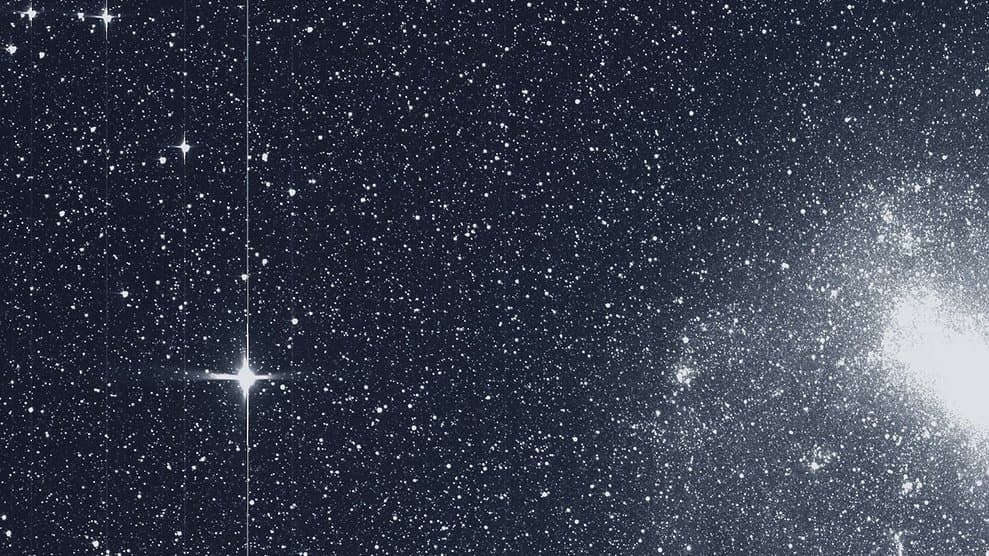
A dense star field recorded by NASA's TESS, with the Large Magellanic Cloud glowing at the right edge.
Part of the first science image returned by NASA's TESS in 2018. Brightness measurements from the same satellite are what caught this planet crossing its star (illustrative)."NASA’s TESS Shares First Science Image in Hunt to Find New Worlds" by NASA's Marshall Space Flight Center, via nasa, BY-NC · BY-NC

A team led from the University of Tokyo has found a giant planet that circles a hot star every 2.17 days on an orbit still stretched into an oval rather than round. Noriharu Watanabe and colleagues report the planet, TOI-1355 b, in Publications of the Astronomical Society of Japan as one of the rare eccentric hot Jupiters (giant planets on very short orbits) found around hot stars. It carries about 5.8 times Jupiter's mass, and its orbit has an eccentricity near 0.22.

The shape matters because of how such planets are thought to have arrived. Hot Jupiters around hot stars are believed to have reached their tight orbits through high-eccentricity migration, a route that begins with a long, stretched orbit. The paper says the ones found so far are on circular orbits. TOI-1355 b's is not, and the authors write that the system could be undergoing that migration now.
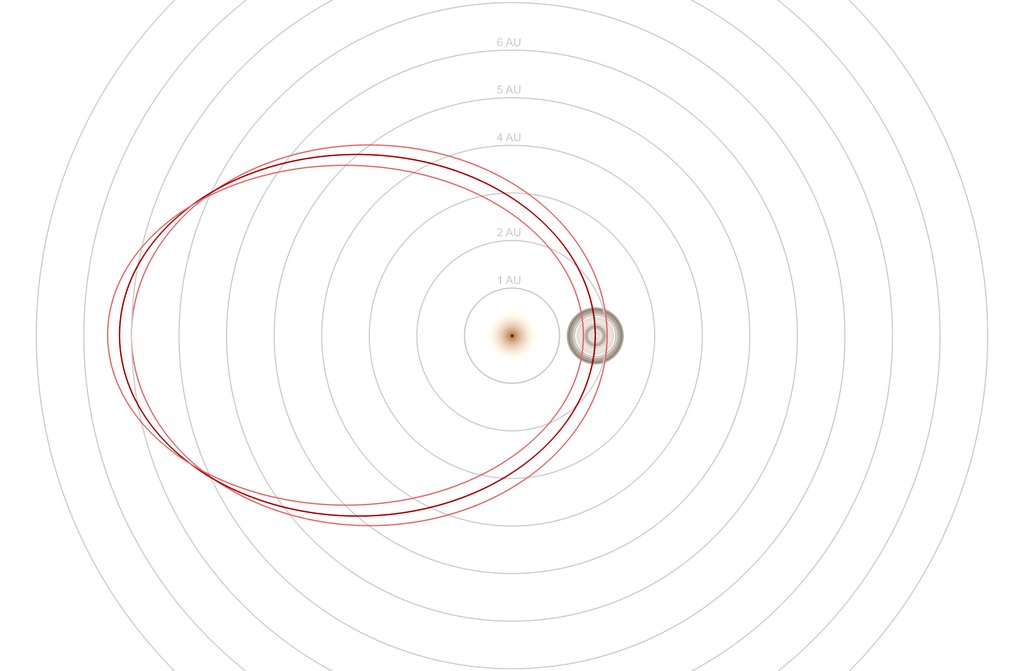
A diagram of a stretched, oval planetary orbit drawn in red against gray circles marking distances of 1 to 6 astronomical units from a central star.
A diagram of an eccentric orbit, drawn for the companion of the star J1407, with distance rings in astronomical units. An eccentric orbit is an oval rather than a circle, which is what makes this newly found planet unusual (illustrative). — "J1407b RiederKenworthy2016 eccentric orbit diagram white" by Nrco0e, via wikimedia, CC-BY-4.0

The transits also have an end date. The planet's path across the star's face has been shifting, a nodal precession, or slow tilt of the orbit's plane. The authors put the end of the transits at the middle of 2033.

TESS identified the planet from its transits. The star's properties come from the high-resolution spectrograph Seimei/GAOES-RV, and the planet's from TESS photometry and ground-based telescopes, which put its radius at about 1.4 times Jupiter's. The team also reports a hint that the planet's atmosphere varies and expects it to be a worthwhile target for atmospheric observations.

Sources

Spot an error?

Spot an error?

Report an error

Spotted a mistake on this page? Tell us what's wrong and our editors will take a look.

What kind of problem?

Only if you'd like us to be able to follow up. We won't use it for anything else.

We correct mistakes openly. Select any text to flag it. Fixes are logged under our Corrections Policy.

Report an error

Reporting on

A Newly Found Giant Planet Will Stop Crossing Its Star in 2033

What kind of problem?

Only if you'd like us to be able to follow up. We won't use it for anything else.

We read every report. Corrections are logged publicly.