A Molecule Long Predicted on Titan Has Finally Been Found
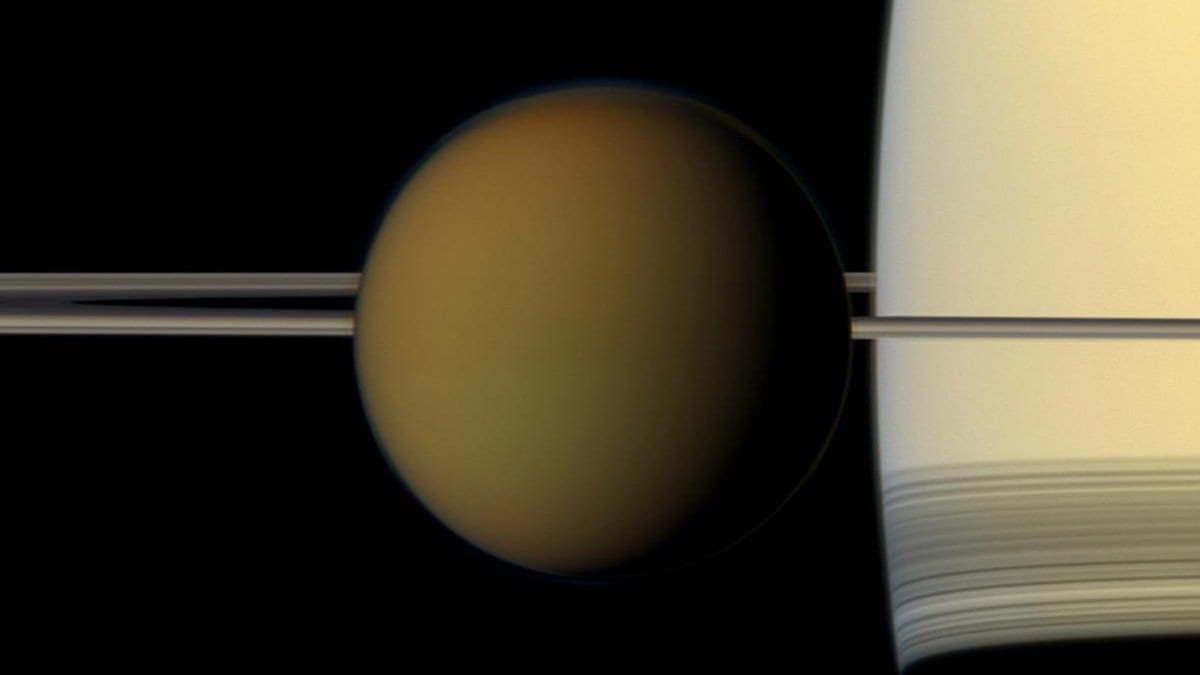
Astronomers have detected methanimine, a simple molecule of carbon, nitrogen and hydrogen, in the atmosphere of Titan, Saturn's largest moon, in observations with the Atacama Large Millimeter/submillimeter Array (ALMA).
Working out what organic chemistry Titan runs starts with an inventory of its atmosphere, and many of the molecules that models place there have never been identified. In a paper accepted by The Astrophysical Journal Letters, Alexander E. Thelen and colleagues write that methanimine (CH2NH) is "the first stable imine (C=N) to be detected on Titan, and may be integral for further biomolecule formation as a precursor to glycine and adenine."
An imine is a molecule in which a carbon atom and a nitrogen atom are joined by a double bond. Glycine is an amino acid; adenine is one of the four bases in DNA.
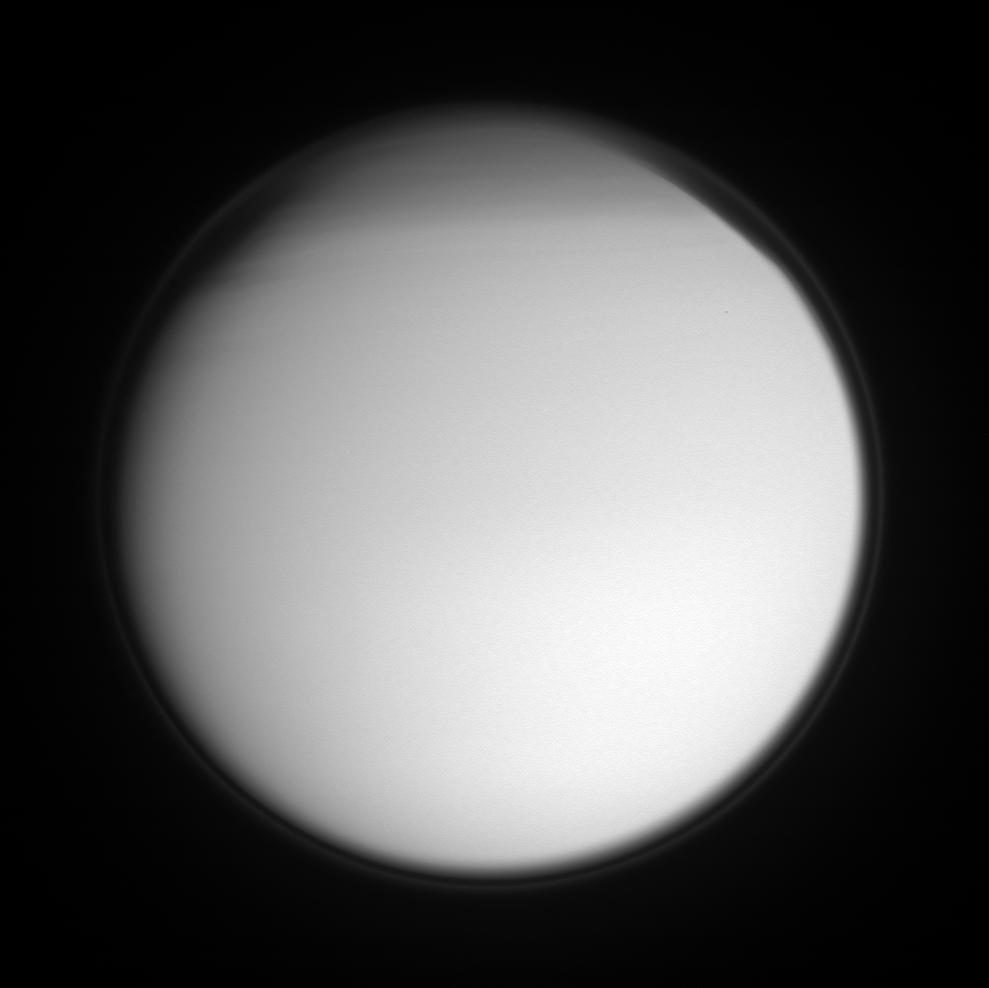
The team puts the amount at 0.1 to 1 parts per billion in Titan's mesosphere, a high layer of the moon's atmosphere. That is between one methanimine molecule in every billion molecules of gas and one in every ten billion.
Those middle-atmosphere amounts match what recent models of Titan's sunlight-driven chemistry predict. The authors read that as confirmation of the routes by which methanimine forms and breaks apart high in the atmosphere. Models that also produce it lower down, from galactic cosmic rays (high-energy particles arriving from space), fit the measurements poorly.
The paper concludes that those lower-atmosphere routes need adjusting. The same cosmic-ray production is predicted for other nitrogen-bearing molecules, among them ammonia and methylamine, which makes the gap a barrier to estimating what Titan's lower atmosphere contains.
The authors describe Titan as a chemical environment where organic molecules essential for life may be assembled without any biology, and they present the detection as motivation to search for further species of the same kind.
The paper, "Detection of CH2NH on Titan," was posted to the arXiv preprint server Nov. 14, 2026, and the journal version has not appeared yet.
Sources
- arXivPreprint