Parker Solar Probe Spots a Double Magnetic Twist in the Solar Wind
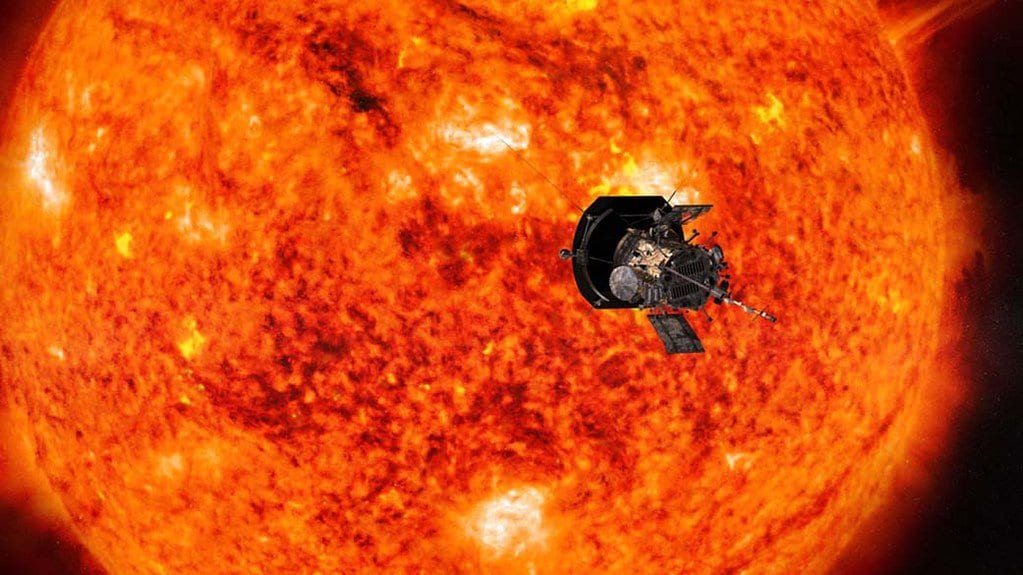
A matched pair of opposite magnetic twists has turned up in the solar wind, at the scale where the wind stops behaving like a flowing fluid and the motion of individual particles takes over.
The study's authors say the pattern sets a new observational constraint on how magnetic structure is carried outward through the solar wind rather than being fixed by local conditions.
Magnetic helicity describes how a magnetic field twists and which way the twist runs. The paper reports that across the range of scales where the solar wind churns like an ordinary fluid, helicity normally cannot be told apart from noise.
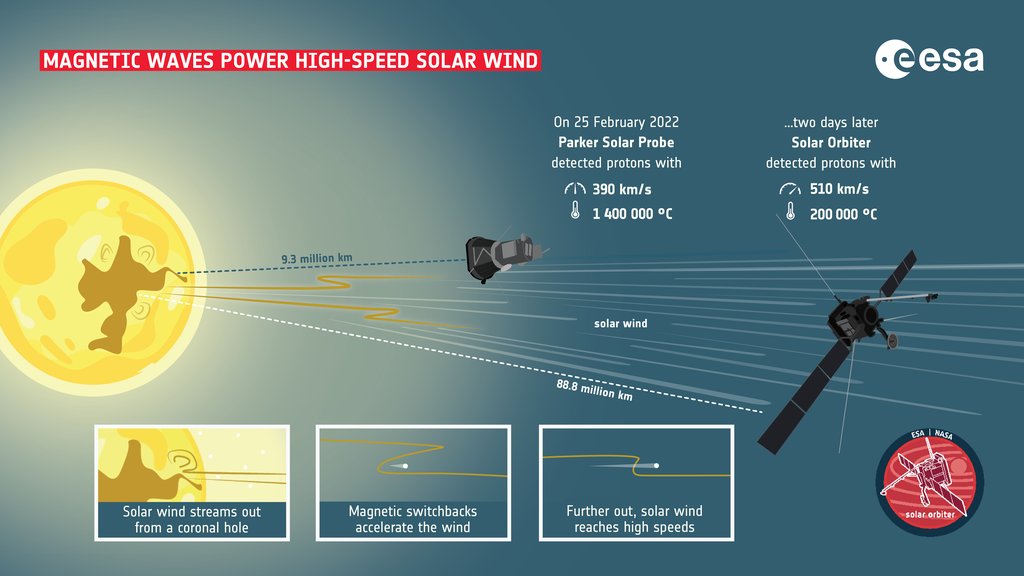
Masatomi Iizawa of Technische Universität Braunschweig and colleagues report a clear signal at the small-scale edge of that range, the boundary that plasma physicists call the MHD-kinetic interface. In Parker Solar Probe measurements taken between 0.1 and 0.8 astronomical units, roughly a tenth to four fifths of the distance from Earth to the Sun, it appears as two peaks of opposite sign, one twist running each way. The Letter appeared Oct. 13, 2026, in The Astrophysical Journal Letters.
The pair does not sit still. The authors report that it moves steadily toward lower frequencies, meaning larger scales, as it is measured farther from the Sun. That drift does not track what local particle physics would predict, such as the steady decline with distance in the rate at which ions circle the field lines. They read the mismatch as evidence that the magnetic structure evolves nonlocally, meaning it is not governed by conditions where it is measured.
The journal published the Letter open access, under a Creative Commons Attribution license.
Sources
- The Astrophysical Journal LettersPeer-reviewed