Sunspots on the Sun's Hidden Half Enter Models of Its Magnetic Field
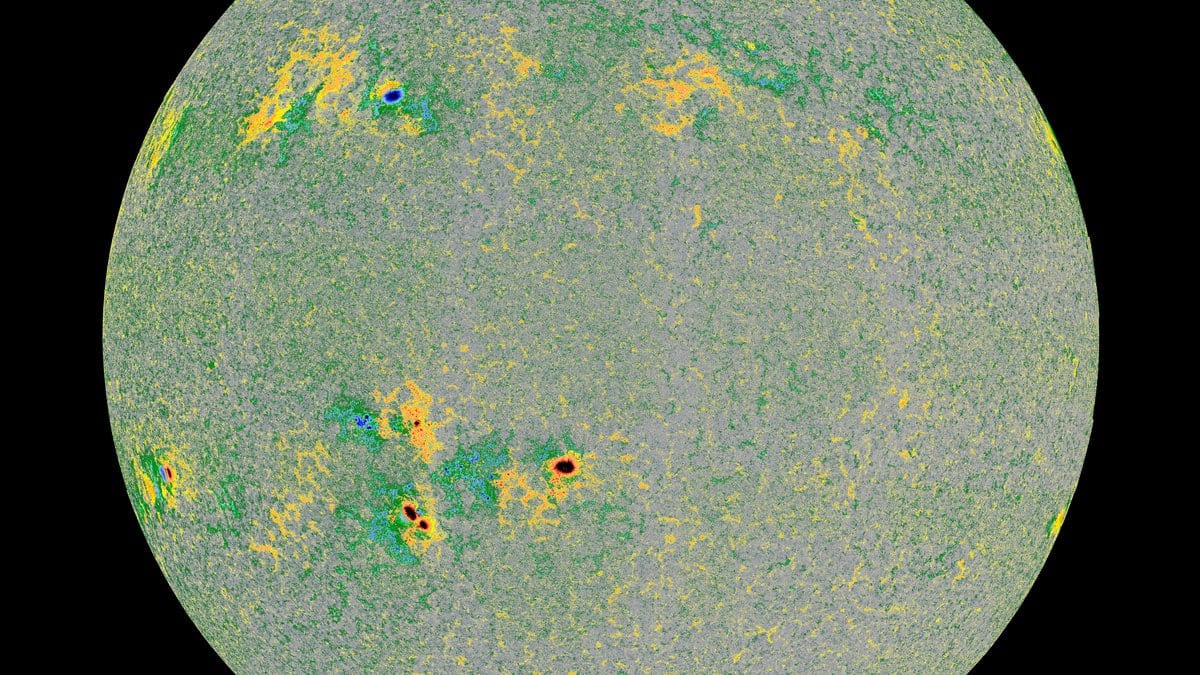
Researchers at Southwest Research Institute have built a way to feed sunspot groups detected on the far side of the Sun into a model that tracks how the Sun's magnetic field moves across its surface. The groups are found by helioseismology, which reads sound waves passing through the Sun to detect activity on the half facing away from Earth.
Those surface flux transport models set the starting conditions for the models of the Sun's outer atmosphere and solar wind that space weather forecasts are built on. The paper, published Oct. 8, 2026, in The Astrophysical Journal Supplement Series, says they are limited by the lack of direct information about magnetic field emerging on the far side. A sunspot group that grows out of sight can rotate into view already active.
Bibhuti Kumar Jha of Southwest Research Institute and colleagues trained a statistical filter to estimate how likely each far-side detection is to be a real sunspot group, using its magnetic flux, field strength and position. On their own evaluation, the filter reaches a precision of 0.93, meaning about nine in ten flagged detections were genuine. The cutoff was chosen to reject 90% of what the authors call ghost regions, or false detections. The work used far-side maps alongside ultraviolet images from NASA's STEREO spacecraft, covering May 2010 to August 2014.
The authors report that near-side-driven runs underestimate the Sun's total unsigned magnetic flux, the amount of field present regardless of its direction, by roughly 10% to 20% of the Sun's whole magnetic budget. That figure is a comparison between model runs, not a measurement of the Sun.
The team also reports that the framework follows individual regions through growth and decay in line with near-side observations over several solar rotations, and calls it a practical pathway for bringing far-side regions into such models. NASA's Heliophysics Division funded the work, with co-authors at Northwest Research Associates, Stanford University, the Naval Research Laboratory and the National Solar Observatory.
Sources
- The Astrophysical Journal Supplement SeriesPeer-reviewed