Skip to content
See the World Through ScienceA project of ALLATRA

The Spacecraft That Could Not Save Swift Flew Within 15 Kilometres of It
Space

Republish this story

Our work is licensed under Creative Commons BY-NC 4.0. You may republish this piece for free — with credit to ALLATRA Media and a link to the original, unedited beyond length trims, and not for commercial use.

Read the full license

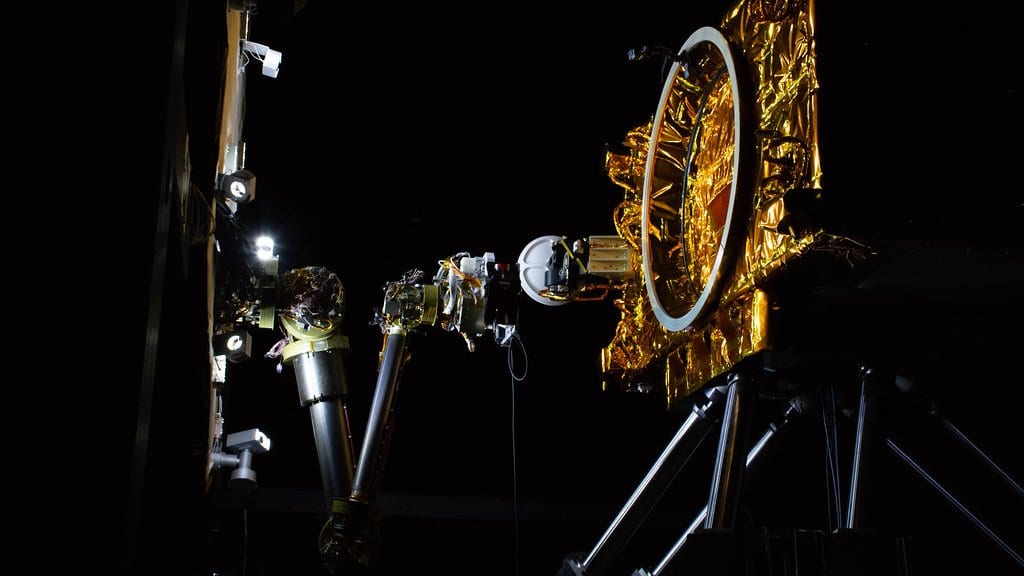
A robotic arm extends toward a gold-foil-wrapped satellite mock-up in a darkened spacecraft servicing test facility.
Ground testing of robotic satellite-servicing hardware at NASA's Goddard Space Flight Center, where a servicing arm approaches a satellite mock-up. Illustrative: this shows the kind of robotic servicing work LINK was built for, not LINK or the Swift observatory themselves."Testing Satellite Servicing Technologies" by NASA Goddard Photo and Video, via nasa, CC-BY-2.0 · CC-BY-2.0

Katalyst Space's LINK spacecraft flew to within 12 to 15 kilometers of NASA's Neil Gehrels Swift Observatory last week, carrying out proximity and hardware tests that remained after the reboost mission was abandoned in August, NASA reported Sept. 4.

Katalyst built LINK as a robotic servicing vehicle intended to raise Swift's orbit and extend the observatory's life. NASA and Katalyst announced on Aug. 19 that attitude-control problems with LINK had forced them to drop the capture and boost attempt, with Swift expected to re-enter later in 2026. The proximity work was what remained.

In the days before the Sept. 4 post, Katalyst raised LINK's orbit and adjusted it to align with Swift's, NASA said. The team deployed all three of LINK's robotic arms and fired all three of its xenon-fueled electric thrusters simultaneously. An image of that firing, released by Katalyst, is dated Aug. 30. LINK then closed to between 7.5 and 9 miles (12 to 15 kilometers) of Swift, and will make no closer approach for the rest of its time in orbit.

The Katalyst team estimates LINK will deorbit within two to three weeks, according to NASA. The agency described the remaining work as collecting data to inform future spacecraft servicing technology and operations.

Swift itself is still operating. The observatory restarted science observations on Aug. 28.

Sources

Spot an error?

Spot an error?

Report an error

Spotted a mistake on this page? Tell us what's wrong and our editors will take a look.

What kind of problem?

Only if you'd like us to be able to follow up. We won't use it for anything else.

We correct mistakes openly. Select any text to flag it. Fixes are logged under our Corrections Policy.

Report an error

Reporting on

The Spacecraft That Could Not Save Swift Flew Within 15 Kilometres of It

What kind of problem?

Only if you'd like us to be able to follow up. We won't use it for anything else.

We read every report. Corrections are logged publicly.