Greenland's Year-Round Ice Jams Can Break up All at Once, a New Model Finds
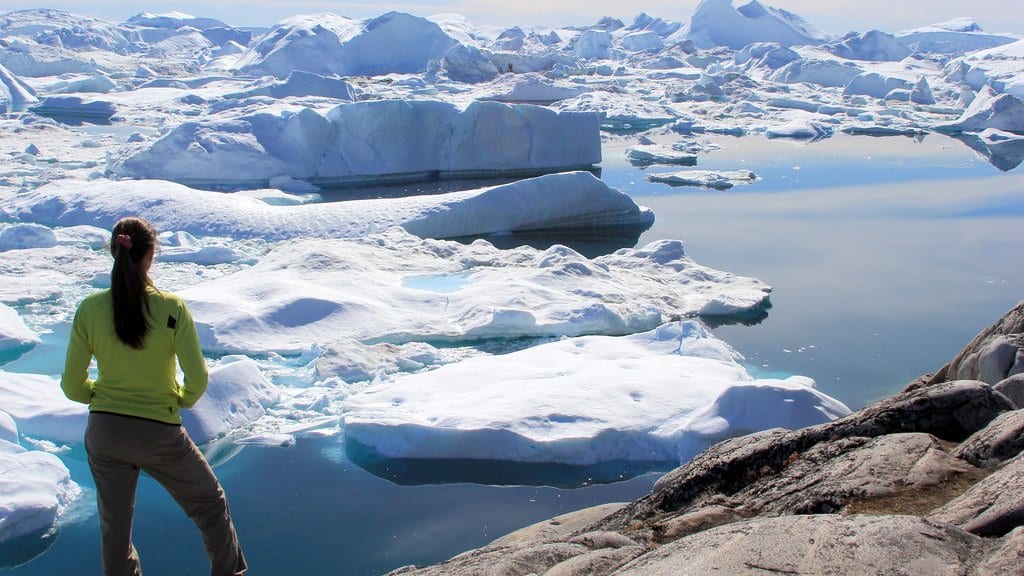
A US research team has modeled the floating jam of icebergs and broken sea ice that fills Greenland's fjords, a mass glaciologists call ice mélange, and finds in its simulations that where the jam lasts all year, an increase in melting below the waterline can tip it into a sudden collapse. The study was published Oct. 19, 2026, in Nature Communications.
The authors report that rapid ice loss from the Greenland Ice Sheet is responsible for roughly 20% of global sea level rise since 2002, and that almost half of that loss is moderated by the presence of mélange, which influences how quickly a glacier sheds icebergs and melts. Mélange that lasts all year is currently present at the majority of Greenland's largest glaciers, and in the simulations its loss would drive faster iceberg loss, more ice loss from the glaciers and more sea level rise.
Observations show a spread of behavior across Greenland's fjords, from a collapse each spring that plays out over a few days to mélange that persists year after year, and the authors write that the drivers of that range are poorly understood. Their Nature Communications paper pairs a detailed model of how water circulates in a fjord with one that treats the mélange as a granular flow, a mass of loose pieces that flows like a fluid. In multi-year simulations, the coupled model reproduced the observed seasonal cycle and characterized how a collapse happens. The authors then turned the collapse point into a threshold and compared it with observations from five fjords across Greenland.
The first author is Paul T. Summers, of Tufts University and the Georgia Institute of Technology, and the senior author is Justin C. Burton, a physicist at Emory University. The US National Science Foundation funded the work through the GLACIOME project. The paper is open access.
Sources
- Nature CommunicationsPeer-reviewed