Physicists Build an Ion Trap From a Single Block of Glass
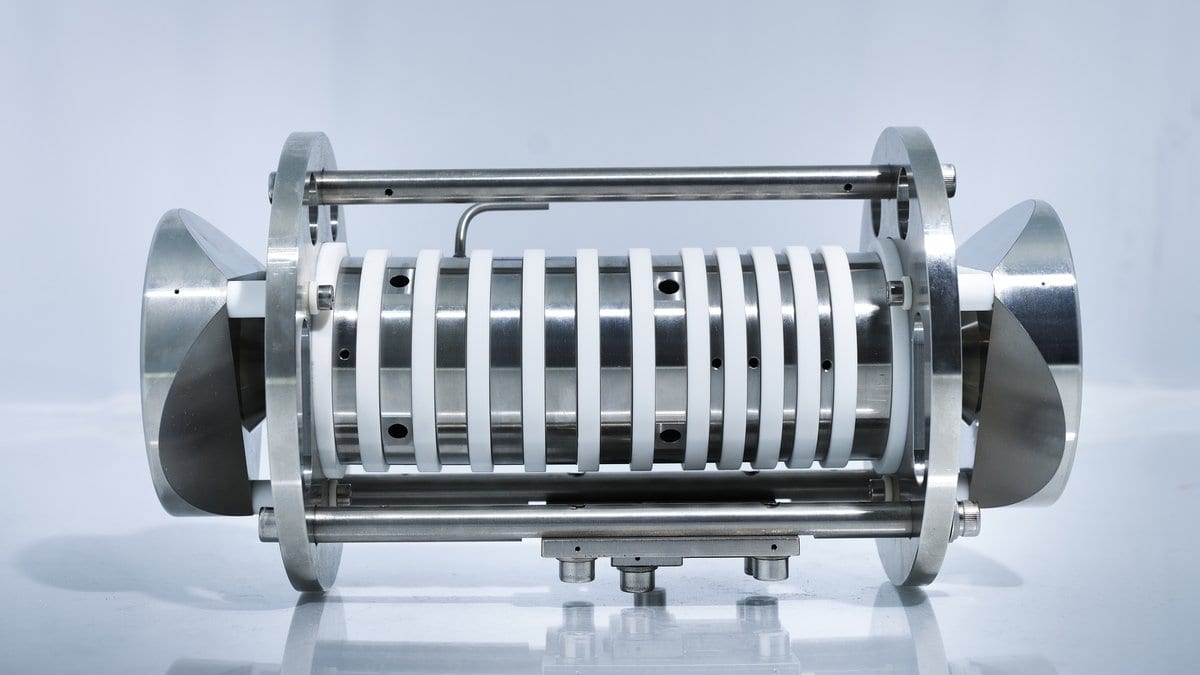
A group at Rice University, Duke University and the University of Maryland has built an ion trap out of a single block of glass, and reports that it holds ytterbium ions steadily while still leaving lasers and lenses wide access to them. The trap was described Oct. 13, 2026, in Physical Review Applied.
The two established designs pull against each other. Flat chip traps are made by the precise methods of the chip industry, but hold ions in shallow wells. Traps whose electrodes surround the ion on all sides hold it more firmly and let it pick up stray motion more slowly. They are normally machined as separate parts and assembled by hand. The paper calls the combination a significant technical challenge: low heating and wide optical access, at the high radio-frequency voltages that heavy ions such as ytterbium and barium need.
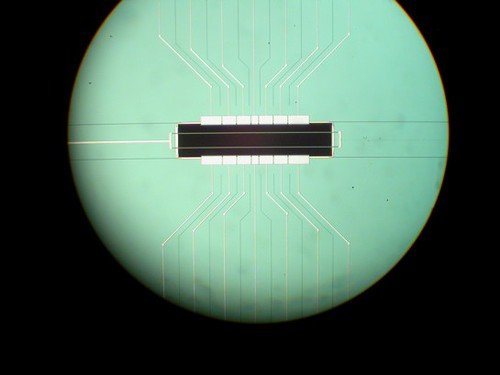
Their trap is one piece of fused silica, a pure glass, with its segmented electrodes built onto it, and the ions sit 250 micrometers away from them. Abhishek Menon of Rice University, Roman Zhuravel of Rice and TAMOS Inc., and colleagues report trapping fields that stay even over more than 200 micrometers along the trap's axis. Optical access from several directions reaches up to 0.7 numerical aperture, a measure of light gathering. Heating of the ions' sideways motion ran as low as about 1.1 quanta of vibration per second near room temperature.
The ions' shared side-to-side motion stayed coherent for about 96 milliseconds, and two ions in the trap were entangled with each other.
Its authors conclude that traps made this way are a scalable platform for quantum simulation, computation, metrology and networking with heavy ions. Two of the paper's authors are at Translume Inc. in Ann Arbor, Michigan, and two of the Rice authors also list TAMOS Inc. in Houston. The paper is open access under a Creative Commons Attribution license, so anyone can read it in full.
Sources
- Physical Review AppliedPeer-reviewed