Bleached Coral Regained Its Algae After Days of Contact With a Healthy Clone
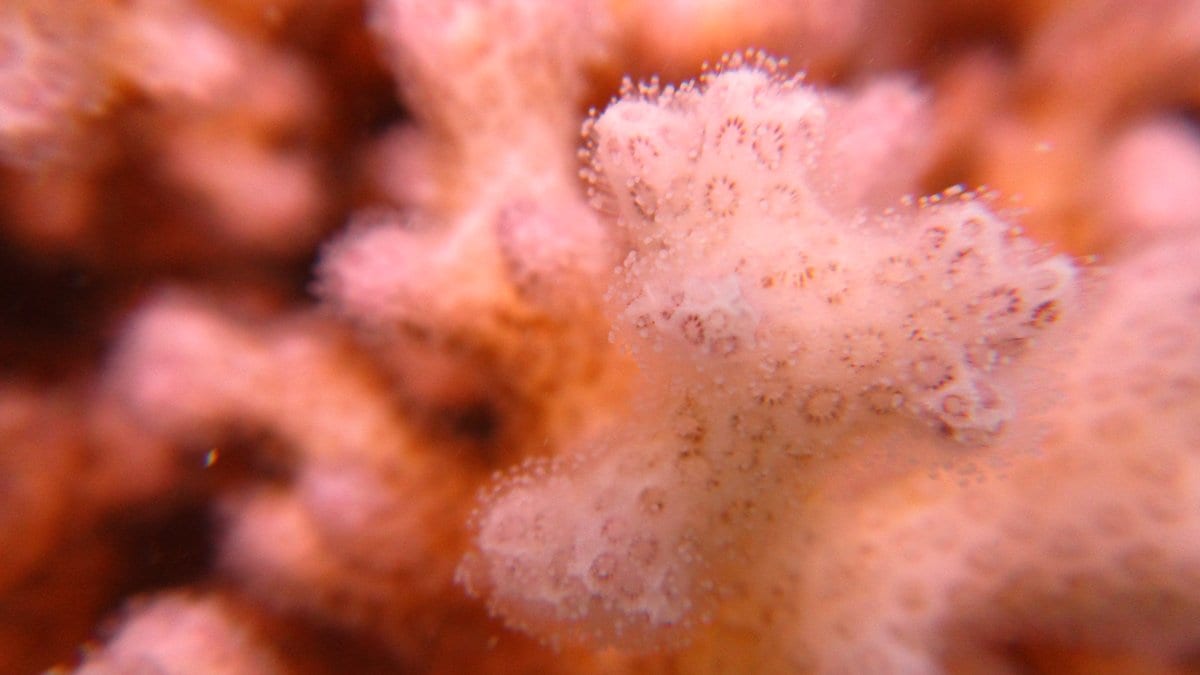
Daniel S. Collins, Stephen R. Palumbi and colleagues at Stanford University's Hopkins Marine Station report that bleached coral fragments regained the algae that feed them after only brief physical contact with healthy fragments of the same colony, in laboratory experiments published Oct. 14, 2026, in Science Advances.
Coral bleaching is the heat-driven loss of those single-celled algae, which live inside coral tissue. The paper calls it a major driver of global coral reef decline, and describes the two known routes back, rebuilding from the few algae left inside a coral or taking up new ones from the water, as often too slow to stop the coral from dying first. It presents contact transfer as a natural process nobody had described, and as a foundation for research into possible recovery treatments rather than a treatment itself.
Transfer took days to weeks in the experiments. A single week of contact, and in some cases as few as 3 days, gave a bleached fragment enough algae to begin a sustained and full recovery on its own. By one week the algae population was doubling about every 4 days. The authors set that against most recovery times for corals in the field and call it up to an order of magnitude faster.
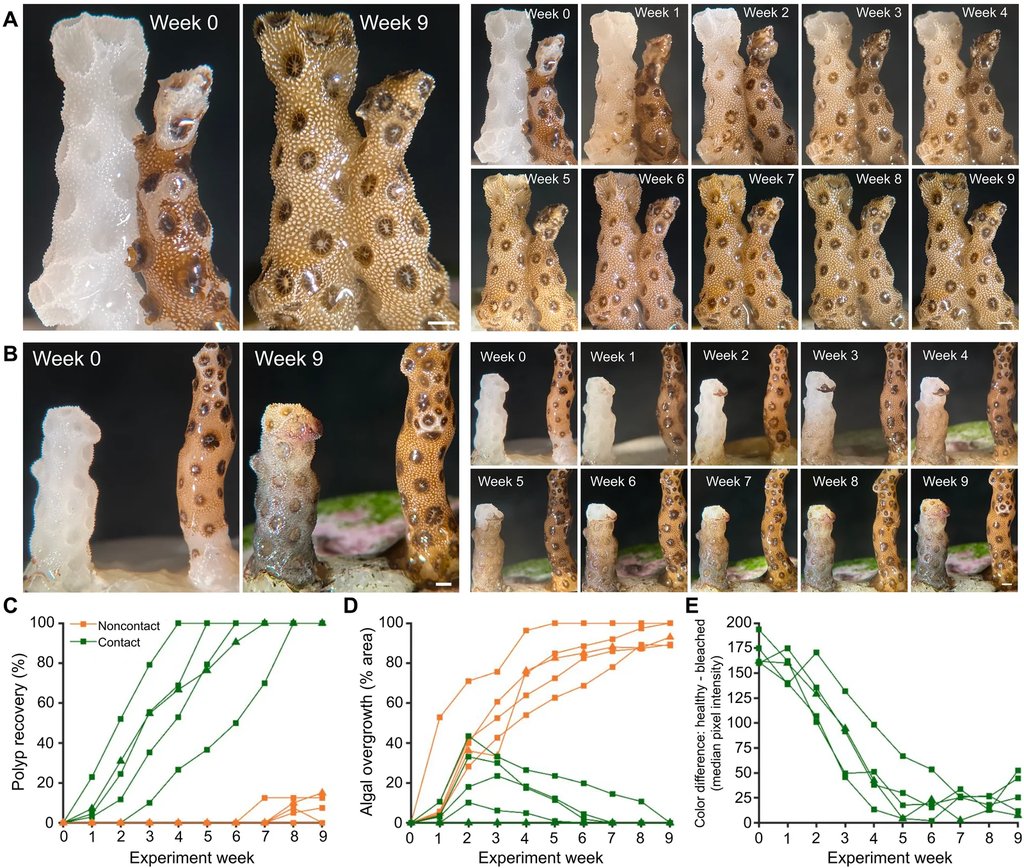
The paper identifies tissue fusion, the two fragments growing together, as the mechanism, and it moves algae in one direction: from healthy tissue into bleached tissue. Because tissues fuse only between corals of the same genet, meaning genetically identical colonies, contact recovery worked only between clonemates; pairings of different genets set off antagonistic interactions instead.
A second, slower route is not blocked by genetics: polyps, the individual animals that make up a colony, took up algae immediately on contact in both same-genet and mixed pairings, but that pathway on its own was not enough to bring a colony back.
Sources
- Science AdvancesPeer-reviewed