Webb Could Not See the Planets That Gas Motions Say Are There
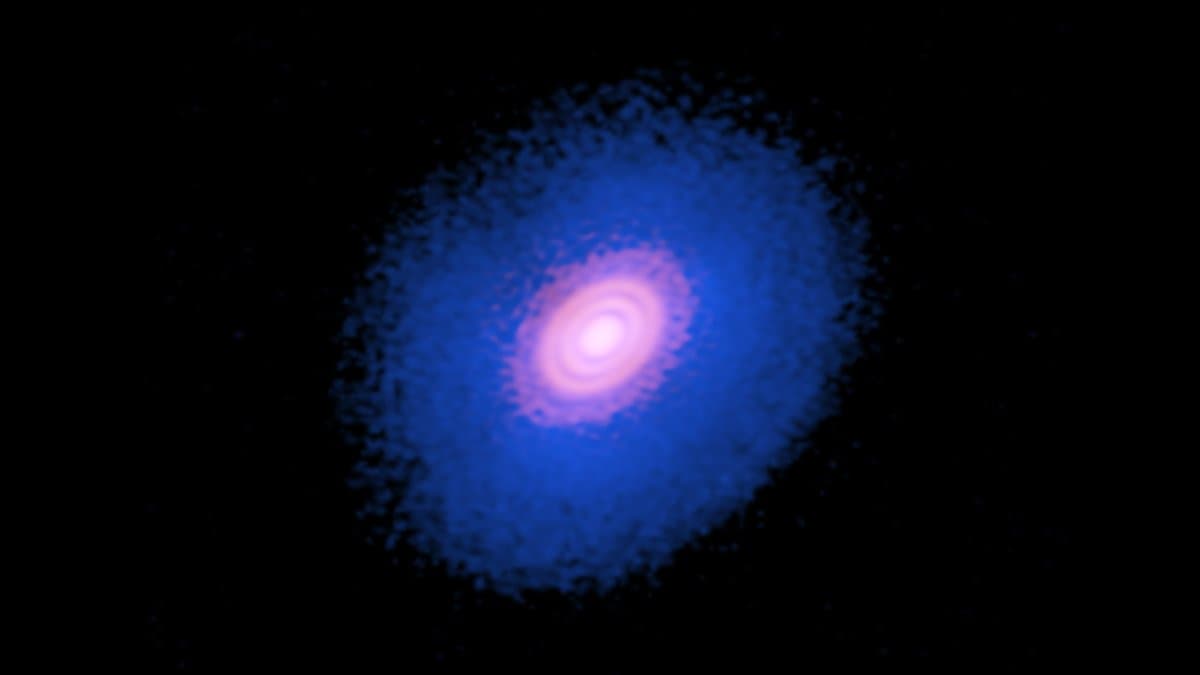
Astronomers pointed the James Webb Space Telescope at five young stars to photograph giant planets inferred from the motion of gas around them, and found no sign of any.
The planets have never been seen. Disturbances in the carbon monoxide gas mapped by the ALMA radio array have been read as the wakes of giant planets carving the disks of dust and gas around newly formed stars, and a direct picture would settle it. Gabriele Cugno and colleagues report in a paper posted to arXiv on Sept. 11 and accepted by The Astronomical Journal that theirs does not settle it either way: the search was not sensitive enough to reach the masses the gas motions imply, so finding nothing does not mean nothing is there.
The team used MIRI, Webb's mid-infrared camera, with a coronagraph, a mask that blots out the star's light. Its targets were the disks around HD163296, RXJ1615.3-3255, RXJ1842.9-3532, SY Cha and LkCa 15. It looked beyond roughly 70 times the distance from Earth to the Sun. No point of light consistent with an embedded planet appeared in any of the five.
To gauge its sensitivity, the team injected artificial planets into the data and tried to recover them. Those tests gave upper limits of roughly 3 to 20 Jupiter masses at separations of a few hundred times that distance, assuming no extra heat from nearby material. The gas motions point to planets of about 1 to 5 Jupiter masses, below most of that range.
Three of the five disks did show a broad glow in the same light, tracing the outer disk out about as far as ALMA sees. The authors attribute their limits mainly to that light, from the inner disk as well as the outer one, swamping the search.
They write that planets still buried in the material they formed from are hard to image this far out, and that the lessons apply to the Extremely Large Telescope, which will search closer in, where giant planets are thought to be more common.
Sources
- arXivPreprint