X-Rays Near Earth Reveal the Heavier Elements in the Solar Wind
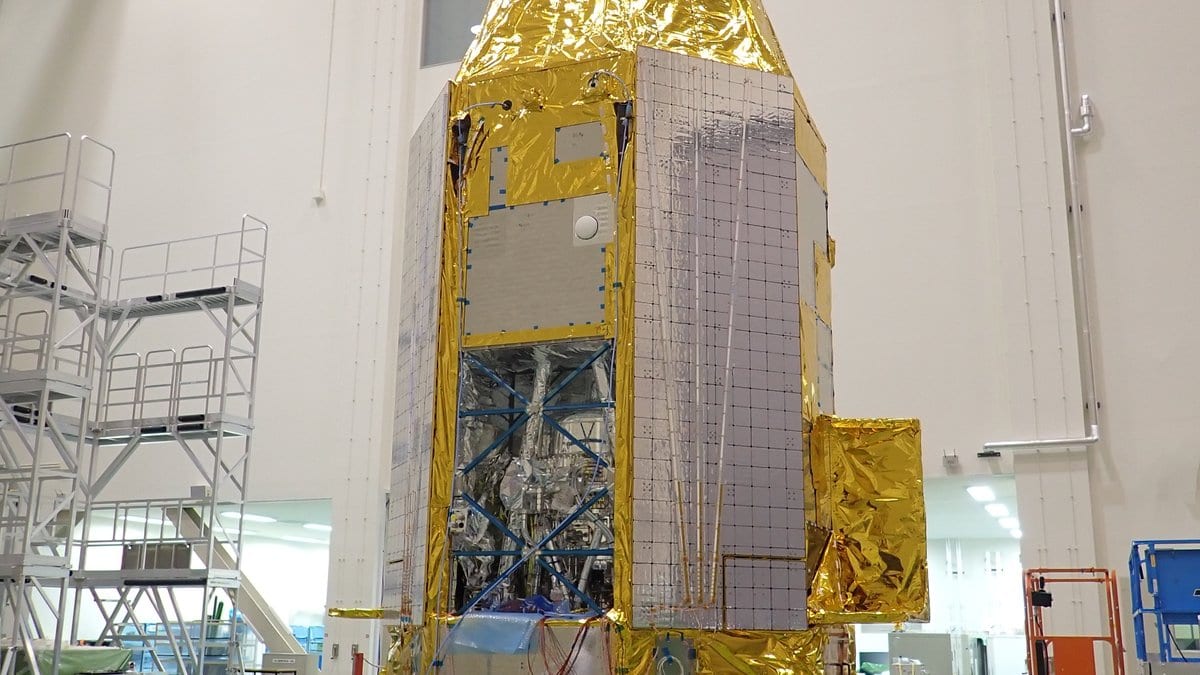
The X-ray telescope XRISM has detected neon, magnesium, silicon and iron in X-rays emitted by the solar wind near Earth, alongside the lighter carbon, nitrogen and oxygen that such measurements usually pick up. The X-rays come from charge exchange, in which an ion in the solar wind strips an electron off a neutral atom and gives off an X-ray as that electron settles.
Because each line's energy depends on which ion produced it, the emission is a way of reading the solar wind's composition from a distance. Daijiro Kanno of Tokyo Metropolitan University and colleagues report the detection in Publications of the Astronomical Society of Japan, published Nov. 13, 2026. The authors give a practical reason to want it: since an instrument problem in 2011, the ion composition spectrometer on NASA's Advanced Composition Explorer has stopped supplying composition data for heavier elements such as neon, magnesium and silicon.
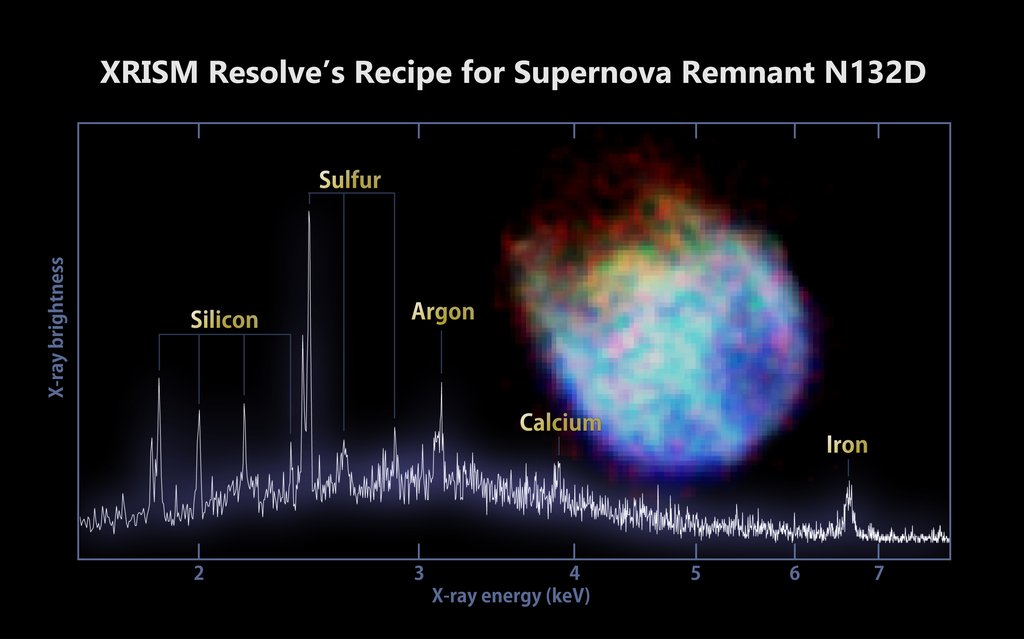
The observation ran from Aug. 9 to Aug. 13, 2024, during a stretch of strong solar activity. An X1.3-class flare went off the day before it began, and coronal mass ejections, the clouds of plasma the Sun throws off, arrived in succession. The soft X-ray count rate more than doubled, rising at nearly the same time as the solar wind proton flux measured by the same spacecraft. The four heavier elements showed up at better than 15 sigma, a measure of confidence, not of quantity: the lines are far too strong to be noise.
Fitting the spectrum with a charge-exchange model, the team found that the more intense the flare, the more highly ionized those four elements were, which they read as a sign that heating in the Sun's corona becomes more efficient in stronger flares.
Charge-exchange X-rays are not a new sight, and Chandra, XMM-Newton and Suzaku have all recorded them. The team describes its own result as a demonstration that XRISM's Xtend camera can do the same for heavy ions. The data were not gathered for that purpose: the telescope was pointed at a distant galaxy, and the emission turned up across its whole field of view.
Sources
- Publications of the Astronomical Society of JapanPeer-reviewed