Some Meteorites Take a Million Times More Tumbling to Crumble Than Others
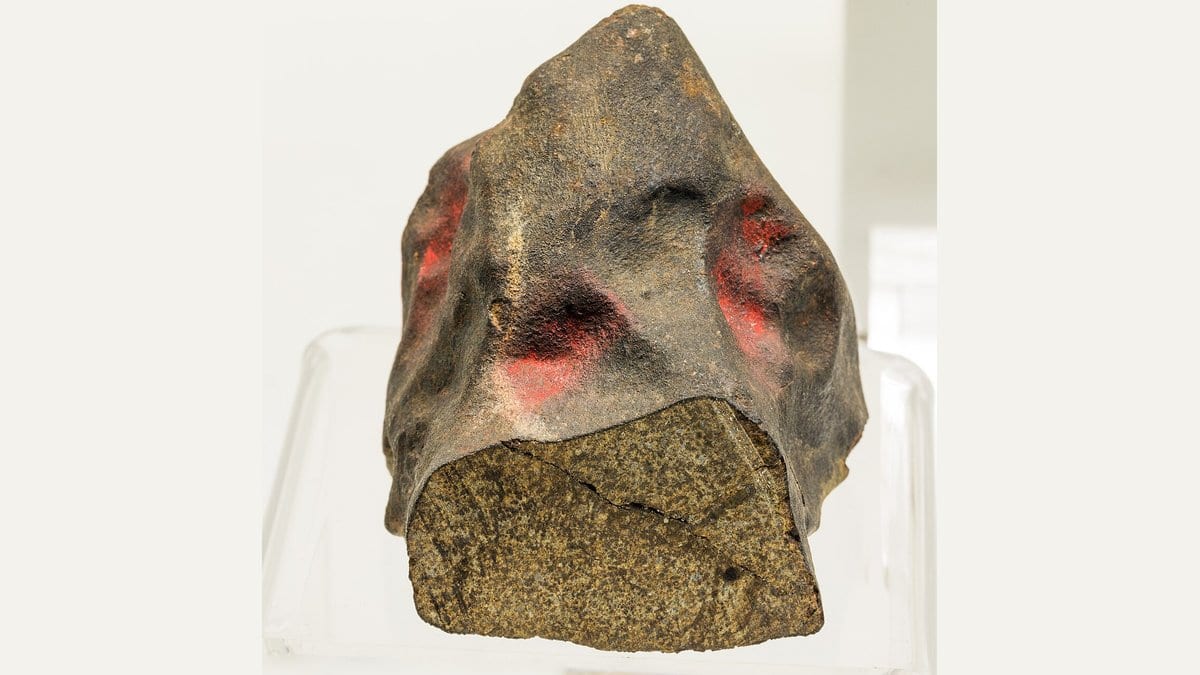
Researchers at Arizona State University and two partner institutions tumbled stony meteorites in a laboratory mill and measured how long each took to fall apart. The number of rotations needed to break a sample down completely varies by more than six orders of magnitude, they report: a factor of more than a million between the toughest and the most fragile. The paper was published Sept. 1 in Communications Earth & Environment.
The team defines friability as the tendency to crumble under repeated low stresses, and says it quantified the property "through laboratory tumbling experiments on a broad range of stony near-Earth objects." Suraj Bhatt of ASU's Ira A. Fulton Schools of Engineering is the lead author; the co-authors are at ASU's Buseck Center for Meteorite Studies, the University of Puerto Rico at Humacao and the University of Arizona's Lunar and Planetary Laboratory.
Breakup does not run at a steady rate. It first accelerates as impacts accumulate, then slows as the breakable material is used up. The authors fit a log-logistic model, an S-shaped curve, to that behavior and describe a material-dependent limit they call the "pillow-effect," in which accumulating fine debris cushions further impacts.
The spread across samples indicates "much broader timescales for regolith maturation and rubble-pile evolution than previously assumed," the authors write, referring to the loose surface layer that builds up on an asteroid. Fine dust from friable material may also increase cohesion under microgravity, which could help explain the weak but cohesive surfaces recorded at the rubble-pile asteroids Bennu and Ryugu.
The work was funded under NASA's Yearly Opportunity for Research in Planetary Defense. The journal records the paper as received Dec. 2, 2025, and accepted March 27, 2026.
Sources
- www.nature.comPeer-reviewed