A Test Image of the Helix Nebula Caught a Dying Star's Debris Being Torn Apart
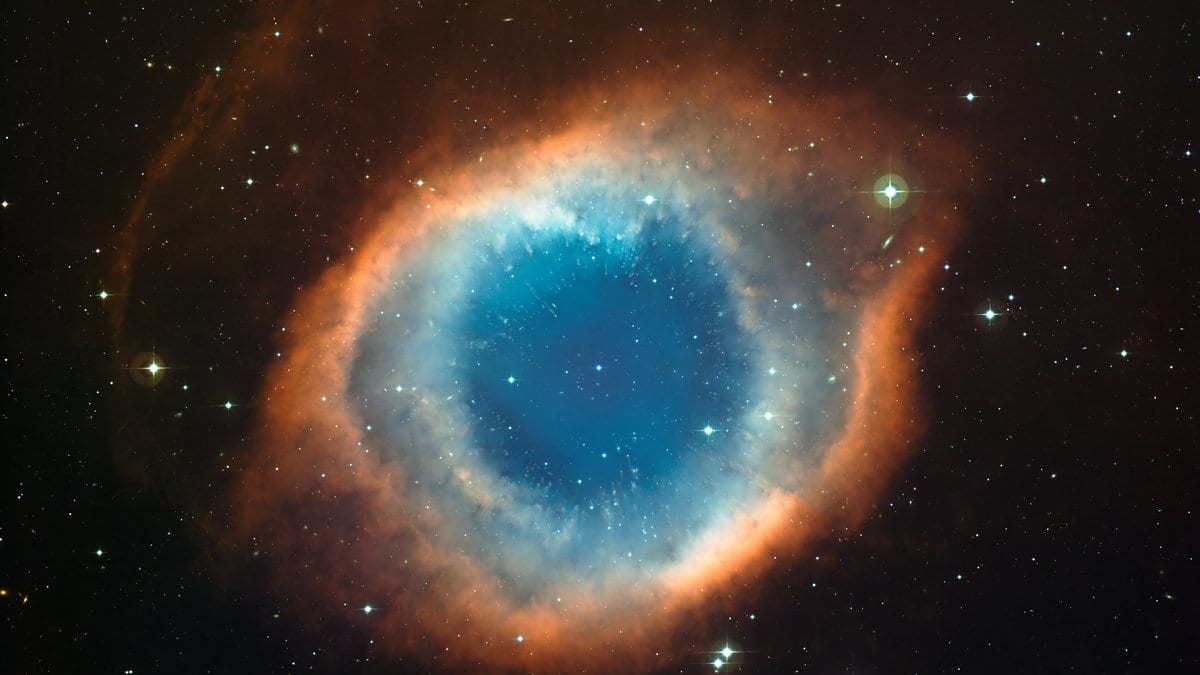
Astronomers have counted 22 arc-shaped shock waves in the faint outer halo of the Helix Nebula, where clumps of material shed by a dying star are ploughing into the thin gas between stars. The work was published in Nature on 12 August by a team led by Pieter van Dokkum of Yale University. The figures below come from a Northwestern University release issued the same day.
The Helix Nebula lies about 650 light-years away in the constellation Aquarius, according to the release, and the remnant of the star that made it, a white dwarf, sits at its centre. The new observations reach past the bright ring into what Northwestern calls the nebula's extraordinarily faint outer halo. There, on the eastern side, the team found 22 complete or partial glowing arcs, which form when largely invisible clumps of debris travel fast through interstellar gas and collide with it.
The arcs change with distance from the star. Northwestern says those nearest the centre are large, thin and sharply defined, while those further out are smaller, fuzzier and more broken up. The team reads that as steady erosion, with a fragment staying intact for roughly 10,000 years after it meets the surrounding gas before being shredded and mixed into space.
The images were a by-product of building an instrument. They were taken at El Sauce Observatory in Chile with MOTHRA, an array still under construction and not fully operating, and the release says the team thought it was taking a calibration image. When finished, MOTHRA will carry 1,140 telephoto lenses with filters tuned to the faint glow of gas.
"We are seeing material shed near the end of a star's life being broken apart and returned to the galaxy," van Dokkum said in the release, which describes the process as cosmic recycling. He said that handoff, from stellar debris to the diffuse gas between stars, "has been very difficult to observe".
MOTHRA and the Dragonfly Focused Research Organization behind it are funded by Alex Gerko, founder and chief executive of XTX Markets, according to Northwestern.