Skip to content
See the World Through ScienceA project of ALLATRA
Source: Peer-reviewedProceedings of the National Academy of Sciences1 source

A Decade of Mars Air Samples Points to Thin Water Films in the Soil
Space

Republish this story

Our work is licensed under Creative Commons BY-NC 4.0. You may republish this piece for free — with credit to ALLATRA Media and a link to the original, unedited beyond length trims, and not for commercial use.

Read the full license

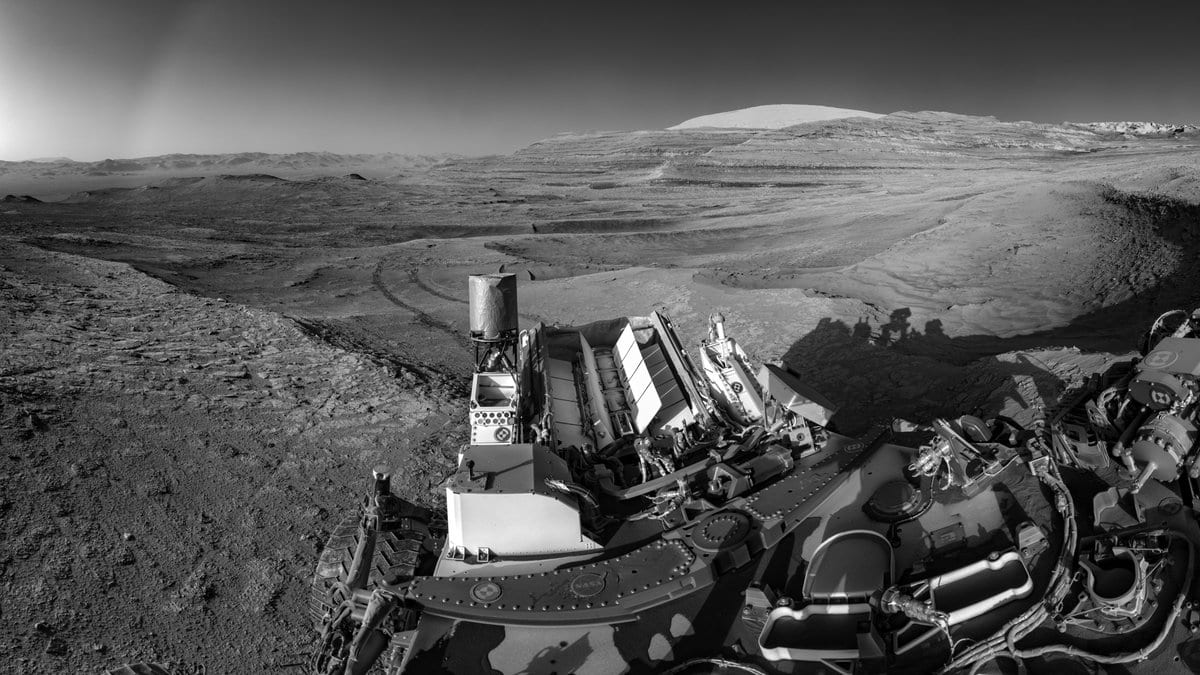
A grayscale view across the dusty floor of Gale crater on Mars, with wheel tracks running back toward the horizon and part of the rover deck in the foreground.
The floor of Gale crater, the one site on Mars where the rover has sampled the air in place since 2012."This view of tracks trailing NASA’s Curiosity rover was captured July 26, 2025, as the rover simultaneously relayed data to a Mars orbiter (curiosity-looks-back-toward-its-landing-site)" by NASA/JPL-Caltech, via Wikimedia Commons, Public domain

NASA researchers report that the carbon dioxide in the air above Gale crater on Mars carries slightly more heavy oxygen in spring and summer than at other times of the year. The pattern turned up in measurements the Curiosity rover made in place between 2012 and 2025, Mars Years 31 through 38, and the team could reproduce it only by letting the gas trade oxygen with thin, liquid-like films of water at or just under the surface.
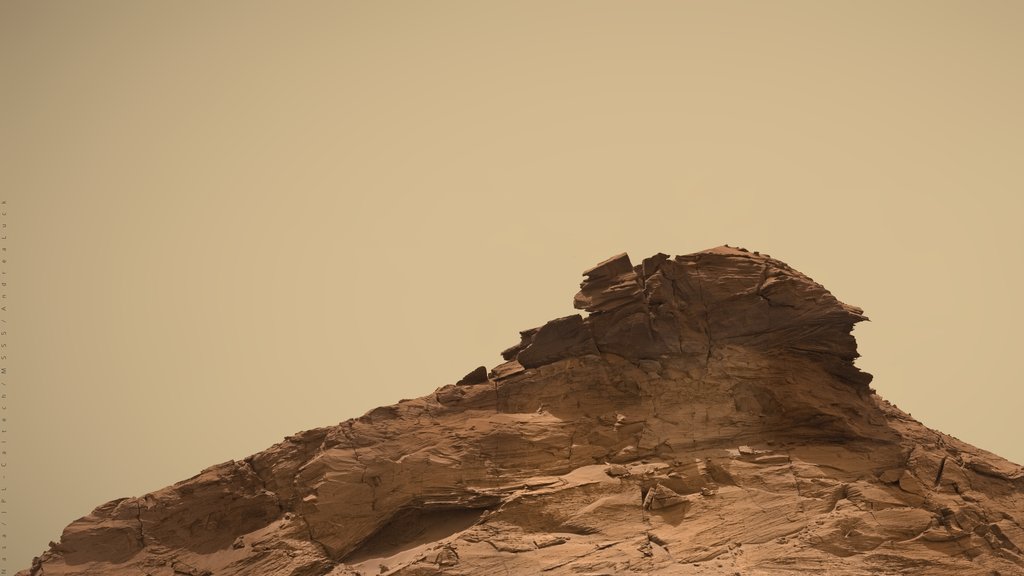
A wind-carved rocky outcrop on the lower slopes inside Gale crater on Mars, with a hazy tan sky above it.
Wind-cut rock on the lower slopes above the crater floor, photographed Feb. 13, 2022, with the dusty martian sky behind it. "Mars - Blackcraig Butte - Climbing Mount Sharp - Gale Crater - Nasa's Curiosity SOL 3383 (51878193636)" by Andrea Luck, via Wikimedia Commons, CC BY 2.0

The record comes from Heather B. Franz of NASA's Goddard Space Flight Center and colleagues and was published Nov. 16, 2026, in the Proceedings of the National Academy of Sciences. They call it the first long-term record of the isotopic makeup of martian carbon dioxide, the mix of heavier and lighter forms of its atoms. The campaigns behind it were designed to look for changes over a martian day and across the seasons.
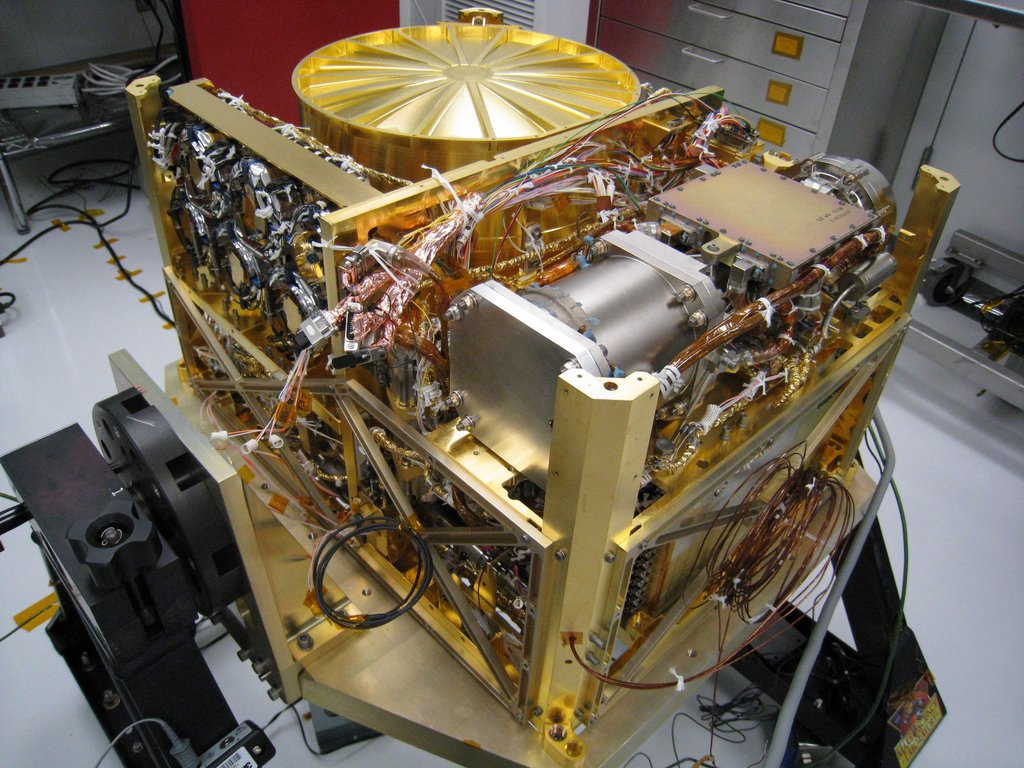
A gold-colored box of flight hardware, wrapped in cabling and bolted into a frame, standing in a laboratory.
The rover chemistry suite in the laboratory before launch, photographed Oct. 7, 2010. It is the hardware that measures the gas reported in the study. "Sample Analysis at Mars MSL" by NASA/GSFC/SAM, via Wikimedia Commons, Public domain

Paired daytime and nighttime analyses, run at the start and the end of the record, showed no significant difference between the two. The seasonal signal did show up: a modest enrichment in the heavy isotopes of oxygen during spring and summer in both the northern and southern hemispheres.

Franz and colleagues report that each candidate explanation falls short on its own: the gas subliming off the polar ice caps, coming off reservoirs at lower latitudes, or being broken apart by sunlight. What did reproduce the enrichment was a model in which the gas swaps oxygen with water rich in the heavy form of the element, sitting in thin, liquid-like films on the surface or held inside the soil, as Mars swings closest to the Sun. That is a modeling result and not a detection of water, and the authors note that one site near the martian equator cannot separate global, regional and local contributions.

The enrichment is weaker near the far point of the orbit, which the team says may reflect colder conditions less favorable to the exchange. The carbon isotopes swing less than the oxygen ones, consistent with less carbon moving between the air and the surface.

Sources

Spot an error?

Spot an error?

Report an error

Spotted a mistake on this page? Tell us what's wrong and our editors will take a look.

What kind of problem?

Only if you'd like us to be able to follow up. We won't use it for anything else.

We correct mistakes openly. Select any text to flag it. Fixes are logged under our Corrections Policy.

Report an error

Reporting on

A Decade of Mars Air Samples Points to Thin Water Films in the Soil

What kind of problem?

Only if you'd like us to be able to follow up. We won't use it for anything else.

We read every report. Corrections are logged publicly.