Juno Looks Under Jupiter's Polar Storms and Finds They Are Not Alike
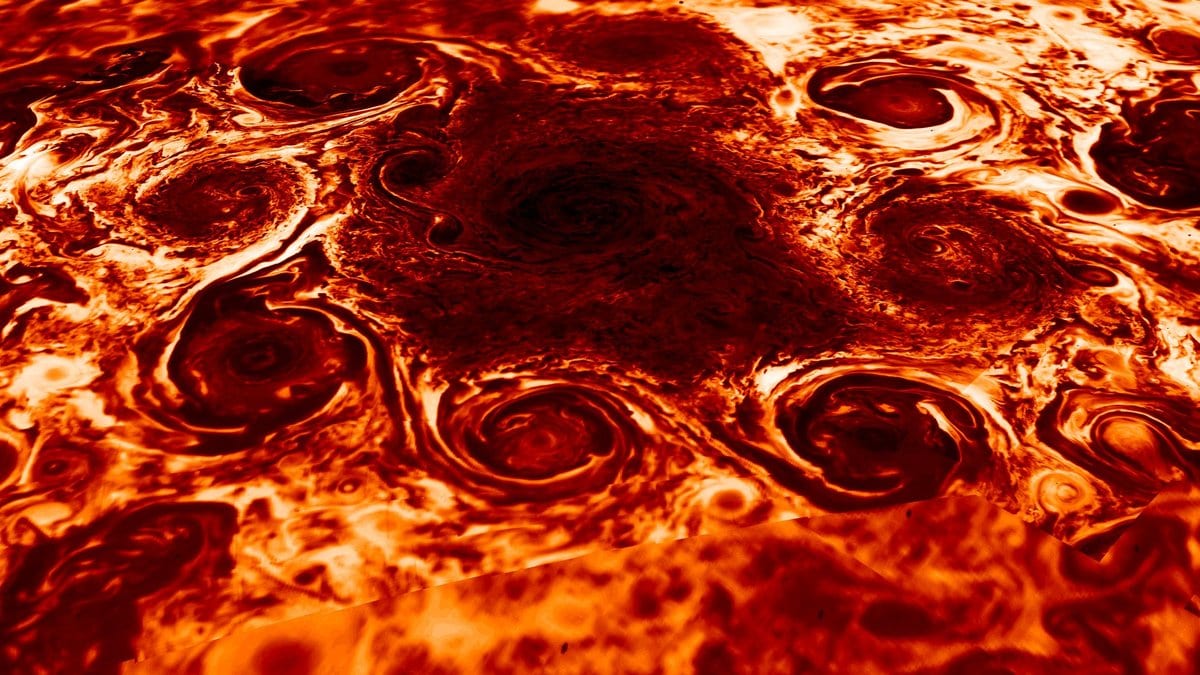
A team working with NASA's Juno spacecraft has mapped the structure beneath the ring of eight cyclones that circles Jupiter's north pole, and finds the eight are not copies of one another. Jiheng Hu of the University of Michigan and colleagues report warm, ammonia-poor cores in all eight, reaching down to about the 5-bar level where water condenses, with five markedly stronger than the other three. The work is a preprint posted Nov. 16, 2026, and has not been peer reviewed. The paper's own notes say it has been submitted.
The authors say that the depth and vertical structure of these cyclones had not been resolved before, and that earlier models treated the ring and the cyclone at the pole as much the same kind of structure. On their reading, the new measurements point instead to different origins and different behavior for the two.
Juno's Microwave Radiometer records the microwaves the atmosphere itself gives off, which travel out through the clouds. That is what lets it read temperature and gas well below the cloud tops rather than at them.
The paper is explicit that microwave brightness alone cannot separate warming from a loss of ammonia, since either one brightens the signal. On both readings the five stronger cyclones show roughly twice the effect of the other three, and the weaker three reach less deep.
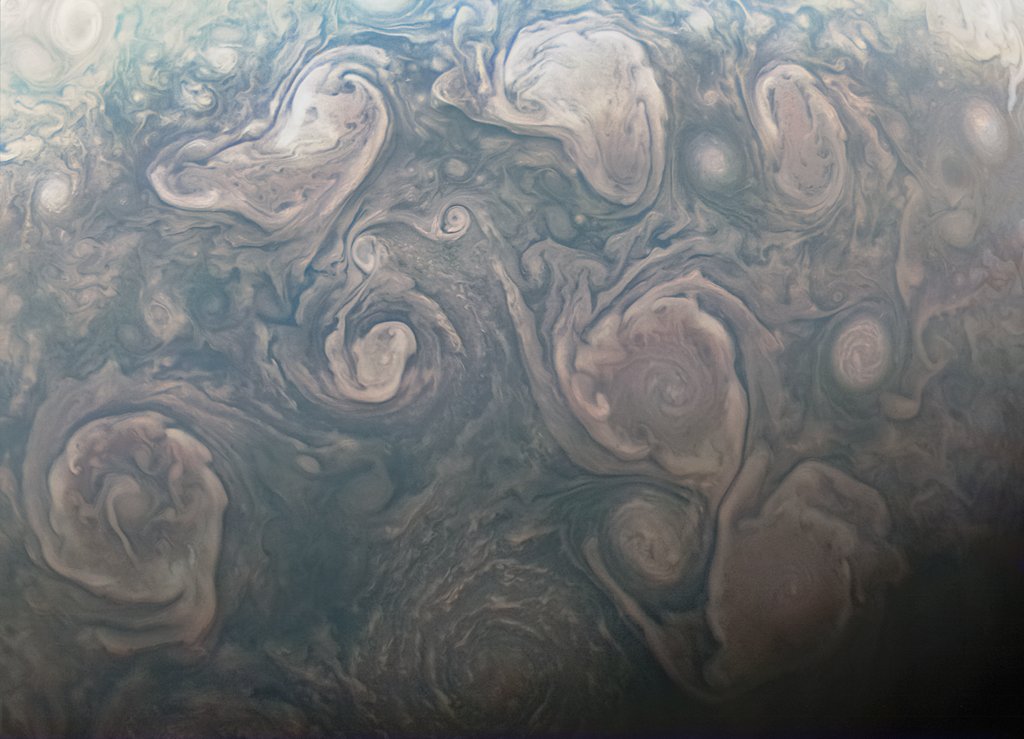
The cyclone at the pole itself is different again. It looks larger and cloudier than its neighbors in visible and infrared images, yet it is almost invisible in the microwave maps; the authors read it as having much the same temperature and ammonia structure as the polar air around it.
Juno discovered this arrangement, a ring of cyclones around a central one at each of Jupiter's poles. The paper puts the eight northern cyclones at roughly 4,000 to 5,000 km across and stable in position and shape, while the weather outside their octagon changes from one orbit to the next. The measurements come from passes over the north pole between May 2023 and May 2024.
Sources
- arXivPreprint