Skip to content
See the World Through ScienceA project of ALLATRA
Source: Peer-reviewedThe Astrophysical Journal Letters1 source

A Faint Gamma-Ray Burst Left One of the Brightest Afterglows Ever Observed
Space

Republish this story

Our work is licensed under Creative Commons BY-NC 4.0. You may republish this piece for free — with credit to ALLATRA Media and a link to the original, unedited beyond length trims, and not for commercial use.

Read the full license

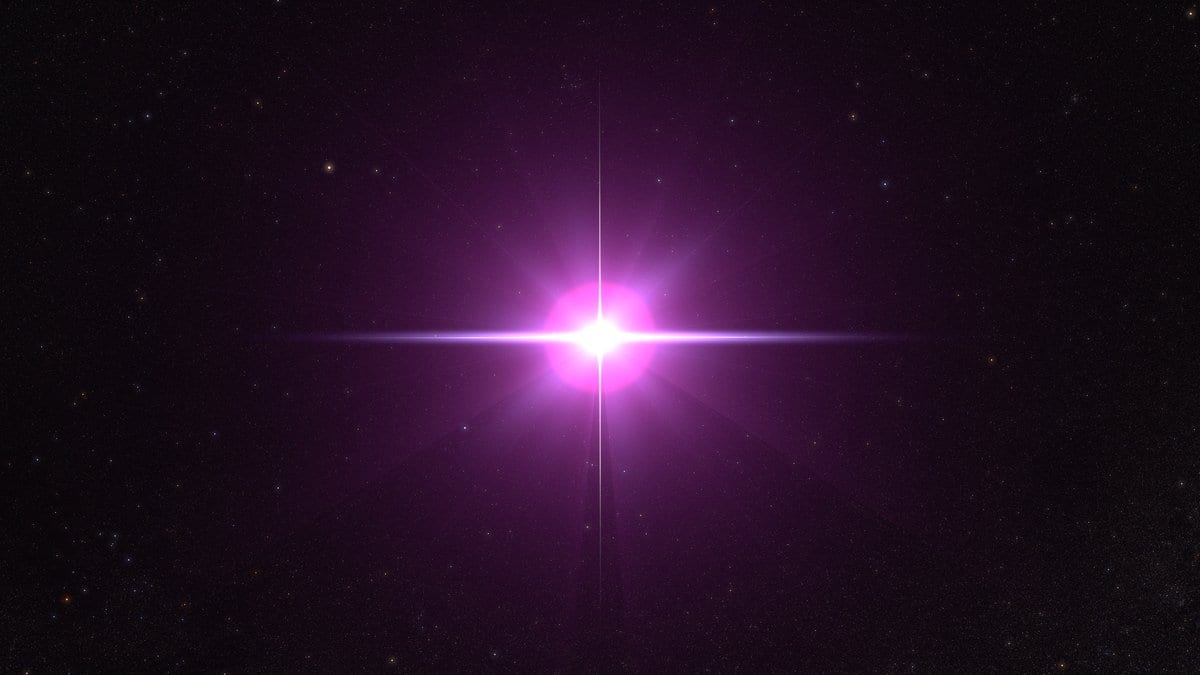
Visualization of a distant gamma-ray burst shown as a brilliant point of light with crossed beams against a field of stars.
Seen from across the universe, the explosion is a single point of light whose apparent brightness depends on where the observer stands (illustrative)."Fermi Finds Novel Feature in BOAT Gamma-Ray Burst (SVS14634 - Distant GRB still)" by NASA's Scientific Visualization Studio - KBR Wyle Services, LLC/Scott Wiessinger, University of Maryland College Park/Francis Reddy, NASA/GSFC/Elizabeth Hays, KBR Wyle Services, LLC/Adriana Manrique Gutierrez, via Wikimedia Commons, Public domain

A gamma-ray burst that flashed only weakly in gamma rays went on to produce one of the brightest afterglows ever observed, and the team that followed it argues the mismatch comes down to viewing angle: the jet was aimed away from Earth. The result was published Oct. 28, 2026, in The Astrophysical Journal Letters.

Yu-Han Yang of the University of Rome Tor Vergata and colleagues say the radio data in their paper provide a first test of reverse-shock models, which describe the wave that runs back into a jet's own material, in a geometry where the jet does not point at the observer.

The burst, cataloged as GRB 260310A, was a nearby long gamma-ray burst accompanied by a supernova, a broad-lined Type Ic in the paper's classification. Its prompt gamma-ray output was modest, about 3.5 × 10⁵⁰ ergs, and yet the authors report one of the brightest afterglows ever observed in X-ray, optical and radio light. The optical afterglow arrived late and rose slowly, peaking about a tenth of a day after the burst, while the X-ray afterglow brightened again later and was tracked for about 68 days with no sign of its spectrum changing.
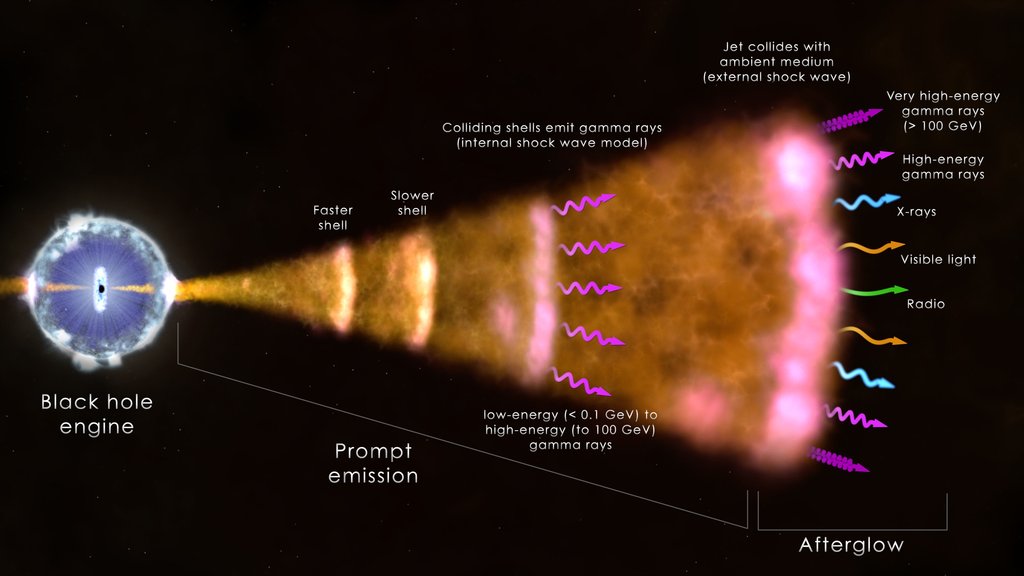
Labeled diagram showing a black hole engine, a narrow jet in which colliding shells emit high-energy radiation, and the afterglow where the jet meets surrounding gas.
A labeled diagram of the two stages: colliding shells inside the jet make the prompt flash, and the jet plowing into surrounding gas makes the long afterglow. "Gamma-ray-burst-Mechanism" by NASA/Goddard Space Flight Center/ICRAR., via Wikimedia Commons, Public domain

The authors argue that the weak prompt flash, its hard peak energy and the delayed afterglow are "naturally explained by a GRB jet viewed off-axis," meaning a jet whose axis misses Earth.

A weak polarization of the radio light, measured 55 days after the burst, points to the forward shock, the outward-moving shock front, as the dominant source of the emission from radio through X-rays at that stage. If the later X-ray brightening instead marks a narrow jet core seen still further off-axis, the authors write, it would imply extreme luminosities and energetics for an observer looking straight down the jet.

Sources

Spot an error?

Spot an error?

Report an error

Spotted a mistake on this page? Tell us what's wrong and our editors will take a look.

What kind of problem?

Only if you'd like us to be able to follow up. We won't use it for anything else.

We correct mistakes openly. Select any text to flag it. Fixes are logged under our Corrections Policy.

Report an error

Reporting on

A Faint Gamma-Ray Burst Left One of the Brightest Afterglows Ever Observed

What kind of problem?

Only if you'd like us to be able to follow up. We won't use it for anything else.

We read every report. Corrections are logged publicly.