X-Ray Survey Finds Black Holes Far Too Big for Their Galaxies
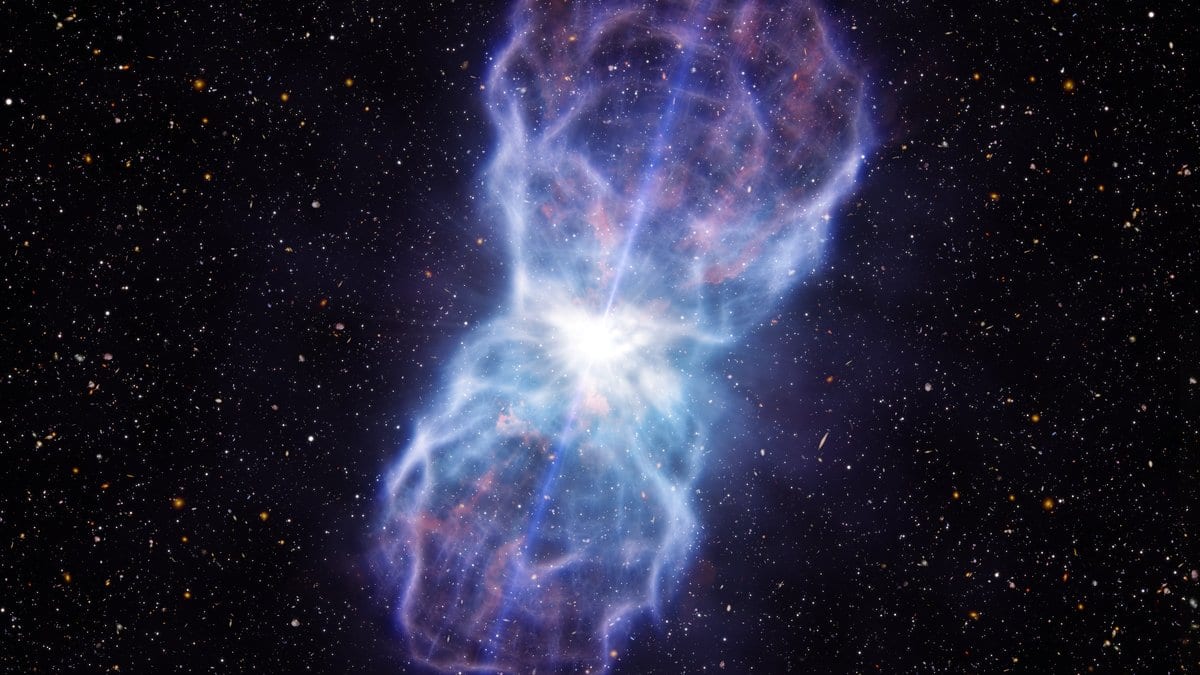
An X-ray survey has turned up fully grown galaxies whose central black holes hold more than 5% of the mass of all their stars, several times the share seen in most galaxies. Johannes Buchner of the Max Planck Institute for Extraterrestrial Physics and colleagues report the sample in Astronomy & Astrophysics, published online Sept. 7.
The mass of a galaxy's central black hole normally tracks the mass of its stars, and the known exceptions had been read as clues to how the first black holes formed. Finding them among evolved galaxies too means such objects are not unique to one formation channel, the authors write. They point instead to a way of feeding a black hole that is disconnected from the stars around it, a growth channel current galaxy-evolution models do not contain.
The measurements come from the first large-area sky survey by eROSITA, the X-ray telescope aboard the Spectrum-RG spacecraft. By their high-energy X-ray light, it picked out 200 quasars, galaxies whose central black holes are feeding brightly. The team combined those with optical spectra from the Sloan Digital Sky Survey and archival ultraviolet-to-infrared photometry to estimate distances, black hole masses and host stellar masses. At redshifts of 0.3 to 0.8, the galaxies lie much closer to the present day than the early-universe objects JWST has reported. Near cosmic noon, the era when galaxies grew fastest, the paper puts their space density at a minimum of four per cubic gigaparsec.
In most galaxies, the central black hole accounts for no more than a percent of the mass in stars. JWST has reported ratios near 10% in dwarf galaxies and at cosmic dawn.
The black holes may have grown in exponential feeding spurts lasting about a billion years. If the same channel operated in the universe's first billion years, it might account for the JWST objects without any special seeding.
Sources
- doi.orgPeer-reviewed