A New Model Says Enceladus Cuts Its Own Geysers From Below
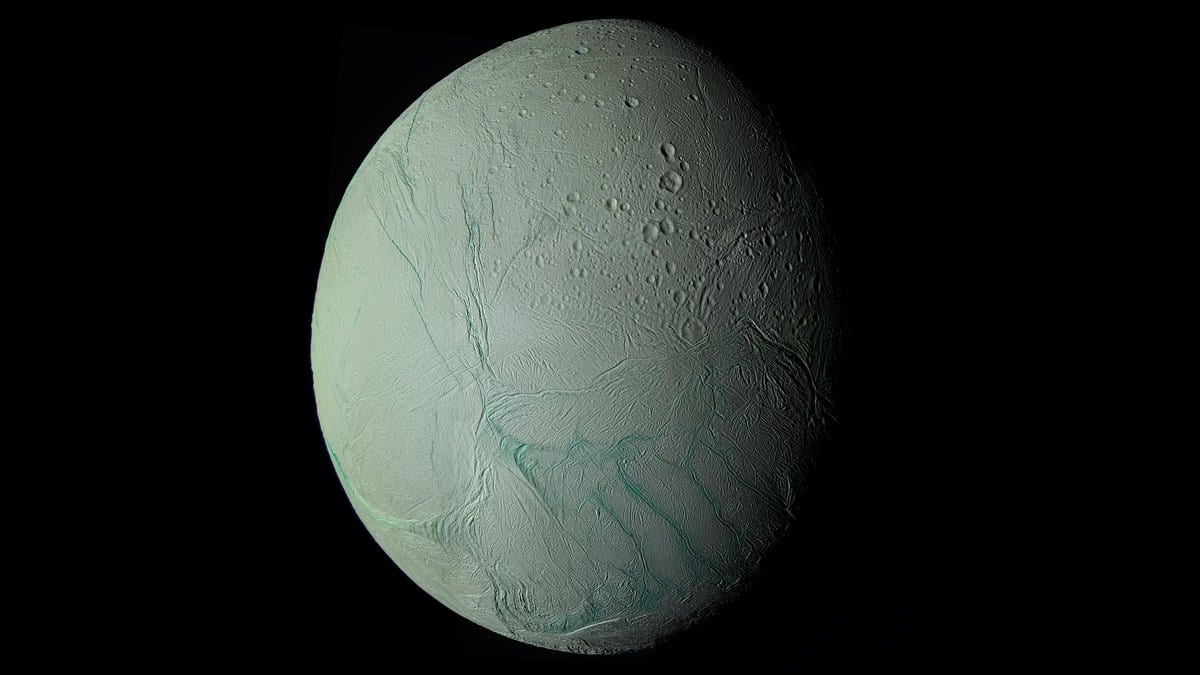
A study published Aug. 23 in AGU Advances by a team from MIT and the University of Arizona proposes that waves inside the buried ocean of Saturn's moon Enceladus carve the four parallel fissures that vent water from its south pole. Led by D. Y. Abdulah at MIT, the researchers used analytical theory and computer simulations to detail the mechanism.
The fissures, known as the tiger stripes, are four parallel, evenly spaced cracks 130 kilometers long that erupt water from a global subsurface ocean into space. Their spacing, an observed 35 kilometers, is what the model is asked to reproduce.
Starting from one existing fissure, topography on the underside of the ice shell rubs periodically against the ocean as the moon librates, rocking slightly as it turns. That motion excites internal gravito-inertial waves, which travel within the body of the water rather than across its surface. The waves propagate downward, reflect off the seafloor and strike the underside of the shell. Breaking on impact generates heat, which promotes melting in a feedback that opens the next fissure in the chain.
Dissipation predicted by the linear analytical theory matches nonlinear simulations run with the MIT General Circulation Model, the paper reports, with stronger agreement when the topography is less steep.
For a south polar ocean between 30 and 60 kilometers thick, the wave patterns accurately reproduce the observed 35-kilometer spacing. The simulated wave energy matches theoretical predictions, confirming that this hidden ocean machinery can carve the distinct fractures seen on the moon today.
Sources
- AGU AdvancesPeer-reviewed