One Asteroid Strike Could Explain Why Deimos Looks so Smooth
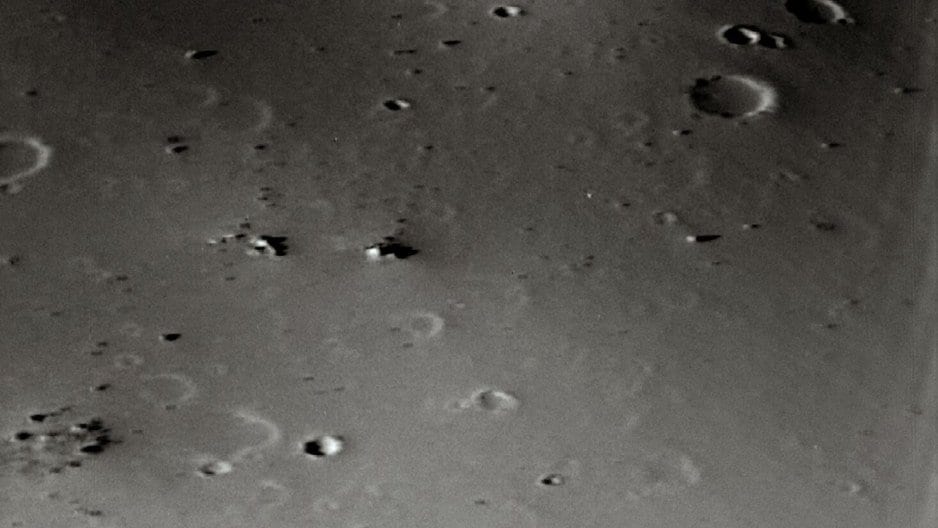
A single glancing impact by a 320-meter asteroid can account for both the 10-kilometer-wide depression at Deimos's south pole and the fine debris covering the whole 12-kilometer moon, according to impact simulations published Aug. 18 in Nature Astronomy.
S. D. Raducan and colleagues modeled the collision with smoothed-particle hydrodynamics, a method that follows material as it is crushed and thrown, and compared the result against a shape model of Deimos that resolves the surface to about 100 meters. The runs held the impact speed at 8.2 kilometers per second and varied projectile size from 300 to 360 meters, impact angle from 0 to 60 degrees and the offset from the moon's center by up to 2.5 kilometers.
Two independent comparisons converged on the same best fit, the paper reports: a projectile 320 meters across, give or take 25 meters, striking at 45 degrees off vertical with an offset of about 2 kilometers. The authors state that the depression "does not have a unique solution," and that other resurfacing processes may also have shaped the moon.
From that best-fitting case the team infers, rather than measures, the moon's mechanical state. Reproducing the shallow, partly filled cavity required surface material with a cohesion no greater than about 100 pascals, they write; stronger material kept steep crater walls the observed profile does not show. With the moon's bulk density of 1.5 grams per cubic centimeter and 40% to 50% porosity, that puts its outer layers closer to recently visited rubble-pile asteroids than to lunar soil, the paper says.
In the best-fitting run, no more than about 1% of Deimos's mass escaped while 10% to 20% was redistributed, landing as a blanket a few meters thick globally and up to roughly 200 meters deep on the Mars-facing side. The team also found the 14 largest craters systematically shallow for their width, which it reads as burial under about 120 meters of debris.
The model was also tested against a roughly 3-kilometer depression on Deimos's farside, imaged by the European Space Agency's Hera spacecraft during its Mars flyby on March 12, 2025.
Sources
- Nature AstronomyPeer-reviewed