Skip to content
See the World Through ScienceA project of ALLATRA
Source: PreprintarXiv1 source

Debris From NASA's Asteroid Impact Shows How Hard the Hit Really Pushed
Space

Republish this story

Our work is licensed under Creative Commons BY-NC 4.0. You may republish this piece for free — with credit to ALLATRA Media and a link to the original, unedited beyond length trims, and not for commercial use.

Read the full license

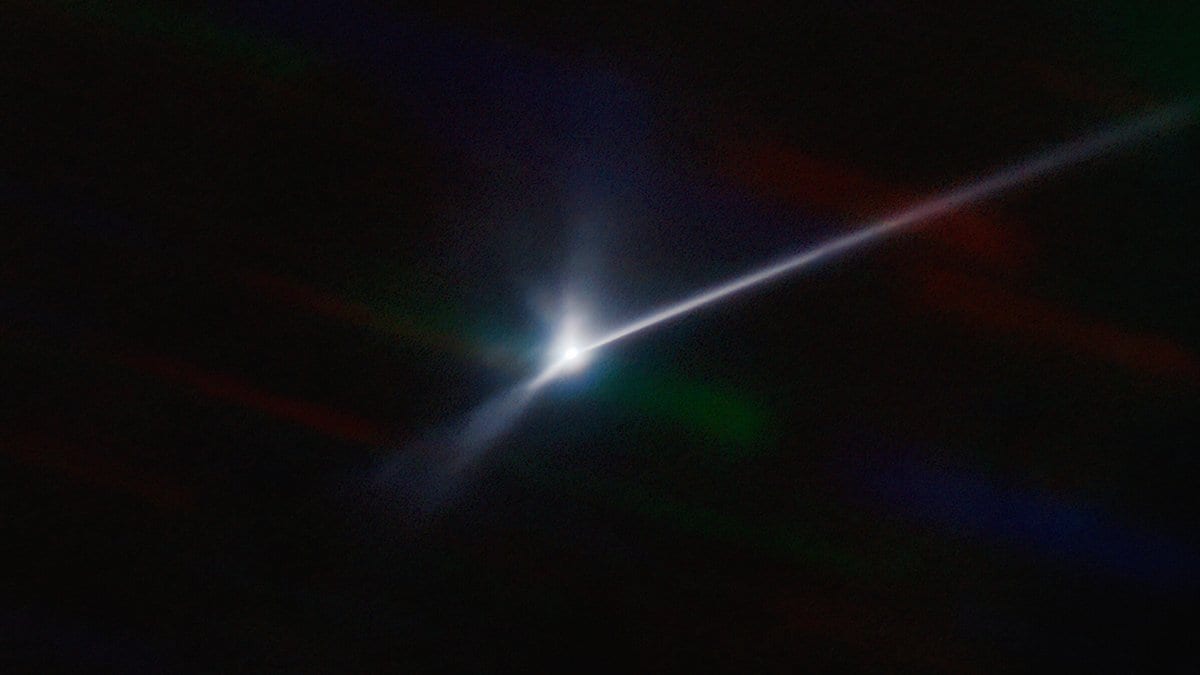
A bright point of light trailing a long, narrow streak of dust across a dark field.
Dust blown off Dimorphos streams away from the asteroid pair, imaged from Cerro Pachón in Chile within days of the Sept. 26, 2022 impact. Rebuilding where that debris went in three dimensions is how the new study measures the push."Aftermath of DART Collision with Dimorphos Captured by SOAR Telescope (noirlab2223a)" by CTIO/NOIRLab/SOAR/NSF/AURA/T. Kareta (Lowell Observatory), M. Knight (US Naval Academy); Image processing: T.A. Rector (University of Alaska Anchorage/NSF's NOIRLab), M. Zamani & D. de Martin (NSF's NOIRLab), via Wikimedia Commons, CC BY 4.0, cropped

Researchers have rebuilt in three dimensions where the debris from NASA's DART impact went, and report that the collision delivered 2.13 times as much momentum to the asteroid moonlet Dimorphos as the spacecraft itself carried. The work is a preprint, posted Nov. 13, 2026, and has not been peer-reviewed.

NASA dates the impact to Sept. 26, 2022. The deflection measured afterward established that debris thrown off a target adds to the push a spacecraft delivers. But orbital tracking records only how the asteroid's motion changed, not how the thrown material produced it, and different combinations of debris mass and speed can give the same recoil. The authors describe their reconstruction as a constraint on the debris itself rather than on the orbit, and say it bears on how well a kinetic impact would work on a different target.
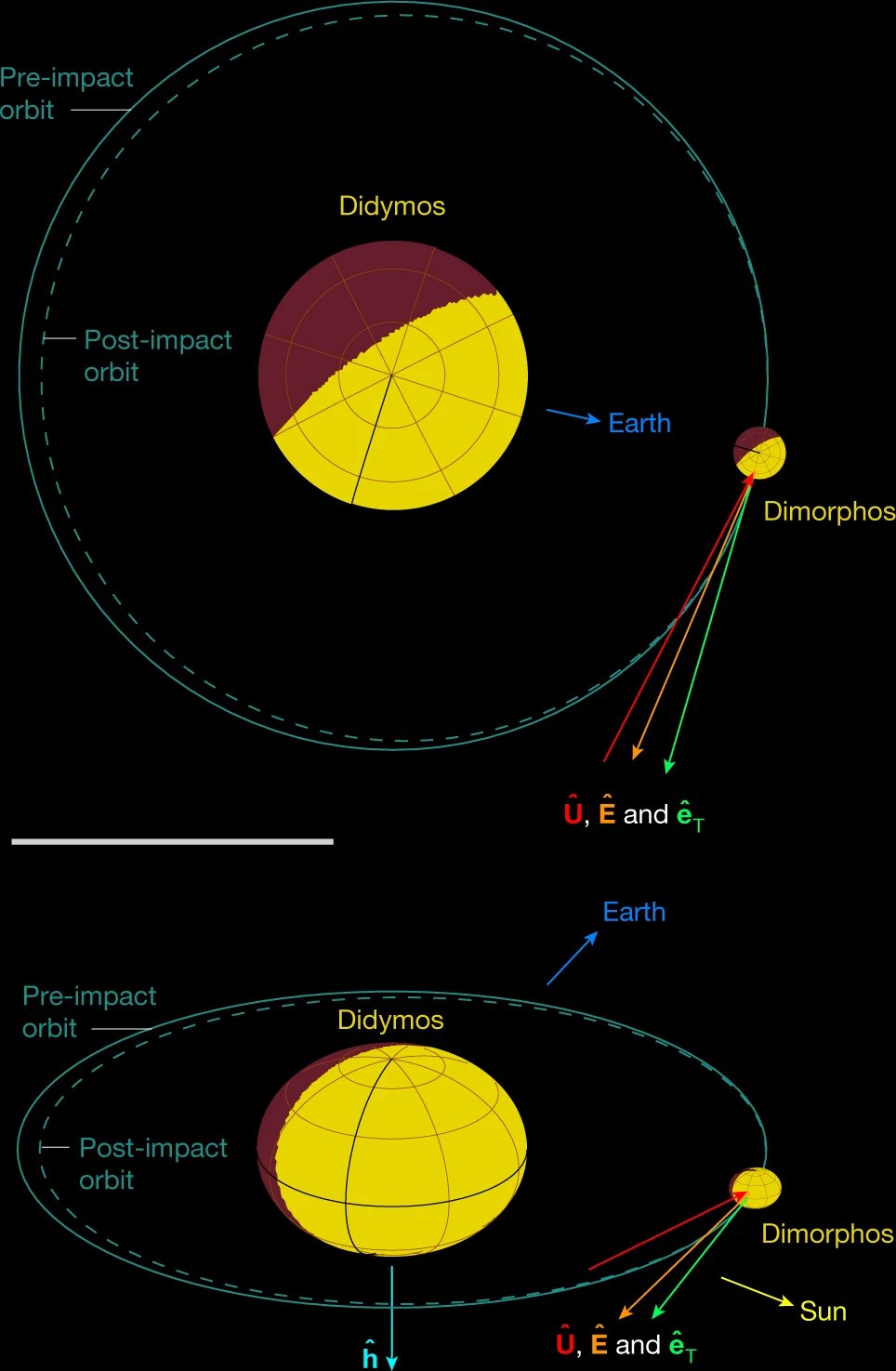
A two-panel diagram of the moonlet orbiting the larger asteroid, with dashed and solid ellipses for the orbit before and after the impact and labeled direction arrows.
How the measurement is set up: the moonlet orbiting its parent before and after the hit, with the directions along which the recoil acted (illustrative). "Schematic of the DART impact geometry on Dimorphos" by Authors of the study: Andrew F. Cheng, Harrison F. Agrusa, Brent W. Barbee, Alex J. Meyer, Tony L. Farnham, Sabina D. Raducan, Derek C. Richardson, Elisabetta Dotto, Angelo Zinzi, Vincenzo Della Corte, Thomas S. Statler, Steven Chesley, Shantanu P. Naidu, Masatoshi Hirabayashi, et al. (full author list: https://commons.wikimedia.org/wiki/File:Schematic_of_the_DART_impact_geometry_on_Dimorphos.webp), via Wikimedia Commons, CC BY 4.0

Zhijun Song of Beihang University and Jian-Yang Li of Sun Yat-sen University, with colleagues, fitted a model of the debris to images taken minutes after the impact by the LICIACube cubesat and over the following weeks by the Hubble Space Telescope. The same model reproduces the plume's shape, its curved streams and the pause in its fading brightness.

The authors put the ratio for Dimorphos at 2.13, with a quoted uncertainty of 0.19, and the ratio for the Didymos system as a whole at 2.04, which they report falls inside the uncertainty of a published estimate from the pair's motion. Combining that recoil with the measured orbital change gives Dimorphos a bulk density of about 1,435 kilograms per cubic meter, worked out without assuming the moonlet's mass.
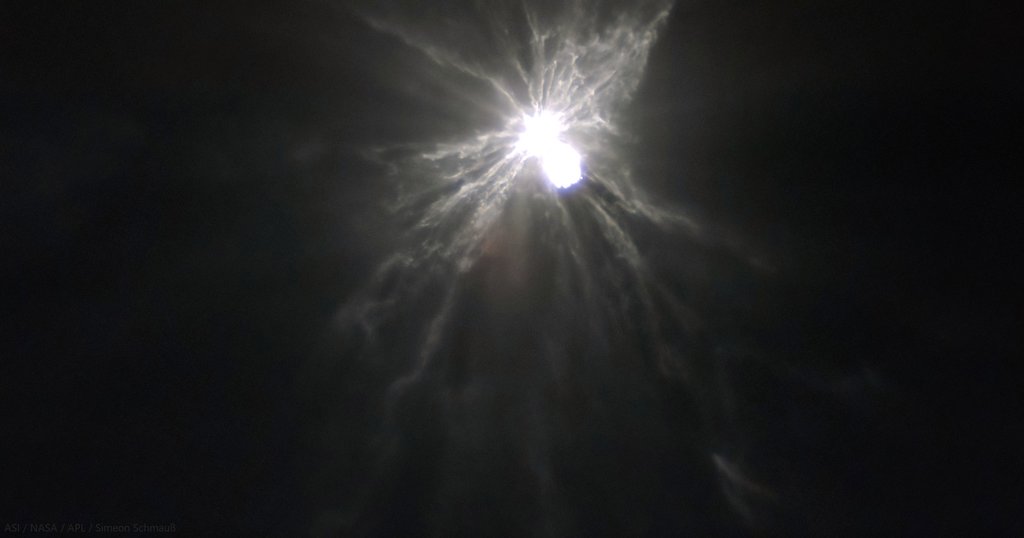
Bright filaments of dust spraying outward from a brilliant point of light against black space.
Filaments of debris spray from the asteroid moments after the hit, recorded by the small Italian companion craft that flew past behind the spacecraft. "DART impact ejecta captured by LICIACube (53216470589)" by semeion.photo, via Wikimedia Commons, CC BY 2.0, resized

The paper also separates what made the plume bright from what delivered the push. Debris launched faster than about 1 meter per second was 4% of the ejected mass but supplied 71% of the momentum gain, while the fine particles that dominate the visible plume carry much less of it.

The authors say the European Space Agency's Hera mission, which has yet to arrive at Didymos, can check that density through measurements of the moonlet's mass, its crater and its boulders.

Sources

Spot an error?

Spot an error?

Report an error

Spotted a mistake on this page? Tell us what's wrong and our editors will take a look.

What kind of problem?

Only if you'd like us to be able to follow up. We won't use it for anything else.

We correct mistakes openly. Select any text to flag it. Fixes are logged under our Corrections Policy.

Report an error

Reporting on

Debris From NASA's Asteroid Impact Shows How Hard the Hit Really Pushed

What kind of problem?

Only if you'd like us to be able to follow up. We won't use it for anything else.

We read every report. Corrections are logged publicly.