Skip to content
See the World Through ScienceA project of ALLATRA

Astronomers Watched a Star Fall Into a Giant Companion and Merge With It
Space

Republish this story

Our work is licensed under Creative Commons BY-NC 4.0. You may republish this piece for free — with credit to ALLATRA Media and a link to the original, unedited beyond length trims, and not for commercial use.

Read the full license

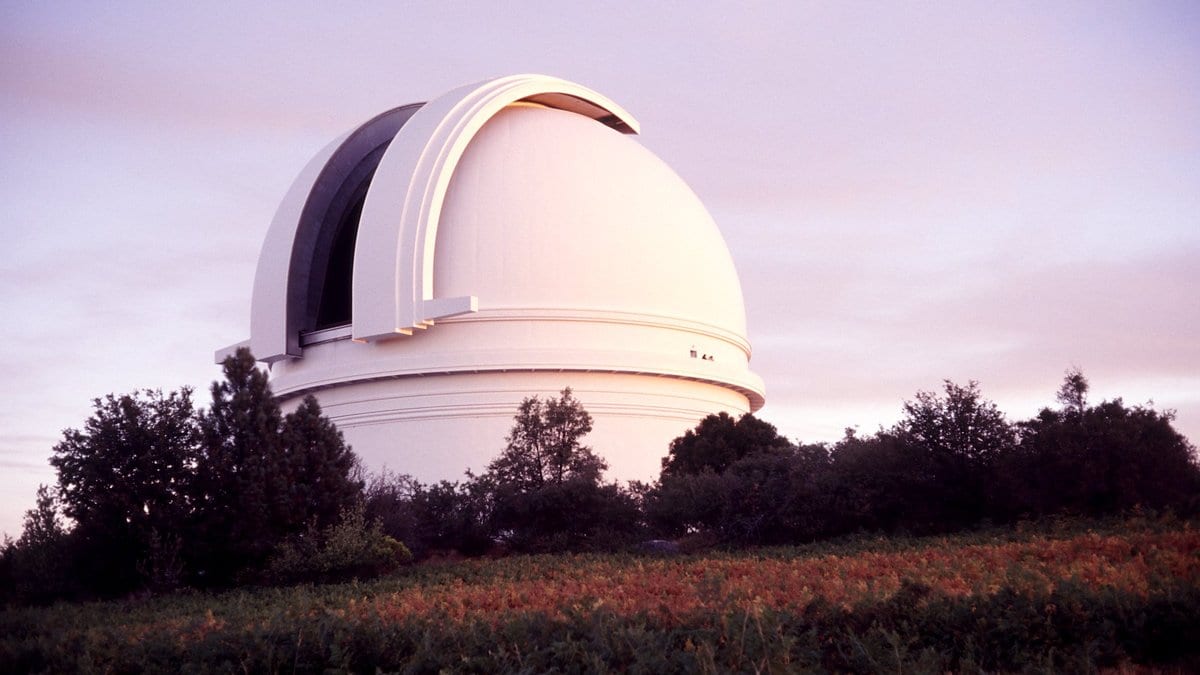
The open dome of the 200-inch Hale Telescope at Palomar Observatory, lit at dusk above a wooded ridge.
Palomar Observatory in southern California, where the Zwicky Transient Facility survey detected the eruption on Oct. 17, 2025. The dome shown houses the 200-inch Hale Telescope (illustrative)."P200 Dome Open" by Coneslayer at English Wikipedia, via Wikimedia Commons, CC BY 3.0, cropped

A star slightly less massive than the Sun spiraled into a bloated giant companion on the outskirts of the Andromeda galaxy and merged with it. Astronomers caught the sequence as it happened. Viraj Karambelkar of Columbia University and colleagues reconstruct the system before, during and after the eruption, using data from telescopes on the ground and in space, including NASA's James Webb Space Telescope, in a paper published Nov. 18, 2026, in Nature.
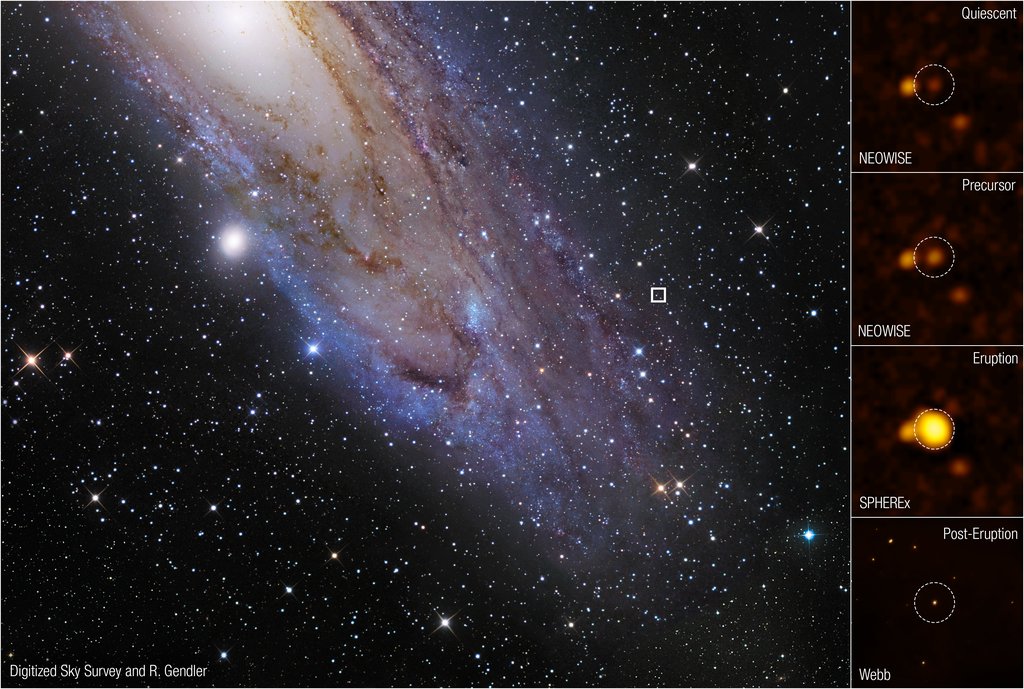
A wide view of a spiral galaxy with a small white box marking one star field, next to four cutout panels labeled quiescent, precursor, eruption and post-eruption.
The box marks the star field on the galaxy's outskirts; the panels at right run from before the outburst to Webb's view, taken Dec. 24, 2025. "AT 2025abao in the Andromeda Galaxy (1511805)" by Image: NASA, ESA, CSA, STScI, Viraj Karambelkar (Columbia), Kishalay De (Columbia); Image Processing: Alyssa Pagan (STScI); Acknowledgment: DSS, Robert Gendler, via Wikimedia Commons, Public domain

Astronomers usually piece such a merger together long after it happened, according to NASA's release. The Nature paper instead reports how much mass the two stars threw off, and how efficient the process was. That process is a common envelope, a shared shell of gas around a close pair. A merger is not its only ending: the release says that in other systems both stars survive as a tight pair, and such pairs can later become neutron stars or black holes.

"Stellar mergers are very, very difficult to observe in real time because they are hard to predict," Karambelkar said. His team saw the system, nicknamed Bao and formally AT 2025abao, behaving oddly in 2023 and kept watching. The Zwicky Transient Facility detected the eruption on Oct. 17, 2025, and Webb's observations were taken on Dec. 24, 2025. "Webb observed Bao only 47 days after the stars' eruption peaked, the earliest ever follow-up of an event like this," Karambelkar added.

The team concluded that before the eruption the giant star was seven times as massive as the Sun and 350 times its radius, and that the smaller companion was about 0.7 solar masses — the first mass estimate for it, according to the release. Once the smaller star reached the giant's surface, the two came together after only seven orbits, about seven years; other known mergers of two smaller stars took thousands of orbits. "One day, its brightness started rising and within a week, it peaked!" said Nadia Blagorodnova, a co-author at the University of Barcelona.
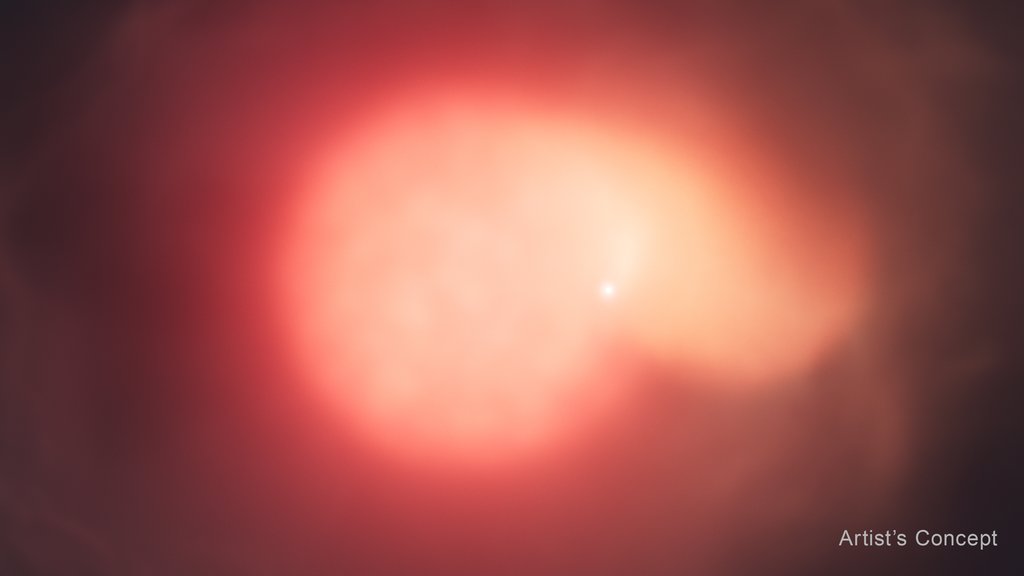
An illustration of a small bright star embedded in the glowing outer layers of a much larger red giant star.
The small white point near the center is the Sun-like star, drawn inside the giant's outer layers as the team describes the system (illustrative). "Andromeda Star Merger (Artist’s Concept) (1511807)" by Illustration: NASA, ESA, CSA, STScI, Leah Hustak (STScI); Science: Viraj Karambelkar (Columbia), via Wikimedia Commons, Public domain

What the merged star looks like now is unsettled; the release says only future observations will show how it settles.

Sources

Spot an error?

Spot an error?

Report an error

Spotted a mistake on this page? Tell us what's wrong and our editors will take a look.

What kind of problem?

Only if you'd like us to be able to follow up. We won't use it for anything else.

We correct mistakes openly. Select any text to flag it. Fixes are logged under our Corrections Policy.

Report an error

Reporting on

Astronomers Watched a Star Fall Into a Giant Companion and Merge With It

What kind of problem?

Only if you'd like us to be able to follow up. We won't use it for anything else.

We read every report. Corrections are logged publicly.