Two Teams Build a Clock That Keeps Time With an Atom's Nucleus
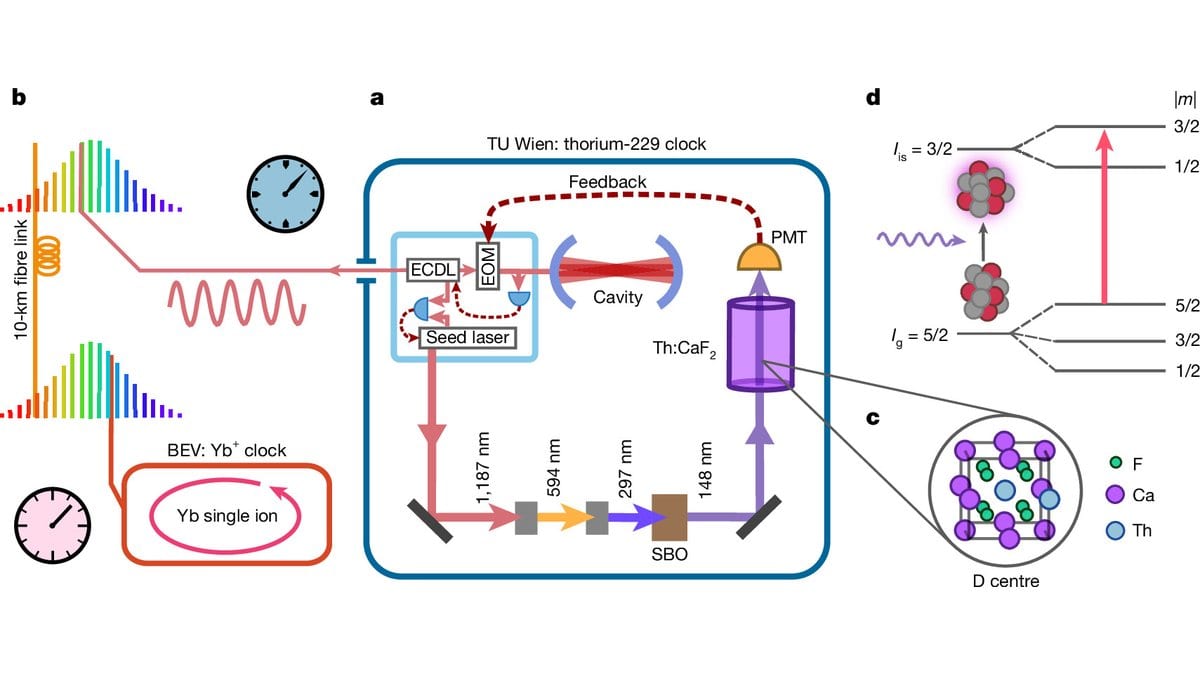
Two research groups have turned a transition inside the thorium-229 nucleus into the frequency reference of a working clock, each reporting it in Nature on Oct. 7, 2026. Both locked a steadily running laser onto the nucleus and closed a fast feedback loop around it, the step that separates measuring the nucleus from keeping time with it.
A nuclear clock takes its reference from the nucleus rather than from the electrons around it. The group led from Tsinghua University writes that the thorium-229 transition offers the most practical route to compact, robust timekeeping and to sensitive tests of fundamental physics. The group led from TU Wien reports that the transition is expected to hold up better against outside disturbance than the electron transitions in today's optical clocks. In both, the nuclei sit inside calcium fluoride crystals; the Vienna crystal is millimeter-sized and runs at room temperature.
The TU Wien group, working with the Austrian and German national metrology institutes, locked its laser to the 148-nanometer nuclear transition and compared a lower-frequency copy of that light continuously against a ytterbium-ion clock. It reports a clock stable to about three parts in a trillion after one second of averaging, and approaching one part in a thousand trillion over a day of operation.
The Tsinghua-led group reports about five parts in 10 trillion after one second for its own clock, and says the frequencies it measured in two separately fabricated crystals agreed.
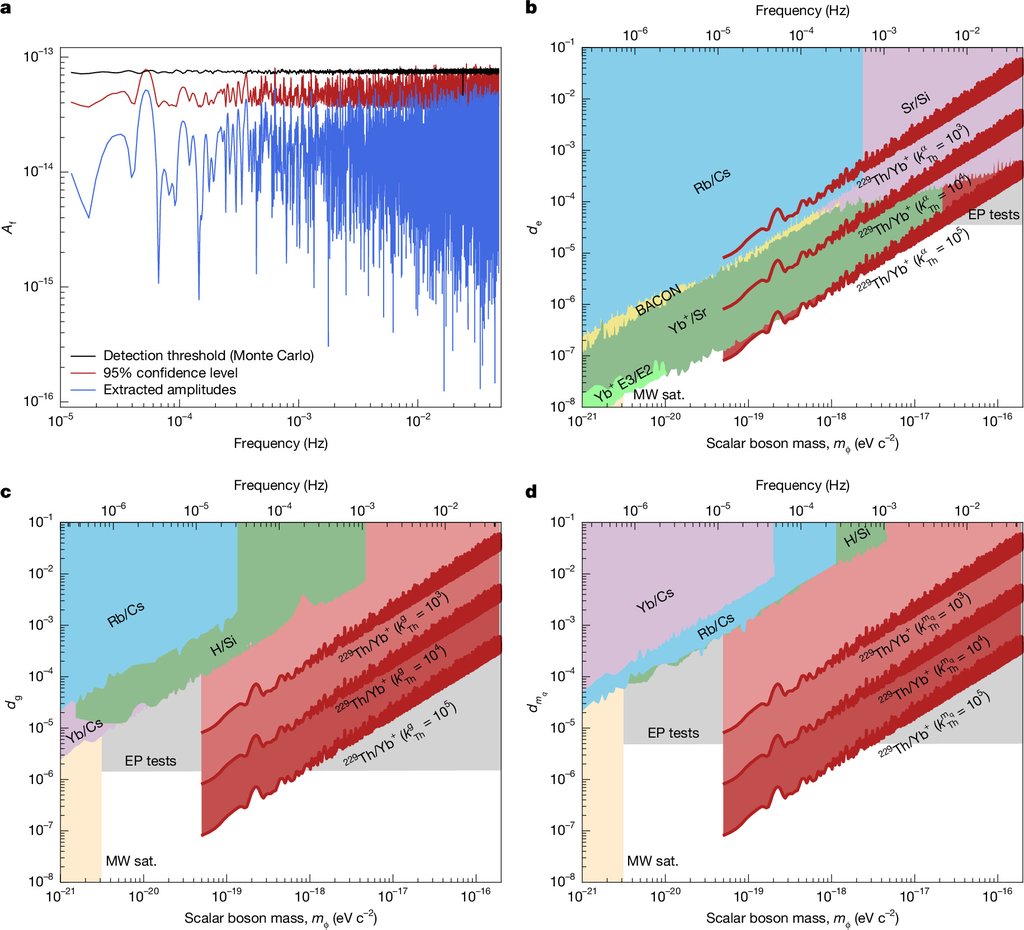
The TU Wien group also used its clock to look for ultralight dark matter, searching for periodic fluctuations and slow drifts in the nuclear transition energy on timescales of up to a day. The authors report that the resulting limits compete with the best atomic clocks on dark matter's coupling to photons and go beyond previous measurements on its coupling to the strong force.
Peik and Tamm proposed a thorium-229 nuclear clock in 2003. The Vienna loop closes around the same group's earlier Nature paper, which read the nuclear resonance in absorption with a steadily running laser but did not steer a clock with it.