Physicists Read a Nucleus by the Light It Absorbs, Not the Glow It Gives Back
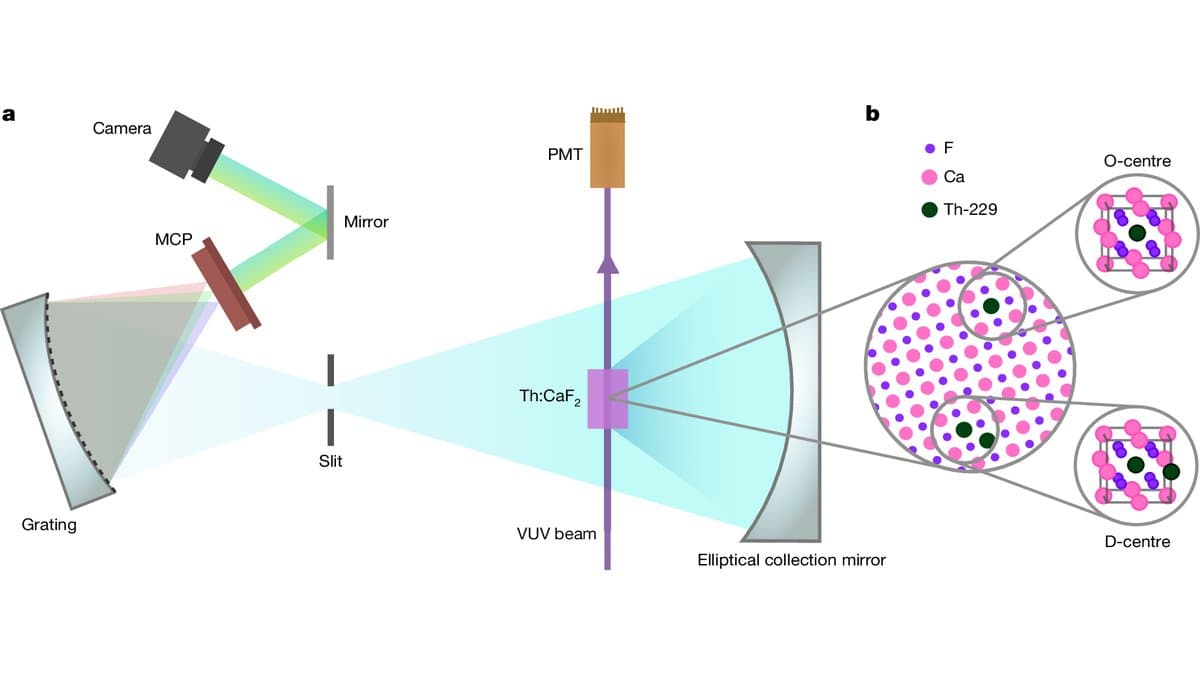
A team at TU Wien's Atominstitut in Vienna and Germany's Physikalisch-Technische Bundesanstalt has excited the nucleus of thorium-229 with a laser that runs steadily instead of in pulses. The power was under a nanowatt. The group read the nucleus's response as light missing from the beam rather than as a glow given off afterward, and reported the work in Nature on September 16, 2026.
The target is a solid-state nuclear clock, a timekeeper whose reference tick comes from a nucleus rather than from an electron. Detecting the glow means waiting for the excited nucleus to decay, and in the calcium fluoride crystal used here that decay has a time constant of about 600 seconds. Because absorption is measured while the laser is still on, the paper describes the response as effectively immediate.
The laser is an all-solid-state source at 148 nanometers, made by stepping an infrared diode laser up in frequency three times. Earlier experiments excited the same nucleus with pulsed light, in which only a small share of the photons sat on the narrow nuclear resonance. A steady, narrow laser puts all of its power there, making the absorption signal strong enough to read.
The group also characterized two thorium sites in the crystal and measured the frequency offset between them. One of the two sits in a highly symmetric pocket of the lattice, where the electrical pull of the surrounding ions on the nucleus is below 0.1 volts per square angstrom, compared with about 100 volts per square angstrom at sites measured before. That, the authors say, should yield resonance lines almost unaffected by the spacing of the crystal.
The paper calls this the first detection of an absorption signal from the thorium-229 nuclear transition, and says the method is a clear pathway to a solid-state nuclear clock of high stability and accuracy. No such clock has been built. The thorium was supplied by the U.S. Department of Energy's National Isotope Development Center.
Sources
- NaturePeer-reviewed