Newton’s Law of Universal Gravitation: Milligram Masses

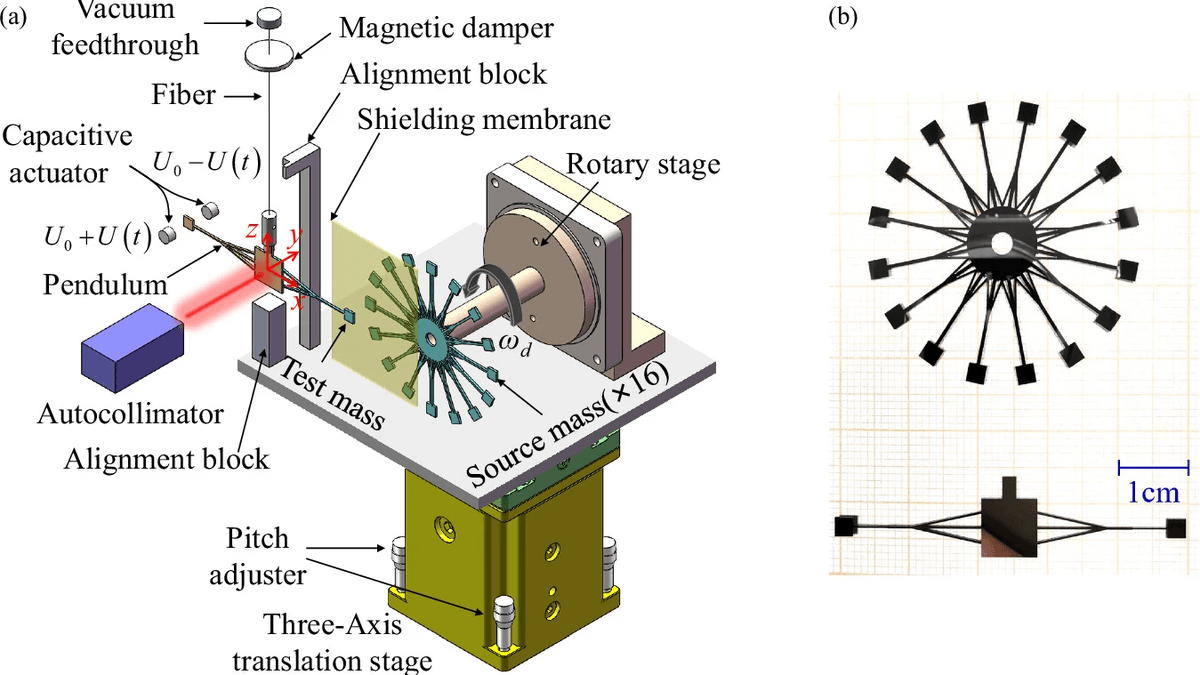
In October 2026, a Chinese research group announced new measurements based on torsion balances. Zheng-Jie An, Wen-Hai Tan, and colleagues at Sun Yat-sen University and Huazhong University of Science and Technology carried out a series of measurements with the equipment and reported their results in Nature Communications on Oct. 7, 2026. The experiment was devised by Shan-Qing Yang, who also led the project. The experimental apparatus consisted of a torsion balance with a silicon test wafer of 7.6 milligrams at one end of the suspended beam and sixteen silicon source wafers of about 7.6 milligrams each on a slowly rotating wheel. The experiment measured the faint gravitational attraction between the suspended wafer and the rotating source masses. The source-mass passage period was 37.5 seconds. Electrical and mechanical interference had to be separated from the gravitational signal.
The measured attraction between the silicon wafers agreed with the value the researchers calculated from Newton’s law of universal gravitation using the actual dimensions and arrangement of the components. Testing whether gravity can establish a quantum link between two objects in the spatial-superposition schemes discussed by An and colleagues will require much smaller masses held in controlled quantum states. Each object could then be prepared in a superposition of different positions to see whether their attraction gives rise to entanglement, in which their quantum states can no longer be described independently. The 2026 experiment did not test this idea. Its aim was simpler, and difficult in its own right: to measure a very weak classical force. The instrument used the principle of the torsion balance, proposed long before quantum theory as a way to determine Earth’s mean density.
John Michell and the Cavendish experiment
The experiment was devised sometime before 1783 by geologist John Michell, who constructed a torsion balance apparatus for it. However, Michell died in 1793 without carrying out the experiment. After his death, the apparatus passed to Francis John Hyde Wollaston and then to Cavendish, who rebuilt it but kept close to Michell's original plan. Michell was an English naturalist, astronomer and clergyman; Wollaston was a professor of natural philosophy at Cambridge. In “Experiments to Determine the Density of the Earth” (1798), Cavendish credited Michell with the proposal and, in a footnote, dated Michell’s communication before Coulomb’s publications on torsion balances. Reconstruction included replacing the warped wooden beam and other inconvenient components; external observation was used to avoid entry into the instrument room.

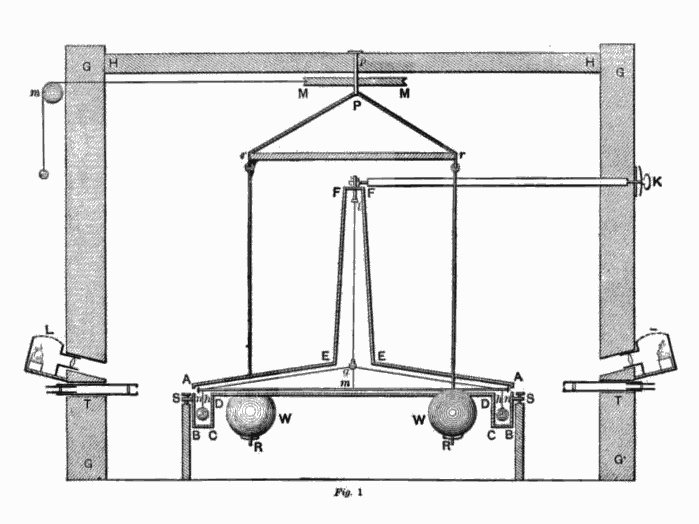
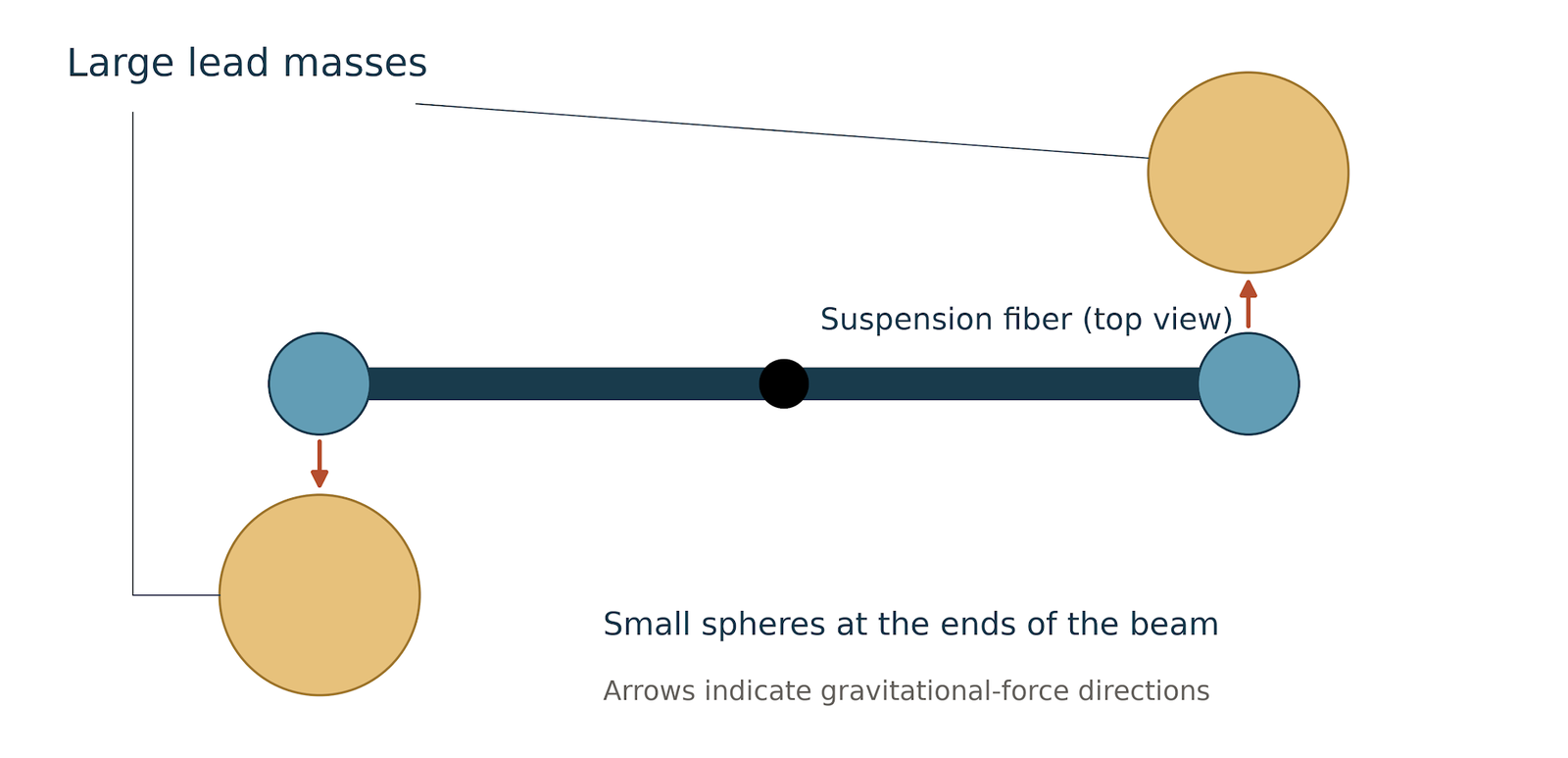
The apparatus consisted of a torsion balance made of a wooden rod horizontally suspended from a wire, with two small lead spheres, one attached to each end. Two massive lead balls, suspended separately, could be positioned beside the smaller balls. Their mutual attraction to the small balls caused the arm to rotate, twisting the suspension wire. To find the wire's torsion coefficient, the torque exerted by the wire for a given angle of twist, Cavendish timed the natural oscillation period of the balance rod as it rotated slowly clockwise and counterclockwise against the twisting of the wire. The torsion coefficient could be calculated from this along with the mass and dimensions of the balance. The 2026 implementation used Michell’s method with smaller masses and electronic control.
Cavendish recognized that Michell's apparatus would be sensitive to temperature differences and the resulting air currents, so he modified it by placing it in a separate room and using external controls and telescopes to make observations. Through two holes in the walls of the shed, Cavendish used telescopes to observe the movement of the torsion balance's horizontal rod. He positioned the heavy masses using a cord and pulley without entering the room. To test the effect of temperature, he left lamps burning beneath the weights overnight and observed the suspension’s response.
Cavendish expressed his result in terms of the density of the Earth. He reported that the Earth's density was about 5.48 times that of water. The gravitational constant (also known as the universal gravitational constant, the Newtonian constant of gravitation or the Cavendish gravitational constant), denoted by the capital letter , is an empirical physical constant involved in the calculation of gravitational effects in Sir Isaac Newton's law of universal gravitation. In Newton's law, it is the proportionality constant connecting the gravitational force between two bodies with the product of their masses and the inverse square of their distance. Gravitational attraction in Cavendish’s experiment was about 1/50,000,000 of the weight of the small balls; he spent several months investigating suspension behavior and spurious deflections.
Gravitational constant and milligram masses
In August 2018, a Chinese research group announced new measurements based on torsion balances, 6.674184(78) /(kg) and 6.674484(78) /(kg) based on two different methods. These were reported as the measurements with the smallest uncertainties at the time, with standard uncertainties cited as low as 12 ppm. The team included Shan-Qing Yang, Wen-Hai Tan, Liang-Cheng Tu and Jun Luo; 12 ppm = 0.0012%. The small individual uncertainties did not eliminate the difference between the two results. At a fixed separation, reducing both masses makes their mutual gravitational attraction much weaker. The gravitational constant is a physical constant that is difficult to measure with high accuracy. This is because gravity is extremely weak compared with the other fundamental forces at laboratory scales. Measuring gravitational forces between milligram-scale objects therefore required isolating the gravitational signal from interference.
In March 2021, Tobias Westphal, Markus Aspelmeyer and colleagues in Austria announced new measurements based on torsion balances. The experiment measured the faint gravitational attraction between two gold spheres, each approximately one millimeter in radius and 90 milligrams in mass. Periodic motion of one source sphere toward and away from the other separated the varying gravitational signal from background noise. In Shan-Qing Yang’s experiment, periodic source-mass motion was produced by a rotating wheel; each silicon wafer had about one-twelfth the mass of a gold sphere. Slow suspension drift and drive vibrations complicated the separation of signal and interference.
Torsion balance
The torsion balance consists of a bar suspended from its middle by a thin fiber. The fiber acts as a very weak torsion spring. The 2026 apparatus consisted of a silicon beam approximately five centimeters long, with an etched test wafer at one end and a counterweight at the other. The moving assembly, including reflector and mounts, had a mass of approximately 243 milligrams. The tungsten suspension fiber was 76 centimeters long and 10 micrometers in diameter. To find the wire's torsion coefficient, the torque exerted by the wire for a given angle of twist, the researchers timed the natural oscillation period of the balance rod as it rotated slowly clockwise and counterclockwise against the twisting of the wire. The period was approximately 49.5 seconds. The torsion coefficient could be calculated from this along with the mass and dimensions of the balance.
The experimental apparatus consisted of a torsion balance and a silicon source wheel 38 millimeters in diameter. Sixteen square source wafers and their connecting struts were fabricated from a single silicon blank. The beam, shielding membrane and wheel plane were parallel; the rotation axis was transverse to the beam. Successive source wafers passed behind the membrane opposite the test wafer. Their mutual attraction to the test wafer caused a torque about the suspension fiber. Figure 3 shows the apparatus geometry.
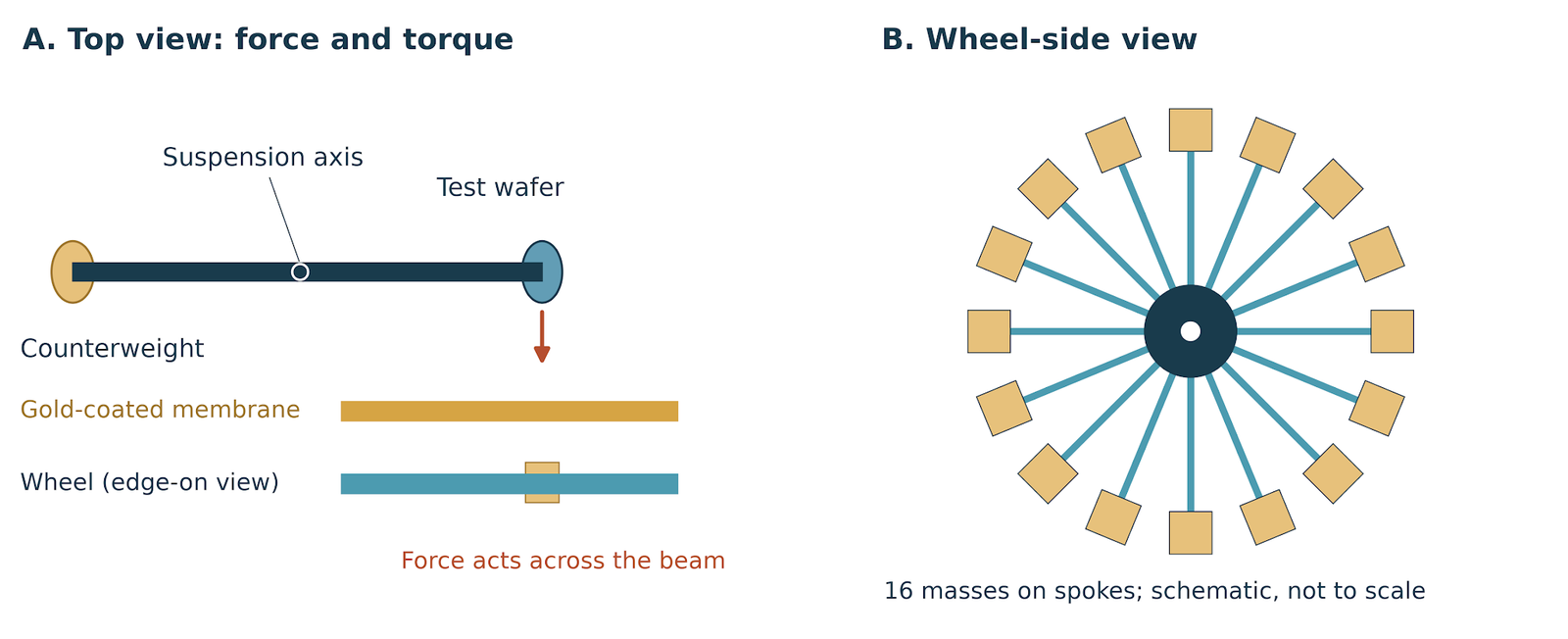
The wheel angular velocity was 0.6 degrees per second, giving a rotation period of ten minutes. Sixteen source masses passed the test wafer during each revolution. The gravitational modulation therefore had a period of 37.5 seconds and a frequency of 26.7 millihertz, sixteen times the rotation frequency. Drive interference occurred at the rotation frequency, approximately 1.67 millihertz. At 26.7 millihertz, instrumental noise was lower, permitting detection of the weak periodic gravitational signal.
Periodic source-mass approach and recession produced periodic changes in the attraction. Drive vibrations and other interference required separation from this signal. A spectral peak at the predicted frequency was insufficient evidence of gravitational origin.
Electrostatic shielding was provided by a gold-coated single-crystal silicon membrane, 50 micrometers thick, between the test wafer and the rotating source masses. Direct electrostatic forces can exceed gravitational forces at these masses; residual electric potentials reduced suspension stability at small separations. Negative feedback is often deliberately introduced to increase the stability and accuracy of a system by correcting or reducing the influence of unwanted changes. Electronic feedback produced an opposing torque and maintained an almost stationary beam. The recorded control voltage was converted into torque using a calibrated, frequency-dependent model of the feedback system. Torque is defined as the product of the magnitude of the force and the perpendicular distance of the line of action of a force from the axis of rotation. The effective lever arm was 23.694 millimeters; dividing the torque by this length gave the corresponding force. The vacuum pressure was approximately pascal.
Control measurements and measurement uncertainty
The control measurements included spectral averaging and increased source–test separation. The authors’ correspondence with the reviewers accompanied the paper. One reviewer questioned the identification of a small spectral peak as gravity rather than random noise. Six independent control-voltage records, each 7,800 seconds long, were averaged spectrally. At a source–test gap of approximately three millimeters, the expected 26.7-millihertz signal was indistinguishable from noise, while the rotation-frequency peak remained nearly unchanged. Distance dependence helped separate the gravitational response from drive interference.
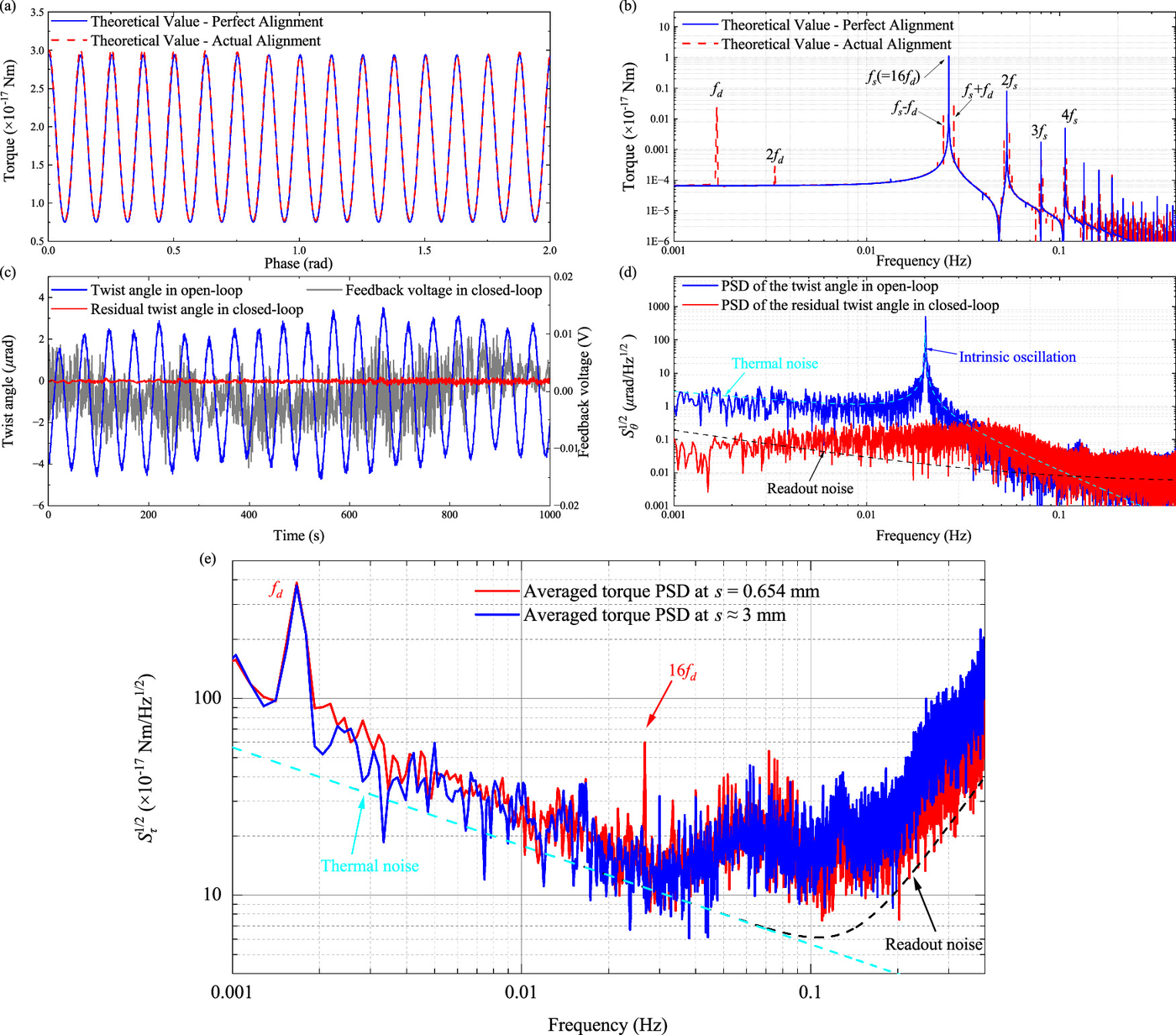
A second control measurement, requested by another reviewer, reduced the wheel speed by a factor of six. The rotation period was one hour, and the source-mass passage period was 225 seconds. Fifteen measurement runs lasted approximately 13 hours each. The measured torque was 11.41 0.46 attonewton meters, compatible with the original result within the statistical uncertainty. Within the experimental precision, the effect was independent of the selected rotation frequency.
To quantify the influence of temperature changes on the measurements, the researchers tested the balance response to room-temperature variations produced by air conditioning. Temperature fluctuations at the gravitational signal frequency during the main measurements were no greater than 2.1 microkelvins, corresponding to a possible spurious torque no greater than 0.24 attonewton meters. Separate electrostatic and magnetic tests gave possible torque contributions no greater than 0.27 and 0.14 attonewton meters, respectively. The latter estimate covered magnetic interaction between the masses; torque noise from horizontal magnetic-field fluctuations was below 0.02 attonewton meters. Systematic uncertainty included these contributions, calibration errors and other systematic effects.
Newton’s law: measured and calculated force
In metrology, measurement uncertainty characterizes the dispersion of possible values of a measured quantity, taking both statistical and systematic contributions into account. The minimum face-to-face separation was 0.654 millimeters. The measured periodic torque was 11.16 0.27 attonewton meters, with statistical uncertainty. This result used 46 records of 7,800 seconds each, approximately 100 hours in total, distinct from the six records used for the spectral control. The Newtonian torque, accounting for the actual dimensions and positions of the rotating source components, was 11.17 0.26 attonewton meters. The SI unit for torque is the newton-metre (). Dividing each torque by the effective lever arm gave an experimental force of 471 23 attonewtons and a calculated force of 471 11 attonewtons. One attonewton is newton. The force uncertainties correspond to one standard deviation and include repeated-measurement scatter and systematic errors.
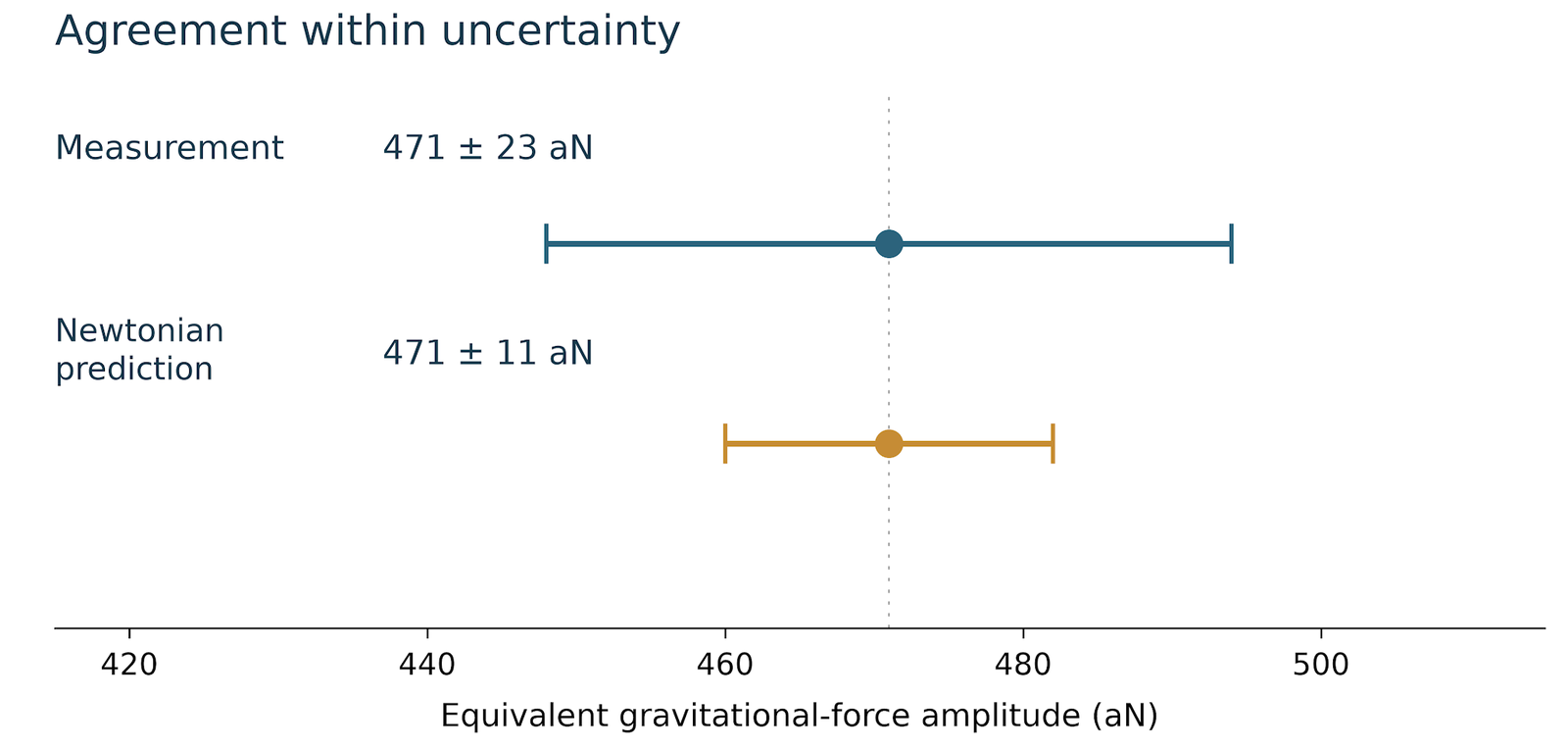
Why doesn’t the textbook formula for two point masses give the same 471 attonewtons? Substituting two masses of 7.6 milligrams each and a gap of 0.654 millimeters would give about 9,000 attonewtons, almost twenty times as much. The main reason is that 0.654 millimeters is the distance between the faces of the extended wafers, whereas the point-mass formula requires the distance between their centers. Moreover, the physicists measured the amplitude of the sixteenth harmonic of the varying torque. They calculated it using the actual geometry of the wafers, spokes and other parts of the wheel. The connecting spokes accounted for about 4.7% of the calculated torque. To obtain the predicted force, the scientists again divided the torque predicted by Newton’s law by the effective lever arm of the beam.
The authors’ value for the gravitational constant was = 6.67(35) /(kg), with a relative standard uncertainty of approximately 5.3%. The CODATA 2022 reference value is 6.67430(15) /(kg). The 2026 determination was less precise than the 2018 determinations and the reference value. The experimental objective was to measure gravitational attraction between a 7.6-milligram test wafer and individual source masses of approximately 7.6 milligrams, rather than improve precision in . The five measured separations ranged from 0.654 to 1.554 millimeters; no deviation from Newton’s law was detected.
Quests for non-inverse square terms in the law of gravity were carried out by measurements at several millimeter-scale separations. The hypothetical additional interaction was represented by a Yukawa correction to Newton’s law. The resulting limits were approximately a hundred times weaker than those from the 2012 experiment using gram-scale tungsten plates. The experimental objective was to measure gravitational interaction between much smaller test and source masses, rather than to obtain the strongest constraint on additional forces.
Quantum superposition and quantum entanglement
Quantum superposition is a fundamental principle of quantum mechanics. The principle of quantum superposition states that if a physical system may be in one of many configurations, arrangements of particles or fields, then the most general state is a combination of all of these possibilities. In 2017, Sougato Bose and colleagues and, independently, Chiara Marletto and Vlatko Vedral proposed tests of gravitationally induced quantum entanglement. The proposed experimental preparation places two masses in superpositions of different positions. Entanglement generated by their gravitational interaction, with alternative entangling mechanisms excluded, would provide evidence relevant to the quantum properties of gravity. The masses discussed by An and colleagues in 2026 were approximately – kilograms, far below 7.6 milligrams. Required mass depends on the proposed scheme; there is no universal mass requirement.
In January 2026, Onur Hosten’s group in Austria wrote about experimentally demonstrating the cooling of the torsional motion of a one-milligram pendulum through feedback using laser radiation pressure. The effective temperature of this mechanical mode was 240 microkelvins. The experimental objective was precise control of mechanical motion; gravitational attraction between two such pendulums was not measured. Tests of gravitationally induced entanglement require control of both quantum objects, detection of their entanglement and exclusion of other entangling interactions.
The experiment by Shan-Qing Yang, Zheng-Jie An, Wen-Hai Tan and their colleagues made it possible to measure the exceptionally weak attraction between silicon bodies of 7.6 milligrams each and compare the result with Newton’s law. The reviewers called for a clearer explanation of the experiment’s relevance to future quantum tests. The measurement itself did not establish the quantum nature of gravity. In 228 years, the individual weights used in experiments of this kind have fallen in mass from Cavendish’s 158-kilogram lead spheres to just a few milligrams, a reduction by a factor of about twenty million. The next step will require holding two small objects in controlled quantum states and testing whether their gravitational attraction can entangle them.
Sources
- An Z.-J., Tan W.-H., Dong W.-C. et al. (2026). Test of the gravitational interaction between milligram masses using a miniature torsion pendulum. Nature Communications 17, 11425.
- Bose S. et al. (2017). Spin Entanglement Witness for Quantum Gravity. Physical Review Letters 119, 240401.
- Marletto C., Vedral V. (2017). Gravitationally Induced Entanglement between Two Massive Particles is Sufficient Evidence of Quantum Effects in Gravity. Physical Review Letters 119, 240402.
- Cavendish H. (1798). Experiments to determine the density of the Earth. Philosophical Transactions of the Royal Society 88, 469–526.
- Li Q. et al. (2018). Measurements of the gravitational constant using two independent methods. Nature 560, 582–588.
- Westphal T. et al. (2021). Measurement of gravitational coupling between millimeter-sized masses. Nature 591, 225–228.
- An Z.-J. et al. (2026). Supplementary Information. Supplementary materials for the study in Nature Communications.
- An Z.-J. et al. (2026). Transparent Peer Review File. Peer review materials on the article page in Nature Communications.
- NIST CODATA 2022. Newtonian constant of gravitation.
- Yang S.-Q., Zhan B.-F., Wang Q.-L. et al. (2012). Test of the Gravitational Inverse Square Law at Millimeter Ranges. Physical Review Letters 108, 081101.
- Agafonova S. et al. (2026). One-milligram torsional pendulum toward experiments at the quantum-gravity interface. Communications Physics 9, 80.