A Battery That Powers a Smart Pill, Then Dissolves in the Gut
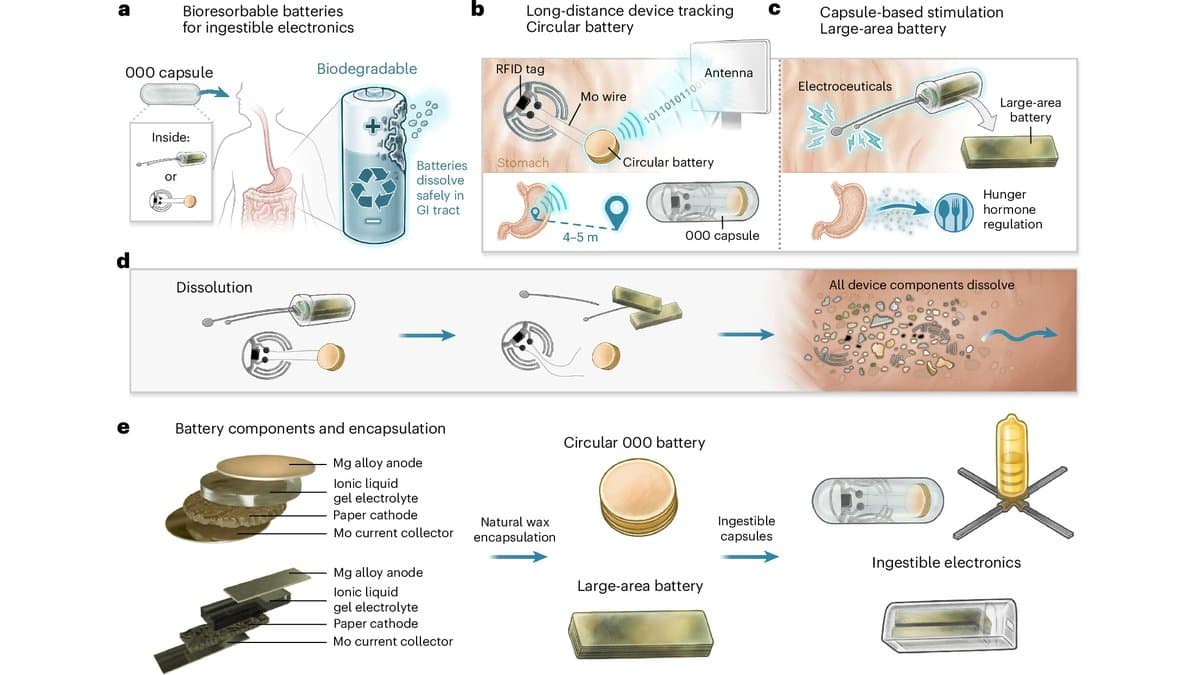
Researchers at MIT and Brigham and Women's Hospital have built a battery that powered two swallowable medical capsules inside living pigs and then dissolved in the animals' digestive tracts.
Pills that sense, track or treat from inside the body run on conventional batteries, which must be sealed away from tissue, leaving a device to be retrieved or passed whole. Writing in Nature Chemical Engineering, Mehmet Girayhan Say, Giovanni Traverso and colleagues describe a power source meant to be absorbed instead.
The cell pairs a magnesium alloy with molybdenum trioxide spread on a sheet of cellulose fibers, wrapped in beeswax. The team measured a peak open-circuit voltage of 1.84 V, taken with nothing drawing current, and put that above the zinc and silver oxide cells already sold for swallowable devices.
Two capsule systems ran on the battery in pigs. One was a radio tag that reports whether a patient has actually swallowed a pill, and it kept talking to an external reader once it was inside. The other delivered electrical stimulation to the stomach lining, a therapy for the stomach disorder gastroparesis that today needs electrodes implanted by surgery. The authors report that in three fasted pigs, 20 minutes of stimulation raised blood levels of the hunger hormone ghrelin by an average of 36.3%, and that biopsies of the stimulated tissue showed no damage.
In simulated stomach fluid, the electrodes dissolved within about two weeks, and the rest of the structure broke down over several months. Two parts do not dissolve: the radio tag's chip and the stimulator's circuit board. The authors say that board is not yet biodegradable. Both are expected to pass out of the body.
Sources

Medical Disclaimer: This content is provided for general informational and educational purposes only. It is not medical advice and should not be used as a substitute for professional medical advice, diagnosis, or treatment. Always consult a qualified healthcare professional regarding any medical condition or treatment decision.