A Human Cell Protein Slows Ebola Down, and the Virus Has Two Ways to Push It Aside

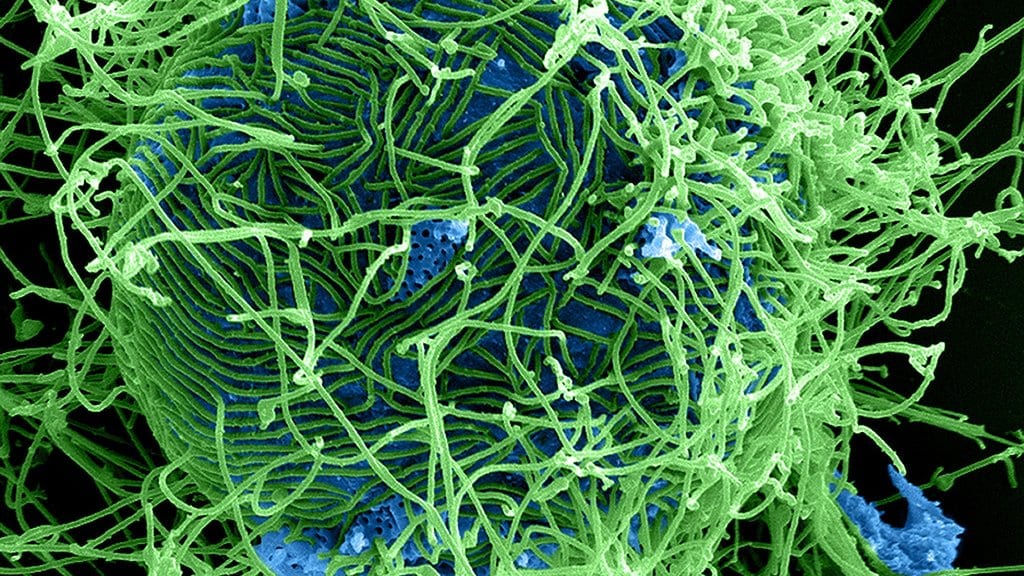
When a virus spends effort removing something from a cell, the thing it removes is usually worth having. That is the logic behind a screen run in Tübingen and published Nov. 4, 2026, in The EMBO Journal: make human cells produce the Ebola virus glycoprotein GP, the molecule that studs the virus surface and opens the door into a cell, then stain those cells with antibodies and watch which surface proteins stop answering.
Dan Hu, Elena Hagelauer and colleagues at University Hospital Tübingen report staining human cells with antibodies against 332 proteins of the outer cell membrane, one well at a time. Forty-six of them lost more than half their antibody signal, and three gained it. Twenty-one were taken forward, seven held up in a second human cell line, and three of those seven belonged to one small family of membrane proteins called tetraspanins: CD81, CD63 and CD9. Infection with authentic Ebola virus, done in the high-containment laboratory of the Friedrich-Loeffler-Institut, lowered all three on the surface of human kidney cells and lowered CD81 on macrophages drawn from eight blood donors. Measles virus, run as a control throughout the study, left them alone.
The same thing happened with the surface glycoproteins of Marburg, Sudan, Reston and Taï Forest virus, Ebola's relatives in the filovirus family. All are highly fatal in people, and Ebola virus disease itself kills 40% to 60% of those it infects, on figures the paper takes from WHO and two reviews. None of the glycoproteins borrowed from other virus families did anything to the three tetraspanins. The habit looks filoviral rather than viral.
The screen could only nominate a suspect
A flow cytometry reading measures whether an antibody can reach a protein, not whether the protein is still there. The paper says so: "reduced cell surface detection could be due to shielding of receptors or their removal and internalization." Showing that CD81 actually holds Ebola back took a separate set of experiments. The group deleted the CD81 gene with CRISPR in two human cell lines, one kidney and one liver, and the virus's matrix protein VP40 piled up. Putting CD81 back in graded amounts pushed those levels down again, step by step. Lentiviruses carrying Ebola's glycoprotein got into CD81-deleted cells more easily, while the same particles carrying a glycoprotein from a different virus did not. CD63 and CD9 turned out to be "largely dispensable" for Ebola replication here.
Almost all of that work used trVLPs, laboratory-made particles that reproduce the stages of the Ebola life cycle at ordinary safety levels without being infectious Ebola. Restriction, in the paper's own account, "was formally only demonstrated in the EBOV trVLP surrogate system of viral replication." The reason given is practical: GP and VP40 clear CD81 away so thoroughly that comparing authentic infection in normal and CD81-deleted cells is hard to interpret. Nor is the family picture uniform. A separate 2026 report describes CD9 as helping VP40 release particles, and the Tübingen group says that finding is not at odds with theirs.
The virus brings two tools to the same job
GP is not the only Ebola protein that lowers CD81. VP40, the matrix protein that assembles new particles at the cell membrane, did it too, less strongly. It lowered CD81 inside the cell as well as on the surface. Four proximity methods, one of them a split fluorescent protein that glows only when its two halves meet, placed GP and CD81 side by side. The paper's summary is that "the data supports a model in which GP directly interacts with CD81," with VP40 associating less efficiently. That is evidence of proximity, not a measurement of binding.
How the levels fall is the part the paper infers rather than shows. Blocking the two routes a cell uses to destroy its own proteins, the proteasome and the lysosome, "slightly blocked" the surface loss caused by GP and "partially restored" total CD81. Stripping sugar groups off the surface with an enzyme brought some antibody binding back, pointing to GP's sugar coat hiding CD81 as well. Yet a GP mutant missing its most heavily sugared domain was "slightly less efficient than WT GP" at pulling CD81 down, a result the paper calls unexpected. Neither GP nor VP40 changed how much CD81 messenger RNA the cell made, so the fall is not happening at the gene.
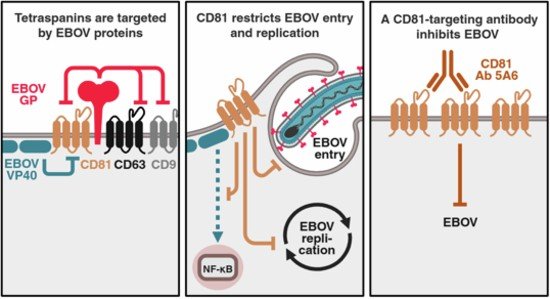
One thread runs further than the measurements, and the authors mark it. CD81's antiviral activity, the abstract says, "might be attributed to CD81-mediated suppression of NF-κB signaling," a master switch for inflammation. What was measured: VP40 switched that pathway on hard in kidney cells, and harder still when CD81 was gone. Adding CD81 back turned it down, while leaving an artificially switched-on version of the pathway untouched. What nobody measured is whether that suppression is why CD81 slows the virus. The upstream claim, that CD81 damps this pathway at all, is the same laboratory's earlier work. The VP40 half has outside support: a different group reported in PNAS on Dec. 29, 2025, that filovirus VP40 proteins switch the same pathway on through another receptor.
An antibody, two experiments, and no animal test
The last figure in the paper is the one most open to misreading. 5A6 is an existing research antibody that grabs the large outer loop of CD81 and clusters it. It was raised for cancer work, and its published mouse safety record comes from mice carrying human CD81 in cancer models. Pre-treating CD81-carrying kidney cells with 5A6 at 1 or 5 micrograms per milliliter cut infection by the stand-in particles, and by authentic Ebola virus in the same cell line, across two independent experiments run in duplicate. The controls are clean: a matched antibody of the same class did nothing, 5A6 did nothing in cells lacking CD81, and it did nothing to measles virus. It was not tried in macrophages, in any animal infected with Ebola, or in a person.
Which is why the forward claim in the paper stops where it does. It calls CD81 a "potentially druggable Ebola virus-inhibitory host factor," and the discussion goes no further than a finding that warrants further investigation. What the authors ask for next is mechanical rather than medical: systematic mutation of GP, VP40 and CD81 to find the pieces that matter. One loose end may be the most interesting. Deleting CD81 made kidney cells and macrophages from three donors swallow more of a fluid tracer, which puts CD81 somewhere in macropinocytosis, the bulk gulping that Ebola uses to get in. The paper's phrase for that is "a not-yet discovered role of CD81 in macropinocytosis."
Sources
Medical Disclaimer: This content is provided for general informational and educational purposes only. It is not medical advice and should not be used as a substitute for professional medical advice, diagnosis, or treatment. Always consult a qualified healthcare professional regarding any medical condition, concern, symptom, or treatment decision.