When a String of Force Snaps, the New Charges Appear at Its Ends
Physicists have watched a string of force snap into new charge pairs, moment by moment and site by site. Arinjoy De, Christopher Monroe and colleagues report that the pairs formed at the string's two ends and then spread inward, not evenly along its length.
The experiment, published on September 23 in Nature Physics, targets a process that resists calculation. In the theory of the strong force, a quark and an antiquark cannot be separated: the energy between them rises with distance until there is enough to make a fresh pair, and the string breaks. The authors write that this string fragmentation is thought to govern how quarks bundle into protons and neutrons in heavy-ion collisions and in the cooling universe after the Big Bang. By their account, classical methods handle the static case well but the moving string badly.
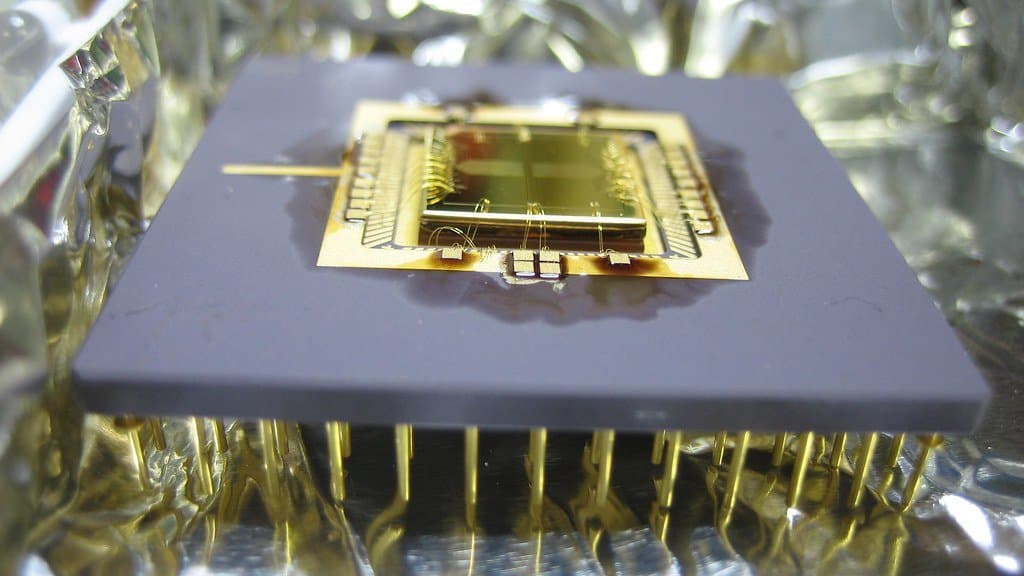
The device is an analogue trapped-ion quantum simulator, a system rigged to imitate another, not to compute it. The authors say a simulator for the strong force itself is beyond any current machine, so theirs runs a stripped-down one-dimensional lattice gauge theory instead. Thirteen spins, each encoded in a ytterbium ion, behave mathematically like a chain of interacting magnets. Laser beams focused on each ion separately let the team hold fixed charges at the chain's ends and raise the string's tension abruptly.
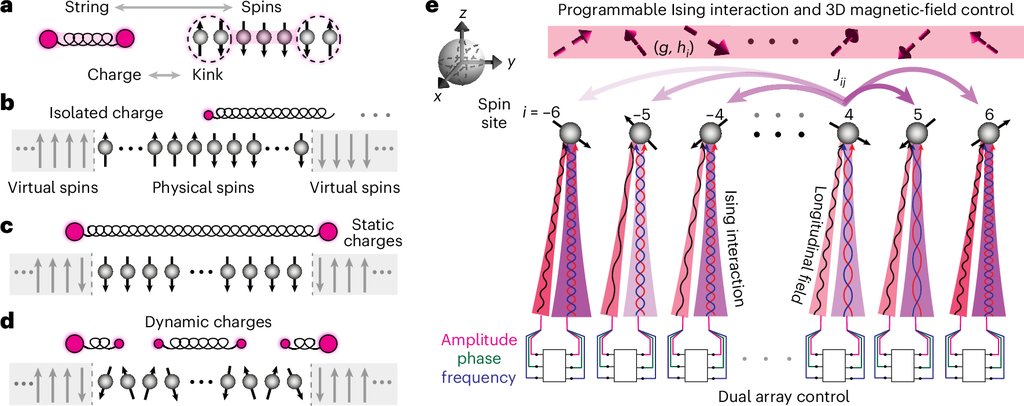
The paper reports that a single charge spread freely along the chain with no string tension, and stopped spreading and oscillated in place as the tension rose. With a string held between two fixed charges, pairs appeared at the edges, oscillating there at weak tension and moving inward at stronger tension.
The conventional account of string breaking, attributed to Schwinger, has pairs appearing uniformly through the bulk at a rate very sensitive to the settings. The authors report that the timing at the edges barely changed across the tension and coupling values they tried, and they name what they saw an edge-facilitated mechanism, distinct from Schwinger's and matched by their own numerical simulations.
The authors write that the approach could carry over to neutral-atom arrays.
Sources
- Nature PhysicsPeer-reviewed