DNA Switches Designed by AI Worked in Mouse Embryos, All 15 Times
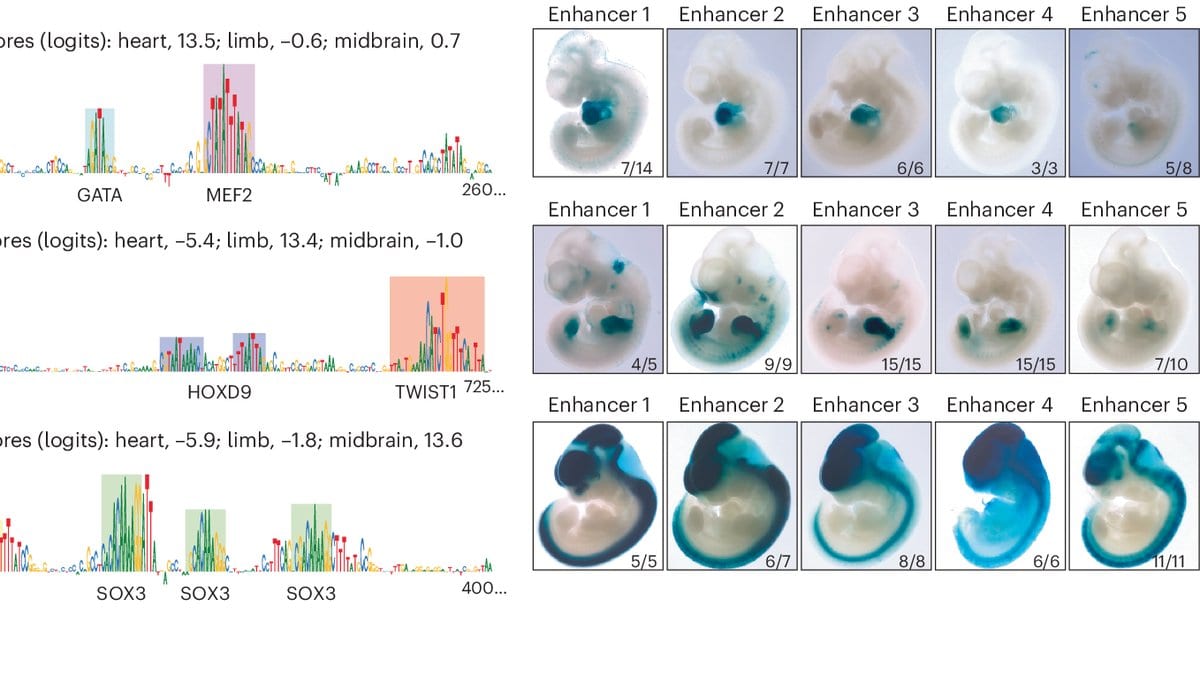
All 15 DNA sequences that researchers designed with neural networks switched a gene on in the tissue they were meant for when tested in mouse embryos, according to a paper published Aug. 25 in Nature Genetics.
The sequences are enhancers, short stretches of DNA that turn nearby genes on in particular tissues. The team trained small neural networks on data showing which parts of the genome are physically open in the heart, limb and midbrain of mouse embryos, then retrained them on enhancers already confirmed in humans and mice. Between 311 and 432 confirmed enhancers per tissue were available for that step. A sequence-design program called Ledidi then wrote candidate enhancers 1,001 base pairs long.
Five candidates each for heart, limb and central nervous system were put into mouse embryos on a reporter that stains active tissue. All 15 were reproducibly active in their target tissue, meaning at least three embryos showed a signal, the threshold the paper says it adopted from the VISTA enhancer database. Specificity varied: four of five heart designs and four of five nervous-system designs acted only in the intended tissue, while all five limb designs also showed weaker activity in other connective tissue.
On sequences held out of training, the models' positive predictive value reached 70.6% or higher, the authors report; models trained only on the openness data, or only on the confirmed enhancers, scored 20.9% to 52.1%. None of the 15 designed sequences resembled anything in the mouse or human genome.
Targeting a smaller brain region worked less well. Of two sequences designed for the midbrain, one was inactive and the other gave an uninterpretable result because of a duplication in the reporter, the paper says.
The authors write that the work "establishes a generalizable framework for programmable control of mammalian gene expression in vivo, opening new avenues in functional genomics, synthetic biology and gene therapy."
The Letter is open access. Its senior authors are Evgeny Z. Kvon at the University of California, Irvine, and Alexander Stark at the Research Institute of Molecular Pathology in Vienna.
Sources
- www.nature.comPeer-reviewed