Bat Genomes Suggest Long Life and Virus Defense Are Connected
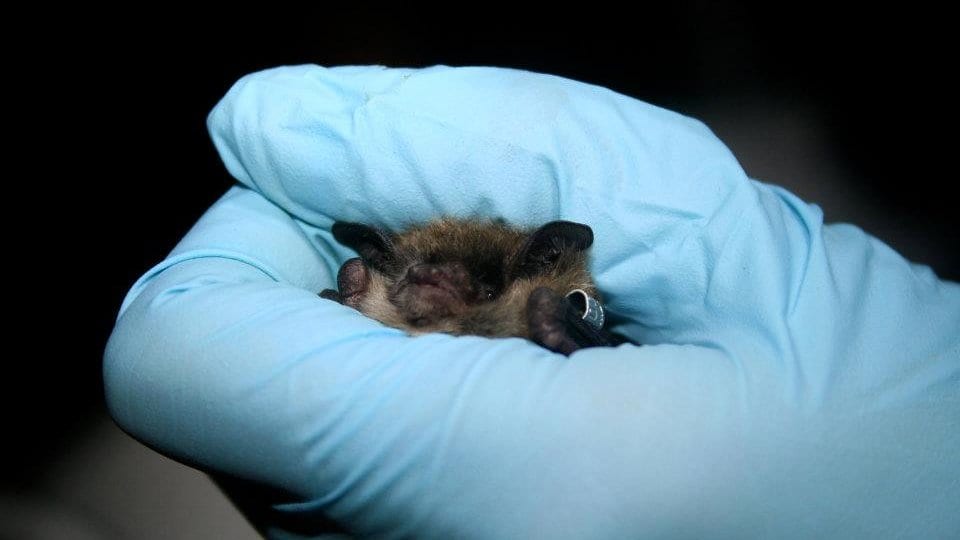
Researchers have assembled near-complete genomes for eight closely related species of Myotis bats and report that the group adapts to DNA viruses and to RNA viruses in two different ways, in a paper published Aug. 26 in Nature.
The open-access study (doi 10.1038/s41586-026-10932-7) lists Juan M. Vazquez of the University of California, Berkeley and M. Elise Lauterbur of the University of Arizona as equal first authors, with co-authors at laboratories in the United States and France. The team also derived primary cell lines from the bats for laboratory tests.
In genome-wide screens, the authors report "genome-wide over-representation of positive selection for DNA-virus-interacting proteins and elevated rates of copy-number variation for RNA-virus-interacting proteins," a split they describe as differing from "all other mammals."
Lifespans within the genus vary about sixfold, the paper reports, citing earlier work: 42 years in Myotis brandtii against seven years in Myotis nigricans, species it says diverged roughly 10.6 million years ago. That repeated evolution of long life "is associated with positive selection in cancer pathways," the authors write, and primary cells from the long-lived Myotis lucifugus showed a distinctive response to DNA damage. Their own conclusion is stated as a suggestion: the results "suggest that bats' remarkable longevity and immunity are linked through pleiotropic adaptations to viruses and ageing-related disease."
The team also resolved duplications of EIF2AK2, an immune gene better known as PKR, whose protein shuts down protein production in an infected cell. Seven of the nine Myotis species examined carried a duplicated version, the paper reports, and a form with three tandem copies was found only in Myotis californicus. The duplicated and single-copy versions "have probably been segregating for tens of millions of years," the authors write.
The assemblies place an average of 98.6% of nucleotides, ranging from 98.1% to 99%, onto 22 to 23 chromosome-scale scaffolds, with an average of 20,869 protein-coding genes per genome, according to the paper. Across the eight, every autosome is assembled end to end in at least one species.
Sources
- NaturePeer-reviewed