Vertigo and Depression Appear in Records Years Before Early Alzheimer's

People later diagnosed with early-onset Alzheimer's disease, the form that begins before old age, had been treated more often for vertigo, depression and several other conditions in the one to five years before diagnosis than people of the same age and sex who were not diagnosed, researchers in Finland report. High blood pressure and high cholesterol, which the study also counted, showed no difference between the groups.
The authors conclude that early-onset Alzheimer's is preceded by recognizable patterns of illness and increased use of health services, and that this may support earlier detection. Their comparison counts diagnoses already written into medical records: it does not show that any of these conditions leads to Alzheimer's, and it cannot tell an individual patient anything about their own risk.
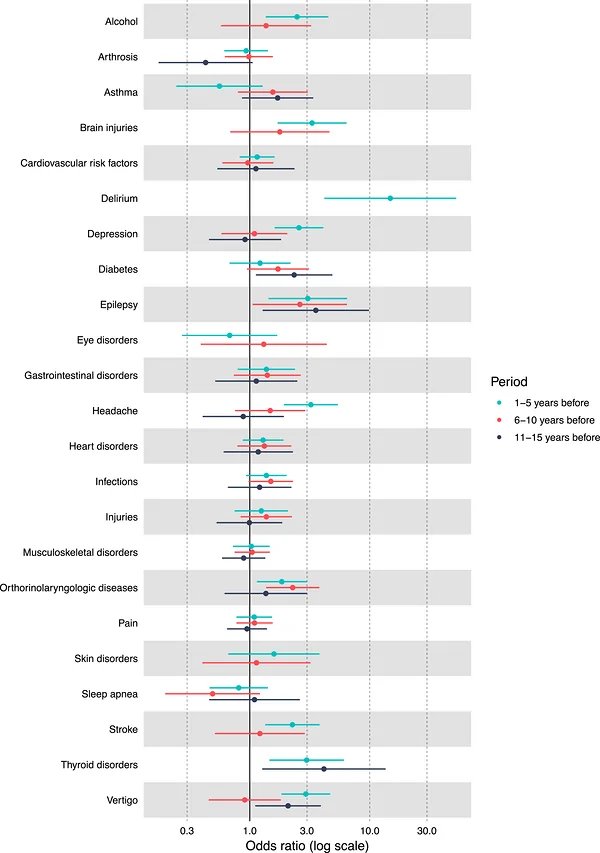
The study was published on Oct. 8, 2026, in Alzheimer's & Dementia. Laura Leppänen, Johanna Krüger and colleagues at the University of Oulu and the University of Eastern Finland compared 407 patients diagnosed with early-onset Alzheimer's at two Finnish university hospitals between 2010 and 2021 against 4,035 controls matched for age and sex, then read back through Finland's nationwide health registers for the 15 years before diagnosis. In the one to five years before diagnosis, vertigo had been recorded for 5.9% of patients against 2.1% of controls, and depression for 5.7% against 2.3%. Headache, delirium, head injuries, thyroid disorders, alcohol-related disorders, epilepsy, stroke and ear, nose and throat conditions were also more common in the same window.
The differences do not reach much further back. Only ear, nose and throat conditions still separated the two groups six to 10 years before diagnosis, and no condition separated them 11 to 15 years before.
Sources
- Alzheimer's & DementiaPeer-reviewed

Medical Disclaimer: This content is provided for general informational and educational purposes only. It is not medical advice and should not be used as a substitute for professional medical advice, diagnosis, or treatment. Always consult a qualified healthcare professional regarding any medical condition, concern, symptom, or treatment decision.