X-Rays Show What Moves First in a Light-Driven Molecule
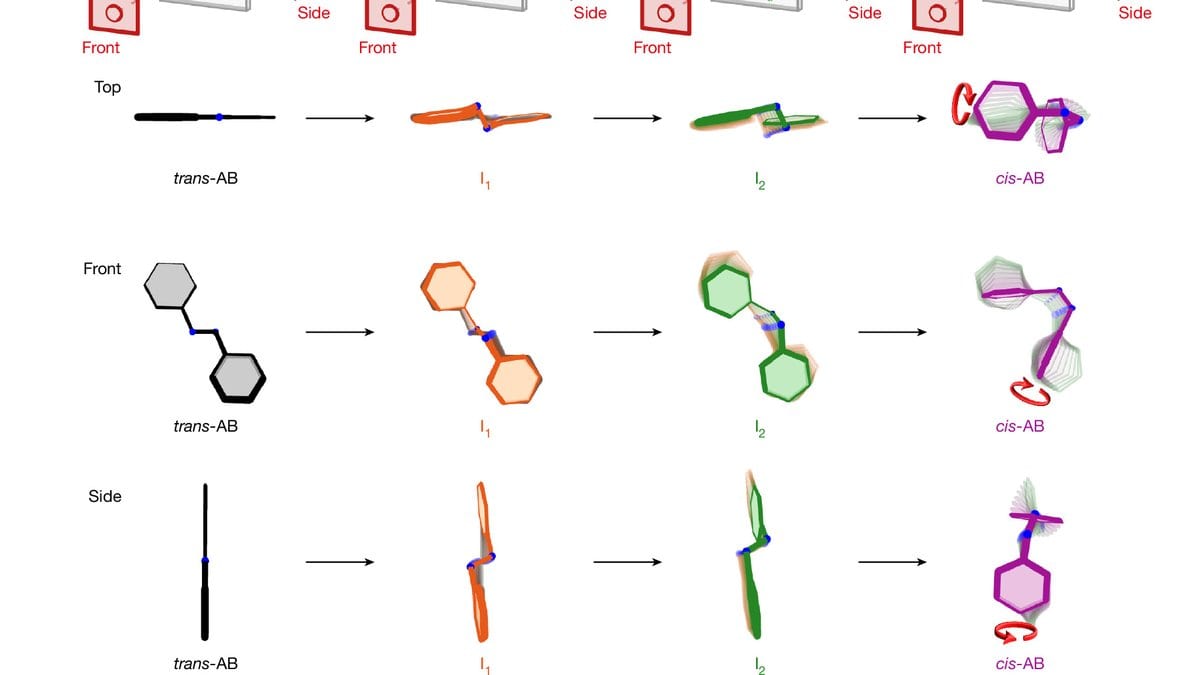
When light bends azobenzene from its straight shape into its kinked one, the molecule's first move is a twist about the two carbon-nitrogen bonds that attach its rings to the bridge at its center. Rotation about the nitrogen-nitrogen bridge itself takes over only afterward. A group at the Korea Advanced Institute of Science and Technology (KAIST) and the Institute for Basic Science in Daejeon, Republic of Korea, reported the sequence in Nature on Sept. 30, 2026.
The Nature paper recovered the structures of the two short-lived forms the molecule passes through on the way, and the authors present it as two results at once: a mechanism for a reaction that theory has disagreed over for decades, and evidence that their technique now reaches molecules it could not before.
Azobenzene is two rings joined by a pair of nitrogen atoms, and the paper calls it a textbook case of the trans-to-cis change. The authors list the earlier proposals as rotation, a bending motion called inversion, a concerted hula twist and a mixture of bending and rotation, with no consensus reached because nobody had direct structural evidence. The twist the X-ray data point to had received little attention in that literature.
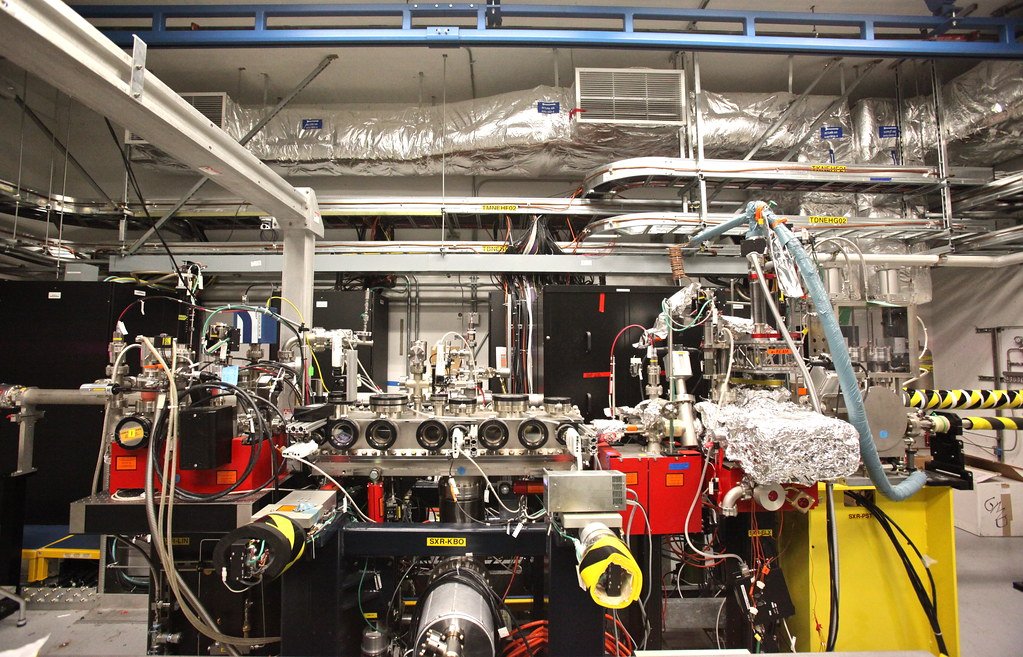
X-ray liquidography reads molecular shapes from the way X-ray pulses scatter off molecules dissolved in a liquid. The solvent's own scattering normally swamps the signal from molecules that contain no heavy atoms, and azobenzene is built from carbon, nitrogen and hydrogen alone. The authors say the measurement establishes the method for solutes of that kind.
The structures also bear on an old puzzle about how little room the change needs: the authors describe the pathway as volume-conserving, rearranging the molecule without pushing much solvent aside. They add that more complex motions cannot be ruled out.
Sources
- NaturePeer-reviewed