Skip to content
See the World Through ScienceA project of ALLATRA
Source: Peer-reviewedNature1 source

Microbes Closest to Complex Life Were Filmed Crawling
Science

Republish this story

Our work is licensed under Creative Commons BY-NC 4.0. You may republish this piece for free — with credit to ALLATRA Media and a link to the original, unedited beyond length trims, and not for commercial use.

Read the full license

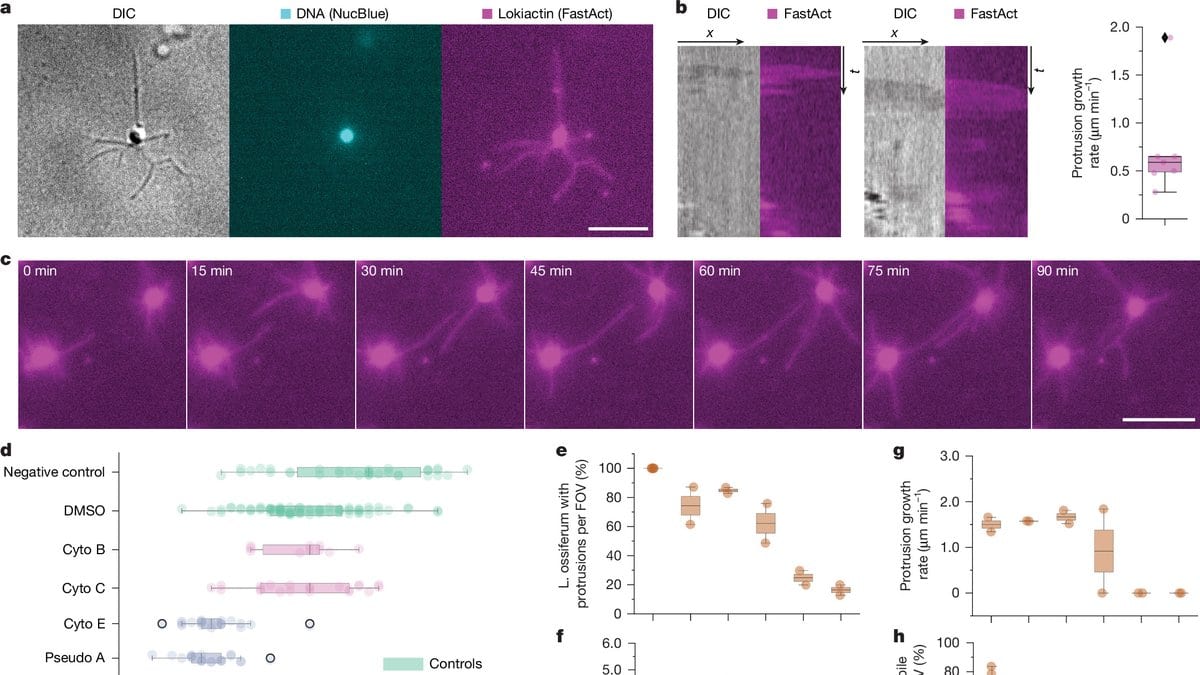
Microscopy panels of a star-shaped archaeal cell with several thin arms, in grayscale, cyan and magenta channels, above a time series of the same cell in magenta.
Live cells of Lokiarchaeum ossiferum, with DNA stained cyan and the actin protein Lokiactin magenta; the lower strip follows one cell for 90 minutes (top panels, a to c, of Figure 3).Fig. 3 from Philipp Radler, Tobias Viehboeck, Zhen-Hao Luo, Nevena Maslać, Katharina Schmidt, Robert Hauschild, Masaru K. Nobu, Silvia Bulgheresi, Theresia E. B. Stradal, Klemens Rottner, Hiroyuki Imachi, Michael Sixt, Christa Schleper (2026), "Dynamic protrusions mediate crawling motility in Asgard archaea", Nature. CC BY 4.0

Researchers have filmed living Asgard archaea, single-celled microbes without a nucleus that are considered the closest known relatives of complex cells, crawling across a glass surface. The work was published in Nature on September 30, 2026.

Crawling is a defining behavior of complex cells, the kind with a nucleus that makes up animals, plants and fungi. The authors describe the shape changes and movement they recorded as unique among microbes that lack one.

Philipp Radler, Christa Schleper and colleagues at the University of Vienna used live-cell microscopy on two cultivated Asgard lineages, Lokiarchaea and Hodarchaea. Both changed shape markedly within minutes, growing and pulling back long, thin arms at 1.5 to 4.8 micrometers per minute. Once a cell had stuck to the glass, it used those arms to haul itself along. Adding selected inhibitors of actin, the protein that builds the internal scaffolding of complex cells, stopped the movement. The authors say that points to a central role for actin.
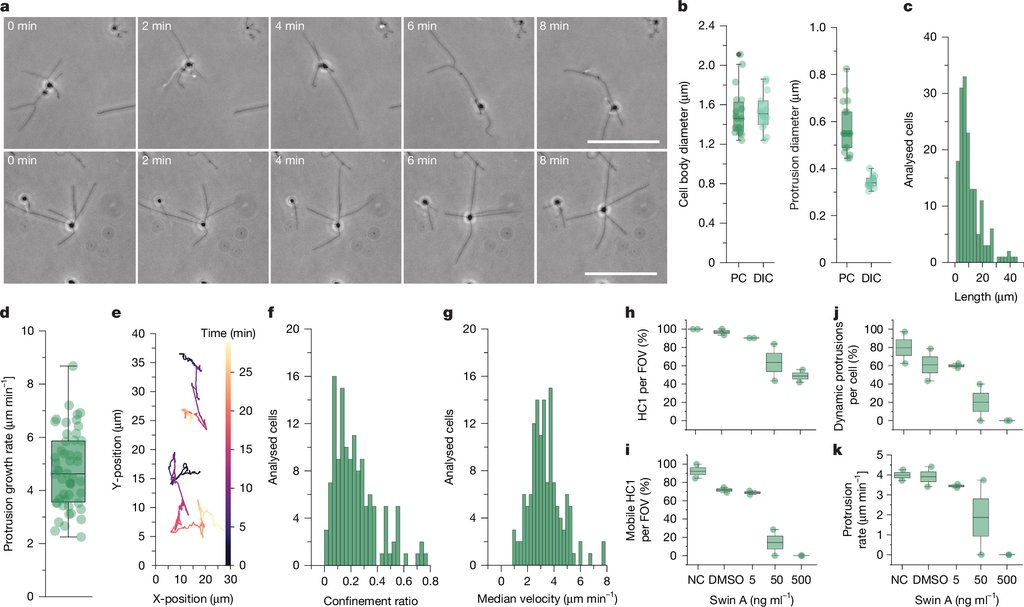
Two rows of time-lapse microscope frames of archaeal cells moving over glass, with box plots and charts of cell size, speed and response to a drug below.
M. peptidophilum, the second species filmed, rearranges its arms and travels over the glass; the charts below measure its cells and the effect of an actin inhibitor (Figure 4). — Fig. 4 from Philipp Radler, Tobias Viehboeck, Zhen-Hao Luo, Nevena Maslać, Katharina Schmidt, Robert Hauschild, Masaru K. Nobu, Silvia Bulgheresi, Theresia E. B. Stradal, Klemens Rottner, Hiroyuki Imachi, Michael Sixt, Christa Schleper (2026), "Dynamic protrusions mediate crawling motility in Asgard archaea", Nature — CC BY 4.0

The handful of Asgard archaea that can be grown in culture have an unusual shape, a central cell body with several arms extending from it, each filled with scaffolding built from actin.

The authors propose the trait may have mattered for the origin of the first complex cells, which are thought to have formed when an Asgard archaeon and a bacterium came together, the bacterium becoming the mitochondria.

Sources

Spot an error?

Spot an error?

Report an error

Spotted a mistake on this page? Tell us what's wrong and our editors will take a look.

What kind of problem?

Only if you'd like us to be able to follow up. We won't use it for anything else.

We correct mistakes openly. Select any text to flag it. Fixes are logged under our Corrections Policy.

Report an error

Reporting on

Microbes Closest to Complex Life Were Filmed Crawling

What kind of problem?

Only if you'd like us to be able to follow up. We won't use it for anything else.

We read every report. Corrections are logged publicly.