Skip to content
See the World Through ScienceA project of ALLATRA
Source: Peer-reviewedNature1 source

Antimatter Went for a Truck Ride Across CERN and Came Back Intact
Science

Republish this story

Our work is licensed under Creative Commons BY-NC 4.0. You may republish this piece for free — with credit to ALLATRA Media and a link to the original, unedited beyond length trims, and not for commercial use.

Read the full license

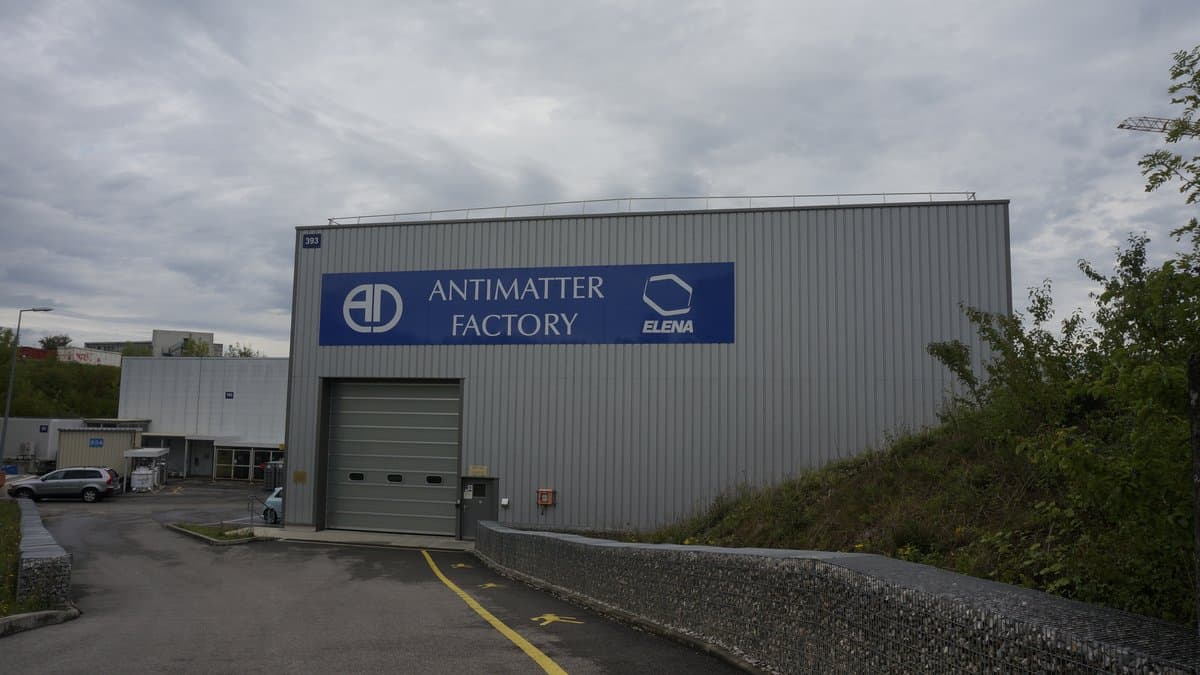
The CERN Antimatter Factory, a gray metal hall with a large blue sign reading ANTIMATTER FACTORY and ELENA above a roll-up vehicle door, with a paved access road running up to it.
CERN's Antimatter Factory on the Meyrin site, the building the trapped antiprotons were driven out of."CERN Antimatter factory building" by Suaudeau, via wikimedia, CC-BY-SA-4.0 · CC-BY-SA-4.0

The BASE collaboration has driven 92 trapped antiprotons out of CERN's Antimatter Factory by truck and brought them back without losing one. Antiprotons are the antimatter twins of protons, and the Antimatter Factory has been the only place they could be studied at rest.

The reason to move them is magnetic noise. Fields inside the facility fluctuate while it runs, and that fluctuation sets the limit on how precisely the group can compare protons with antiprotons, the team reports in Nature, in a paper published Sept. 16, 2026. Taking antiprotons to a quiet laboratory somewhere else is a strategy the authors expect to allow at least 100-fold better tests of the symmetry between matter and antimatter.

For the journey, the particles sat in BASE-STEP, a transportable Penning trap, which holds charged particles with a magnetic field and a set of voltages.
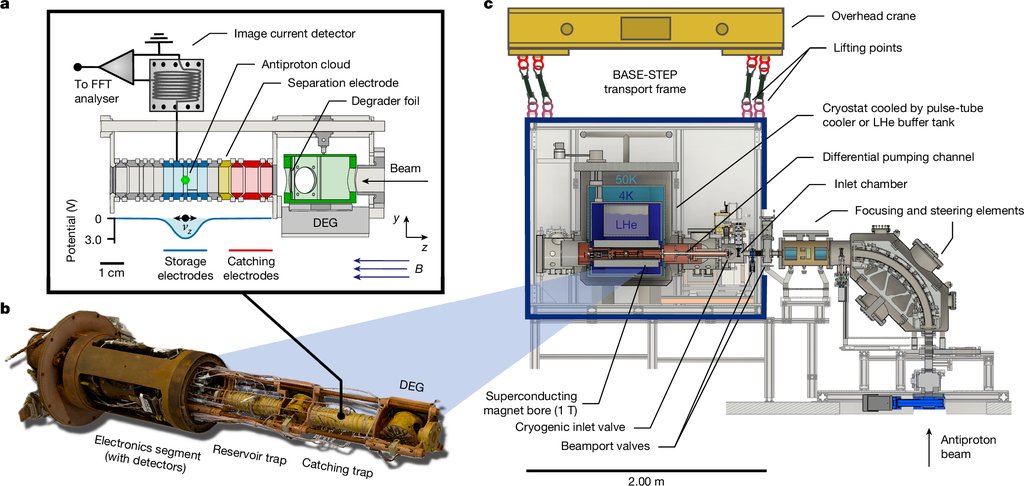
A three-panel technical drawing of the BASE-STEP apparatus: the catching and storage electrodes, the cryogenic inset inside the magnet bore, and the injection beamline feeding the transport frame.
The BASE-STEP apparatus. Panel a shows the catching and storage electrodes that hold the antiproton reservoir, panel b the cryogenic inset inside the 1-tesla magnet bore, and panel c the injection beamline that feeds the transport frame. — Fig. 1 from M. Leonhardt, J. Morgner, F. Abbass, K. K. Anjum, B. Arndt, R. P. Czampiel, N. Daehnhardt, S. Endoh, T. Imamura, J. I. Jäger, L. Kürschner, B. M. Latacz, P. Micke, D. Natakala, R. Rahner, D. Schweitzer, S. Stahl, F. Völksen, H. Yildiz, K. Blaum, J. A. Devlin, Y. Matsuda, C. Ospelkaus, W. Quint, A. Soter, J. Walz, Y. Yamazaki, S. Ulmer, C. Smorra (2026), "Road transport of trapped antiprotons", Nature — CC BY 4.0, resized

A crane lifted its frame onto a medium-duty truck, and once the trap was unplugged, batteries and a tank of liquid helium kept it powered and cold. It covered 7.5 kilometers in 24 minutes in ordinary traffic across CERN's Meyrin site, and a reading taken every minute tracked the antiprotons the whole way. The paper reports no particle loss and no measurable change in the trap's vacuum.

Electrons and protons had been moved this way before, in two earlier studies, but whether the extreme vacuum antiprotons need would survive a trip was untested. This batch stayed in the trap for 33 days in all, and the one antiproton that was lost went during voltage ramps used to split the cloud and merge it back, not on the road.

The authors call the transport the starting point for "a new era of antiproton precision measurements." They plan to move antiprotons next into receiver traps at CERN and at Heinrich Heine University in Düsseldorf, Germany.

Sources

Spot an error?

Spot an error?

Report an error

Spotted a mistake on this page? Tell us what's wrong and our editors will take a look.

What kind of problem?

Only if you'd like us to be able to follow up. We won't use it for anything else.

We correct mistakes openly. Select any text to flag it. Fixes are logged under our Corrections Policy.

Report an error

Reporting on

Antimatter Went for a Truck Ride Across CERN and Came Back Intact

What kind of problem?

Only if you'd like us to be able to follow up. We won't use it for anything else.

We read every report. Corrections are logged publicly.