Thirsty Air Is Catching up With Dry Soil as a Limit on Plant Growth
Soil moisture still sets the limit on plant growth across most of the world's vegetated land, but the dryness of the air above it is catching up. A study published Oct. 28, 2026, in Nature Geoscience reports that across the satellite record from 1982 to 2022, the influence of atmospheric dryness on year-to-year swings in vegetation has strengthened while the influence of water in the soil has weakened.
Atmospheric dryness here means vapor pressure deficit, a measure of how strongly the air pulls water out of leaves. The authors say the shift matters for projections of the land carbon and water cycles, and for the way Earth system models represent how vegetation responds to water.
Lingcheng Li and senior author Nate McDowell, both at Pacific Northwest National Laboratory, and their colleagues fed satellite greenness readings and gridded weather records into a separate machine-learning model for each cell of a global grid, then applied an explainable-AI step that splits a model's output among its inputs. Soil moisture came out as the stronger control over 57.2% of vegetated land and atmospheric dryness over the rest. Splitting the record in two, the team found the importance of atmospheric dryness had risen across 62.0% of vegetated land while soil moisture's had fallen across 55.8%.
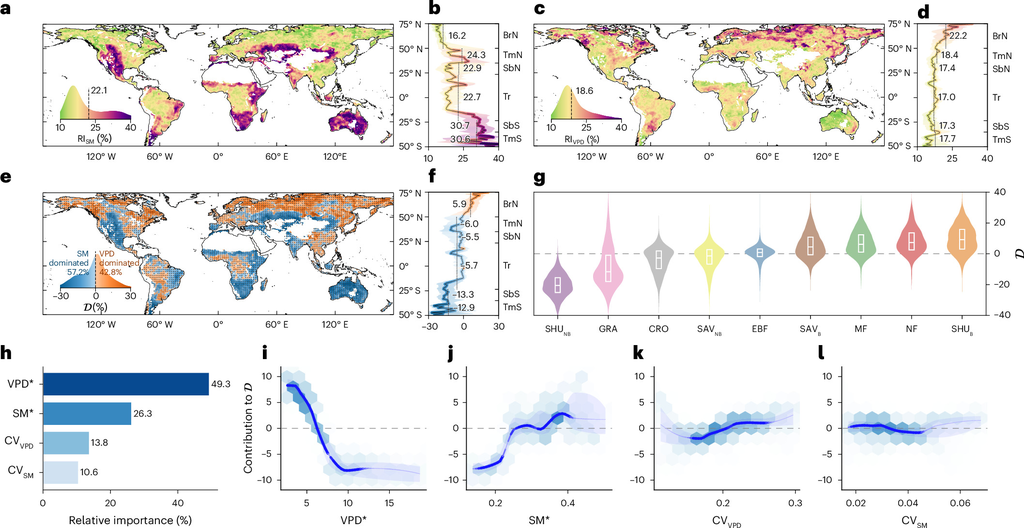
The movement runs mostly one way. Of the land where soil moisture had been dominant, about two thirds shifted toward atmospheric control, including the US Great Plains, the Sahel, northern China and Australia. Where the air already dominated, the shift was close to evenly split in both directions. Most of the climate reference regions used by the IPCC showed strengthening atmospheric control.
Continued warming will probably intensify the pattern, as rising vapor pressure deficit and more frequent extreme events strengthen atmospheric constraints on vegetation. The researchers' code and processed data are posted on Zenodo.
Sources
- Nature GeosciencePeer-reviewed