Watering US Crops Prevents More Emissions Than It Causes, Study Estimates
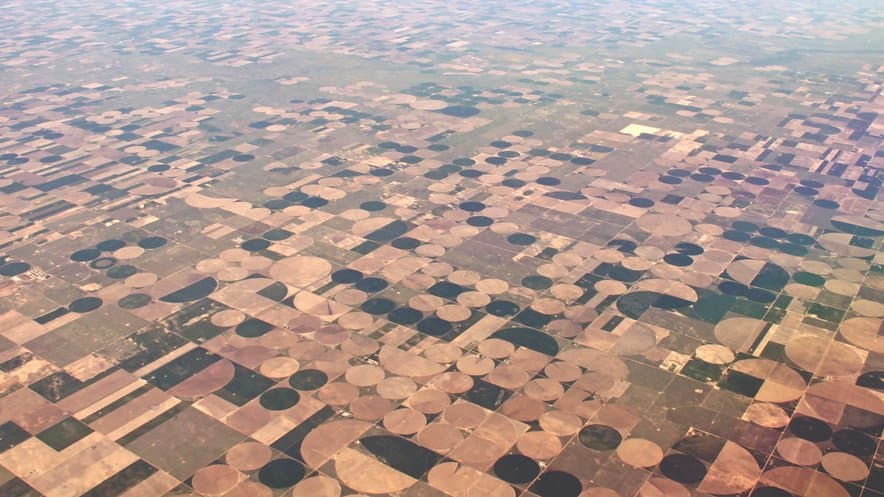
Irrigation on US farmland keeps far more greenhouse gas out of the atmosphere than it puts in, a study published Sept. 14 in the Proceedings of the National Academy of Sciences estimates, because the extra yield means less land has to be cleared for crops elsewhere in the world.
Farm emissions are normally counted on the farm. Avery W. Driscoll of Colorado State University and colleagues write in the study that direct emissions and the land clearing that higher yields avoid have to be counted together before a farming practice can be judged. Land use and conversion for agriculture account for nearly a quarter of global greenhouse gas emissions.
Irrigation raises US crop production by 3% to 39%, depending on the crop, and earns growers at least $31.9 billion in additional revenue, the authors estimate.
They then ran those productivity gains through a global economic model that tracks land use place by place. It projects that without the irrigated harvest, 32 million hectares of forest and a further area of other natural vegetation would have been converted to grassland and cropland worldwide. On that basis the paper puts the gross benefit of US irrigation at 6.86 gigatons of carbon dioxide equivalent a year, against 0.019 gigatons of direct emissions from irrigation itself.
That larger figure is a model projection, not a measurement: it is the quantity the model calculates would have been released had the same harvest come from more land.
Driscoll's senior co-author, Nathaniel D. Mueller, is also at Colorado State University; the others are at the University of Minnesota, the USDA Forest Service's Rocky Mountain Research Station, the University of Maine and The Nature Conservancy. The National Science Foundation and the US Department of Agriculture funded the work, which is free to read under a Creative Commons license.
Sources
- Proceedings of the National Academy of SciencesPeer-reviewed
